
Spend half a day as a Tianjin craftsman: A hands-on lesson in intangible cultural heritage, from the Imperial Flower Fair to New Year picture rubbing.
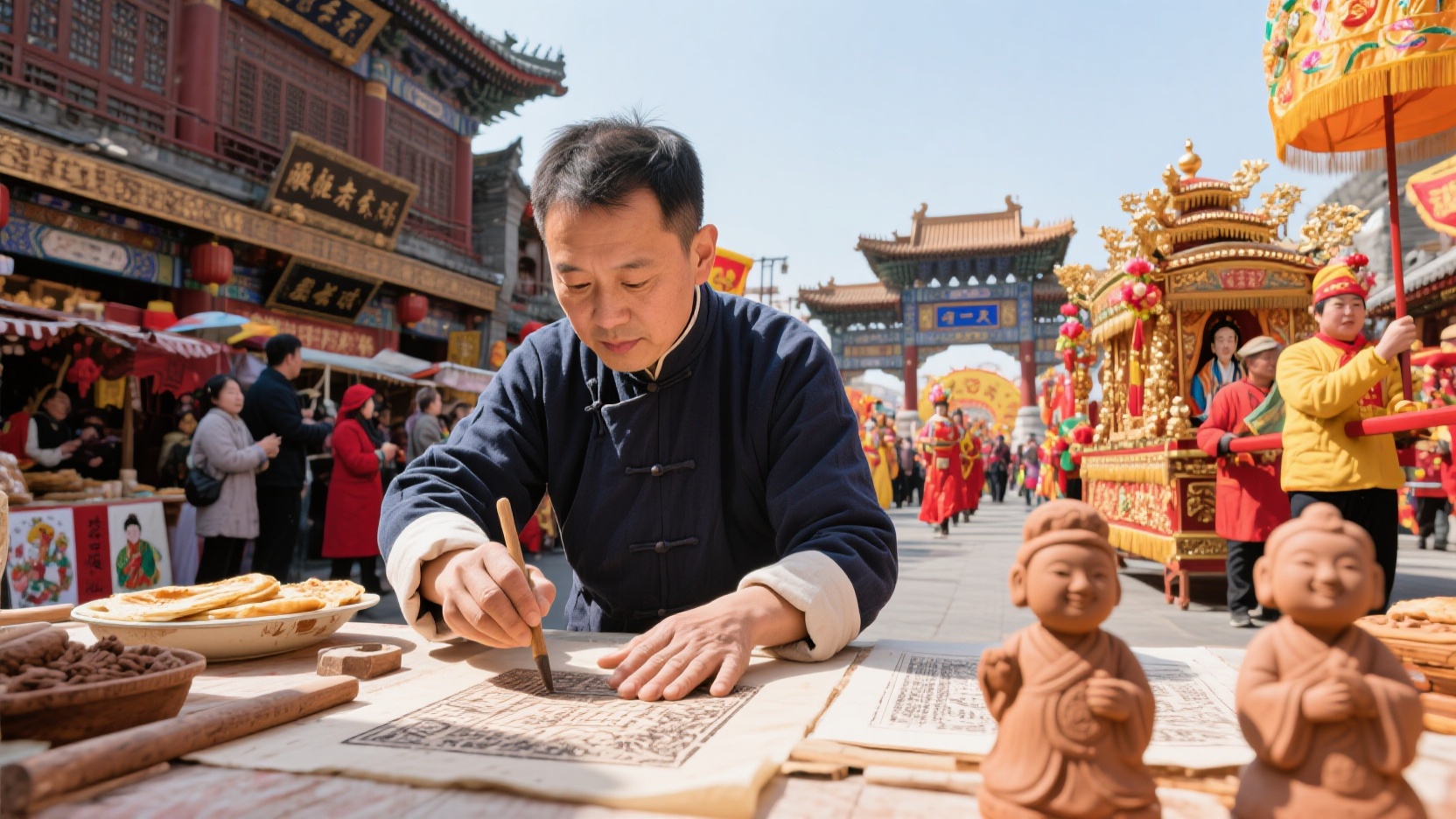
Tianjin's intangible cultural heritage isn't displayed in showcases, but rather found at the Tianhou Temple in the third month of the lunar calendar, in the Yangliuqing workshops before the Spring Festival, in Gegu Town on the sixteenth day of the first lunar month, and at the stalls on the Ancient Culture Street. To truly immerse yourself in Tianjin's folk customs, set aside at least half a day, not just to observe, but also to sit down and participate or stroll along with the flower fairs. The following text breaks down these participatory experiences along four lines: "Festivals—Crafts—Markets—Ceremony Processions."
Tianjin Huanghui: The Mazu Parade and Flower Fair on the 23rd Day of the Third Lunar Month
The Tianjin Imperial Fair, centered around the Tianhou Palace, is held annually around the 23rd day of the third lunar month, the birthday of Mazu. It serves as the most concentrated window into Tianjin's folk beliefs and folk performances. If you miss the main day, around the 20th of the third lunar month, various local associations will already be "parading" in front of the palace, allowing you to see their unmade-up rehearsals. Before the fair, each association holds a "worship" ceremony in the square in front of the palace, followed by processions of drummers, stilt walkers, flag bearers, lion dancers, and other performers parading along the streets. Visitors can arrive early to secure a good spot around the Tianhou Palace, focusing on the stilt walkers' costumes and impromptu songs, and listening to the rhythmic changes during the drummers' "drum battles." They can also follow the processions for a while, noting the etiquette of "welcoming" between the different associations—when two associations meet, their leaders exchange name cards and bow to each other—a more insightful aspect than the performances themselves. The Imperial Fair was originally called the "Niangniang Fair" but was renamed the "Imperial Fair" after being praised by the Qing Dynasty court. It was not an officially organized festival, but a sacrificial system spontaneously maintained by dock merchants, porters, and community residents, which best reflects Tianjin's urban character of "prospering because of the Grand Canal".
Yangliuqing woodblock New Year pictures: A "door god" is completed through outlining and engraving.
Yangliuqing woodblock New Year paintings can be experienced year-round, but the workshops are busiest and the festive atmosphere is strongest from the twelfth lunar month to the Spring Festival. Upon entering a painting workshop in Yangliuqing Ancient Town, you'll first see the line drawings "outlined" on the workbench, then experience "woodblock printing": applying ink, laying out paper, and evenly printing with a stencil. Even a slight misalignment will result in double lines. The printing order is usually ink lines first, followed by yellow, blue, green, and red color blocks. A complex New Year painting requires five or six layers or more; participants typically only need to complete the ink lines or two colors. After printing the ink lines, the New Year painting undergoes a "half-print, half-painting" process, where the artist manually paints and colors the faces. This is the key difference between Yangliuqing New Year paintings and those from other production areas. Participants can complete a monochrome door god or a "Lotus and Fish" ink line drawing, print it themselves, and take it home. Yangliuqing New Year paintings originated in the late Ming Dynasty and reached their peak in the mid-Qing Dynasty. Because of their meticulous facial details and expressive features, they are often compared to Suzhou's Taohuawu, known as "Southern Peach Blossom and Northern Willow." In the past, Tianjin families would put up "fish in a vat" decorations, which served both as a form of decoration and as a way to wish for "abundance year after year".
Ancient Culture Street Intangible Cultural Heritage Market: Sit down at the stalls of Clay Figure Zhang and Kite Wei
The intangible cultural heritage market on the Ancient Culture Street is most concentrated during the Spring Festival, Lantern Festival, May Day, and National Day holidays, with permanent stalls also available on other days. At the Clay Figure Zhang stall, you can usually see the artist sculpting on the spot, the clay taking on the outline of a figure in minutes between his fingers—a skill inherited from the "sleeve-based figure-making" technique of the Daoguang era. Visitors can buy unfinished pieces to try coloring, or sculpt simple items under guidance, focusing on understanding the sculpting sequence of "inside before outside, head before body." Next door, Kite Wei emphasizes bamboo frame construction and painting; his kites are detachable and foldable, and have won awards at domestic and international expositions for their exquisite craftsmanship. Before sitting down to try it yourself, it's worth observing the artist's material handling process: for clay figures, the head is sculpted first, then the body; for kites, the frame is built first, then the paper is pasted on, and finally, the "eyes" are painted. Around the Spring Festival, the paper-cutting stalls at the market are also worth trying; the "fat pig arching the door" and "hanging money" cut from red paper are indispensable elements of Tianjin's New Year customs. Behind these stalls lies the tradition of "Gongqianji" in Tianjin, a port city for grain transport. Craftsmen have long faced merchants from all over the country, forming a market culture of "on-site production and immediate sale".
Gegu Baolian Festival: Folk Procession and "Running the Carriage" Ceremony on the Sixteenth Day of the First Lunar Month
The Ge Gu Baolian Festival, held on the sixteenth day of the first lunar month, is a large-scale folk ceremonial event rarely seen in North China, taking place in Ge Gu Town, Jinnan District. Some of the local folk troupes begin setting up their displays on the evening of the fifteenth, with the main procession taking place on the morning of the sixteenth, culminating in the "Rainbow Procession" in the afternoon. Multiple palanquins, sedan chairs, and folk troupe processions parade along the streets. The most spectacular part is the "Rainbow Procession": dozens of men carry the sedan chairs on their shoulders, walking briskly to the accompaniment of suona horns and drums, the curtains on the chairs billowing – a truly impactful scene. Visitors should watch from a safe distance on the street, paying close attention to the decorations of each palanquin, the rules of conduct between the folk troupes, and how the crowd spontaneously maintains order after the procession ends. Although the palanquins are modeled after imperial processions, they are funded and maintained by the local community, and the various folk troupes are organized by "associations," demonstrating a clear generational tradition. The Gegu Baolian Festival, centered on the worship of Mazu and incorporating memories of canal transport, salt industry, and immigrants, has been listed as a national intangible cultural heritage. It is not included in the ticketed area of the scenic spot and is the true "main event" for locals during the first month of the lunar calendar.