
Living half-Japanese in Suzhou | From Yashenxian to Winter Solstice Wine, Tiger Hill Folk Music Festival and Peach Blossom Village New Year Paintings
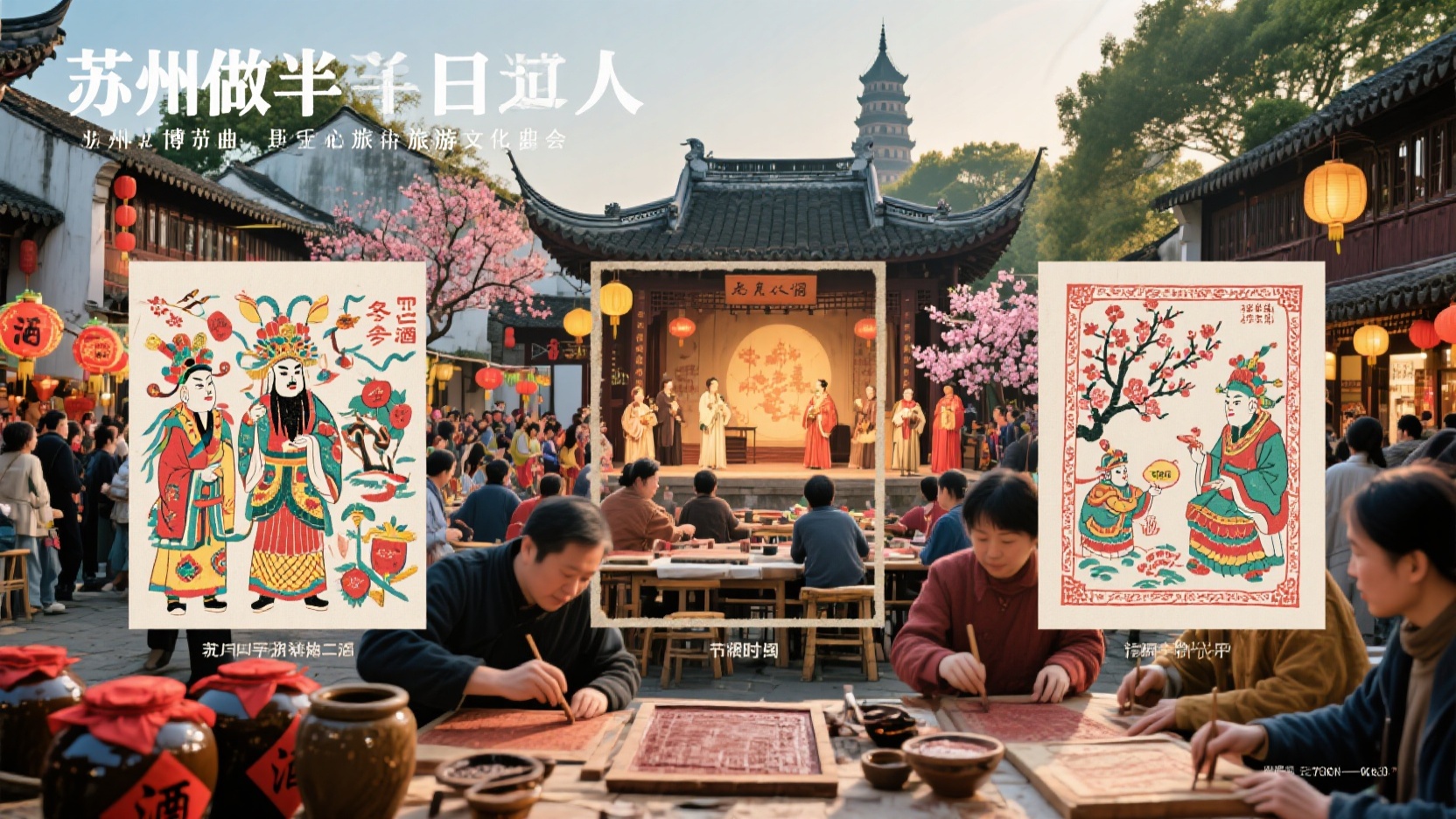
The cultural and artistic experience of Suzhou isn't limited to gardens and museums. Travelers who truly want to "sit down" can focus their itinerary on the city's seasonal festivals and hands-on crafts. The following itinerary, spanning from April in the lunar calendar to around the Mid-Autumn Festival, connects three festive folk customs with one intangible cultural heritage craft, perfect for spending half a day experiencing life as a local.
On the 14th day of the fourth lunar month, people "chase the immortals": Experience the mystical aura amidst the crowds at Changmen Gate.
Around the 14th day of the fourth lunar month every year, the area around the Shenxian Temple on Xiatang Street inside Changmen Gate in Suzhou enters "Ya Shenxian" (轧神仙) mode. "Ya" in Suzhou dialect means "to squeeze" or "to crowd." This custom originates from the legend of Lü Dongbin: the 14th day of the fourth lunar month is Lü Dongbin's birthday, and he would disguise himself as a beggar, vendor, or pilgrim to mingle in the temple fair. People believed that as long as they squeezed in the crowd, they might "squeeze" the gods and receive good fortune. Therefore, people going to the temple fair would specifically squeeze into the most crowded areas.
To truly experience the "Ya Shen Xian" (轧神仙) experience, don't just stand on the periphery taking photos. First, buy a pink "Shen Xian Gao" (神仙糕), made of glutinous rice flour filled with red bean paste and imprinted with fairy patterns, from a stall near the Shen Xian Temple. Then, put on a red velvet-woven fairy hat and slowly move with the flow of people from Xiatang Street inside Changmen Gate towards the Shen Xian Temple. Along the way, vendors mainly sell flowers, seedlings, bamboo and wooden utensils, and seasonal snacks, with elderly people haggling in Wu dialect. The real key is the rhythm of "Ya": being pushed along by the crowd, bumping shoulders with strangers, and hearing a few words of soft Suzhou dialect, you'll understand that this folk custom is not a performance, but a collective seasonal ritual.
On the eve of the Winter Solstice: a glass of locally brewed winter wine, a meal more solemn than New Year's Eve.
In Suzhou, the Winter Solstice is considered as important as the Lunar New Year. The night before the Winter Solstice is called "Winter Solstice Night," and many families prepare a more formal reunion dinner than Lunar New Year's Eve. The main dishes on the table are not dumplings, but winter-brewed rice wine, braised dishes, and mutton cake. Winter-brewed rice wine is a sweet osmanthus-flavored glutinous rice wine, produced only around the Winter Solstice each year. Old Suzhou residents are accustomed to taking plastic buckets to time-honored shops to "buy in bulk." Buying in bulk means purchasing the wine by weight from a large vat, a ritualistic practice.
Tourists can recreate a simple "Winter Solstice Night Route": in the evening, head to a time-honored shop near Guanqian Street to buy a cup of locally brewed winter wine, along with some Suzhou-style braised dishes like soy sauce duck and char siu, and a piece of mutton cake with a translucent meat jelly. No need for a private banquet; find a spot along the riverside stone railing to sit and watch the locals hurry by carrying their wine barrels. Winter wine has a distinct osmanthus fragrance and a sweetness reminiscent of fermented glutinous rice, easy to drink, but with a slight aftertaste. The Suzhou people celebrate the Winter Solstice with such grandeur because of the remnants of the Zhou Dynasty calendar—the Winter Solstice was once the beginning of the year, thus "Winter Solstice Night" still retains a similar significance to staying up all night on New Year's Eve in Suzhou. On the Winter Solstice, Suzhou people also eat Winter Solstice dumplings, filled with shredded radish or red bean paste; these dumplings symbolize reunion. After a cup of wine, the season is no longer just a word on a calendar.
Around the Mid-Autumn Festival, a folk music gathering was held at Tiger Hill: Listening to the Water Mill Opera on the Thousand-Man Stone.
To experience Kunqu Opera with minimal barriers, consider visiting Tiger Hill around the Mid-Autumn Festival. During the Ming Dynasty, the Tiger Hill Kunqu Opera Gathering was a major spontaneous event for Kunqu enthusiasts in Suzhou. Zhang Dai's *Tao'an Mengyi* records a gathering on the 15th of August at Tiger Hill, where participants ranged from gentry to commoners, singing Kunqu Opera's "Shuimoqiang" style. Kunqu Opera was inscribed on UNESCO's first list of "Masterpieces of the Oral and Intangible Heritage of Humanity" in 2001. Today, Kunqu Opera gatherings still occur in the Thousand-Person Stone area of Tiger Hill during the autumn, resembling more of an elegant gathering where amateur performers and tourists sit around the stone steps, taking turns singing, rather than a formal theater event.
To experience the Tiger Hill Opera performance, there's no need to sit formally. Find a stone step, sit down, and listen to a segment from "The Peony Pavilion: Strolling in the Garden" or "The Jade Hairpin," paying attention to the delicate and nuanced transitions in the singing. If someone hands you sheet music, simply hum along to "Without visiting the garden, how can one know the beauty of spring?"—even if you're off-key, it's alright. If you miss the opera performance, the old storytelling venues on Pingjiang Road and Shantang Street also offer Suzhou storytelling performances. The sound of the gavel and the strumming of strings will transport you to the auditory memories of Suzhou.
Taohuawu woodblock New Year prints: Print a "Harmonious Family" print by hand.
Beyond festivals, hands-on experience is the most direct way to understand Suzhou crafts. Taohuawu woodblock prints, along with Tianjin's Yangliuqing prints, are known as "Southern Peach and Northern Willow." The classic pattern "A Harmonious Gathering" depicts a round-faced figure with a wide grin, a style traceable to the Ming Dynasty painting "A Harmonious Gathering," symbolizing the unity of Confucianism, Buddhism, and Taoism, and the attainment of harmony and good fortune. In the Taohuawu historical and cultural area or the intangible cultural heritage workshops within the ancient city, you can participate in a simplified overprinting experience: evenly applying ink to the woodblock, covering it with Xuan paper, and using a palm rub to make the print, then repeating the process with different color blocks. Overprinting typically involves printing the line print first, followed by the color blocks; "A Harmonious Gathering" requires five to six color blocks to complete.
This process, seemingly simple, demands precise alignment of the printing plate, even ink application, and steady pressure. As the "harmony" you've printed gradually takes shape on the rice paper, you'll discover that the logic of Suzhou handicrafts lies not in grand gestures, but in maintaining a sense of proportion in every repetitive movement. Taohuawu New Year pictures were even exported to Japan via the Grand Canal, influencing the use of color and composition in Ukiyo-e prints. Taking away a New Year picture you've printed yourself is like taking away a tangible memory of Jiangnan woodblock printing.
From the crowds thronging the streets to the sweet wine enjoyed on the winter solstice, to the melodious tunes on the stone steps of Tiger Hill and the scent of ink from the New Year painting workshops, a cultural and artistic journey through Suzhou is never a static visit. Stepping into these seasonal and handcrafted scenes, even if only for half a day, brings you closer to the daily lives of the locals than visiting ten gardens.