
Experience life as a Shanghainese for half a day: From the Yu Garden Lantern Festival to the seasonal experiences of Anting Yaobanbu (a type of traditional Chinese medicine).
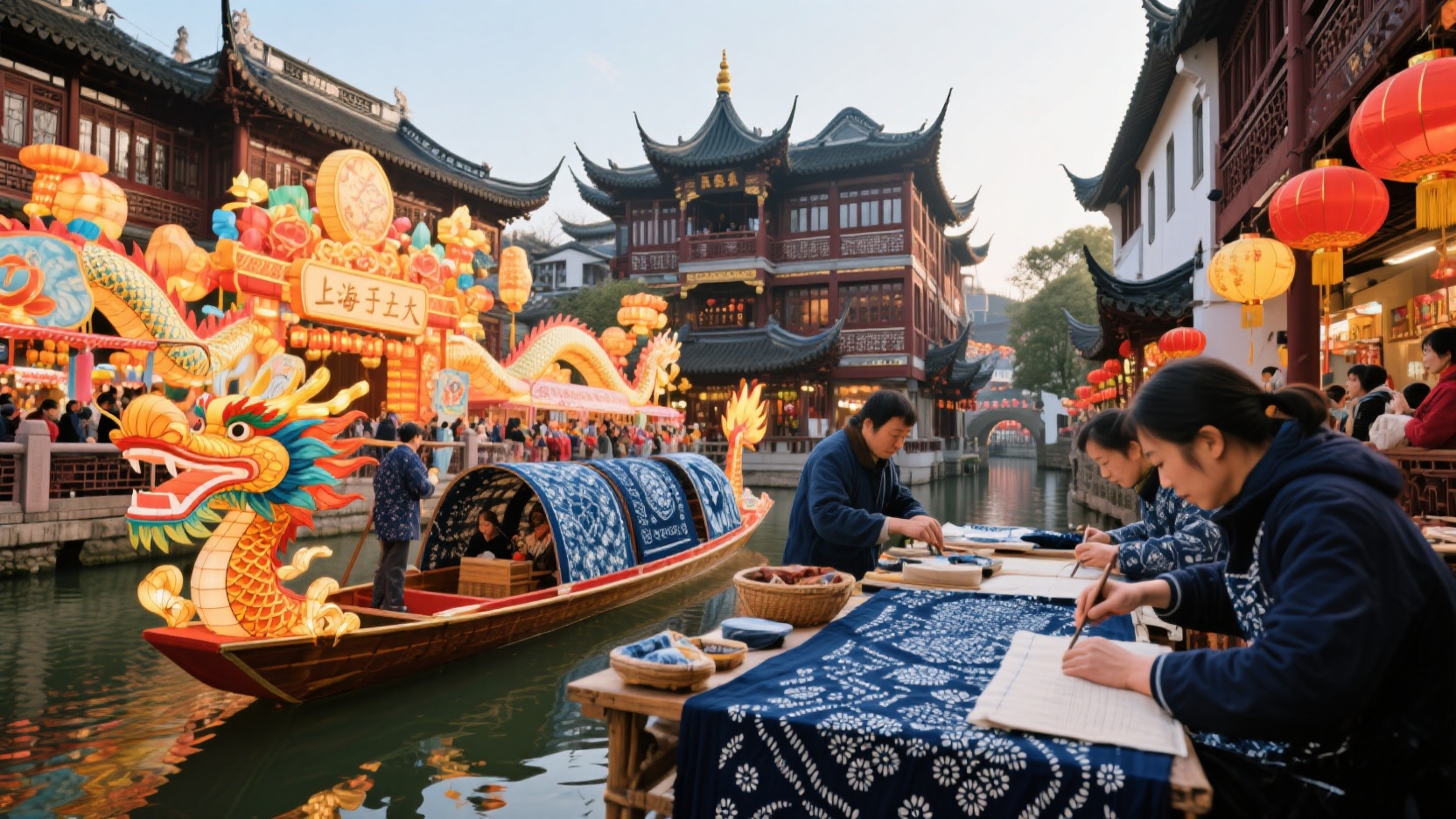
Shanghai's intangible cultural heritage isn't displayed in glass cases, but rather found in the crowds at the Nine-Turn Bridge, the incense offerings at the Longhua Pagoda, the boats on the Luodian River, and a vat of indigo. The following four experiences are arranged seasonally and are perfect for setting aside half a day, without rushing to see the sights, but simply enjoying a snack, a drumbeat, or a piece of cloth.
Yu Garden Lantern Festival: From the first month of the lunar calendar to the Lantern Festival, the old city area is illuminated by lanterns along the Nine-Turn Bridge.
The Yu Garden Lantern Festival runs from the first day to the eighteenth day of the first lunar month, with the core area located in the Yu Garden Bazaar and the Nine-Turn Bridge. The best time to visit is in the late afternoon, when the light is just before dusk, allowing you to clearly see the details of the lanterns, and after nightfall, their reflections on the water create a beautiful scene. A suggested experience is to first walk around the Nine-Turn Bridge. In the old town, there's a saying that "walking the Nine Turns will cure all diseases." During the festival, the bridge has flow control measures, so while walking is slow, it's a good time to observe the framework and decoration of the zodiac lanterns. After crossing the Nine-Turn Bridge, head to the Old School Field Road area to solve lantern riddles. The riddles often use Shanghainese homophones, offering a way to understand the local language. Around the Lantern Festival, old town pastry shops will be making black sesame glutinous rice balls, a standard combination of glutinous rice skin and black sesame filling with lard. The lanterns are part of Shanghai's national intangible cultural heritage, "Shanghai Lanterns." Many lanterns still use wire frames and silk coverings, a clear difference from mass-produced lanterns. The area around the City God Temple has been a lantern market in the county town since the Ming and Qing dynasties. During the Republic of China period, lanterns were set up along Fangbang Road, forming a collective memory of "going to the City God Temple to see the lanterns".
Longhua Temple Fair: On the third day of the third lunar month, enjoy a spring outing amidst peach blossoms and Shanghai opera.
The Longhua Temple Fair is usually held around the third day of the third lunar month, centered around Longhua Temple, Longhua Pagoda, and Longhua Square. Continuing the tradition of "going to Longhua on the third day of the third lunar month," the fair is generally divided into three areas: a market, performances, and handicrafts. It's recommended to start by strolling through the market, where you can find traditional snacks like peach blossom cakes, Longhua vegetarian duck, and local flatbreads. Next, enjoy a performance of Shanghai opera or Jiangnan silk and bamboo music in the square. The Shanghai opera lyrics, sung in the Shanghai dialect, often tell stories of ordinary families, offering a better authentic local flavor than Mandarin subtitles. In the afternoon, you can spend time in the intangible cultural heritage handicrafts area, trying your hand at Shanghai-style paper cutting or lantern making. The cultural roots of the Longhua Temple Fair lie in the incense offerings at Longhua Temple. During the Ming and Qing dynasties, vendors set up stalls along the road in front of the temple, attracting pilgrims, flower growers, and acrobats, forming an important spring gathering in the southwestern suburbs of Shanghai. Today, the fair still retains the structure of the incense offerings and market, but places greater emphasis on intangible cultural heritage displays, making it suitable for a half-day visit.
Luodian Dragon Boat: A floating stage on the city's river during the Dragon Boat Festival
The Luodian Dragon Boat Culture Festival takes place around the Dragon Boat Festival in the city river of Luodian Town, Baoshan District. Unlike common racing dragon boats, Luodian dragon boats are centered around "performance." The boats are heavily painted and gilded, with a platform at the bow and a boatman at the stern, while a band plays Jiangnan silk and bamboo music on board. The core action on the water is called "da zao," where the dragon boat rotates and weaves on the water, using the long stern to control its direction; "yao shou" is the thrilling action when the sterns of two boats meet. On shore, visitors can start by making zongzi (sticky rice dumplings). Luodian zongzi are wrapped in straw and have a savory filling, often made with pork leg and salted egg yolk. In the afternoon, visitors can try their hand at playing the gongs and drums. Veteran artists will break down the "san ji tou" rhythm, and after one listen, you can understand the drumbeats of the dragon boat performance. The dragon boat making technique is also an intangible cultural heritage, with fixed forms for the boat's wood, paint, and flags. In the past, Luodian was a distribution center for cotton cloth. The Dragon Boat Festival was not only a form of entertainment in the water town, but also served as a platform for merchants to socialize and pray for safe voyages.
Anting Yaoban Cloth: A Half-Day Dyeing Workshop of Engraving, Dyeing, and Oxidation
Anting medicinal-patterned cloth is a traditional Shanghai blue-and-white printed fabric. Because lime and bean flour are added to the resist paste, it was formerly known as "medicinal ash." Production is not limited by season, but the temperature and humidity in spring and autumn are more conducive to the oxidation of the dye. The experience usually begins with carving a pattern using paper or tung oil paper. Common patterns include auspicious designs from the Jiangnan region such as "Phoenix with Peony" and "Pine and Crane for Longevity." Next, the carved pattern is placed on white cloth, resist paste is applied, and the cloth is left to dry until semi-dry before being immersed in an indigo dye vat. The cloth is yellowish-green when it comes out of the vat, gradually turning blue upon contact with air; this step is called "oxidation" and requires repeated immersions. Finally, the paste is removed, the cloth is washed, and dried, leaving the pattern in white. Medicinal-patterned cloth differs from tie-dye and batik in that the patterns come from the carved pattern, with neat edges and repeatable designs. Cotton cloth production in the Anting area dates back to the Song Dynasty, and medicinal-patterned cloth was a common material for dowries, bundles, and curtains. A half-day workshop doesn't just leave you with ordinary blue cloth, but a complete memory of the entire process from carving to dyeing.
The four experiences can be strung together according to the seasons: visit Yu Garden on the fifteenth day of the first lunar month, go to Longhua on the third day of the third lunar month, rush to Luodian before the Dragon Boat Festival, and spend half a day in Anting during other seasons. They don't require you to just stand and watch and leave, but rather use a snack, a drumbeat, or a vat of dye to immerse you in the seasonal rhythms of Jiangnan.