
Lanzhou Old City Folding Route | A 3.8km Citywalk Connecting Old Buildings and Farmers' Markets (Personalized Checklist to Avoid Pitfalls)
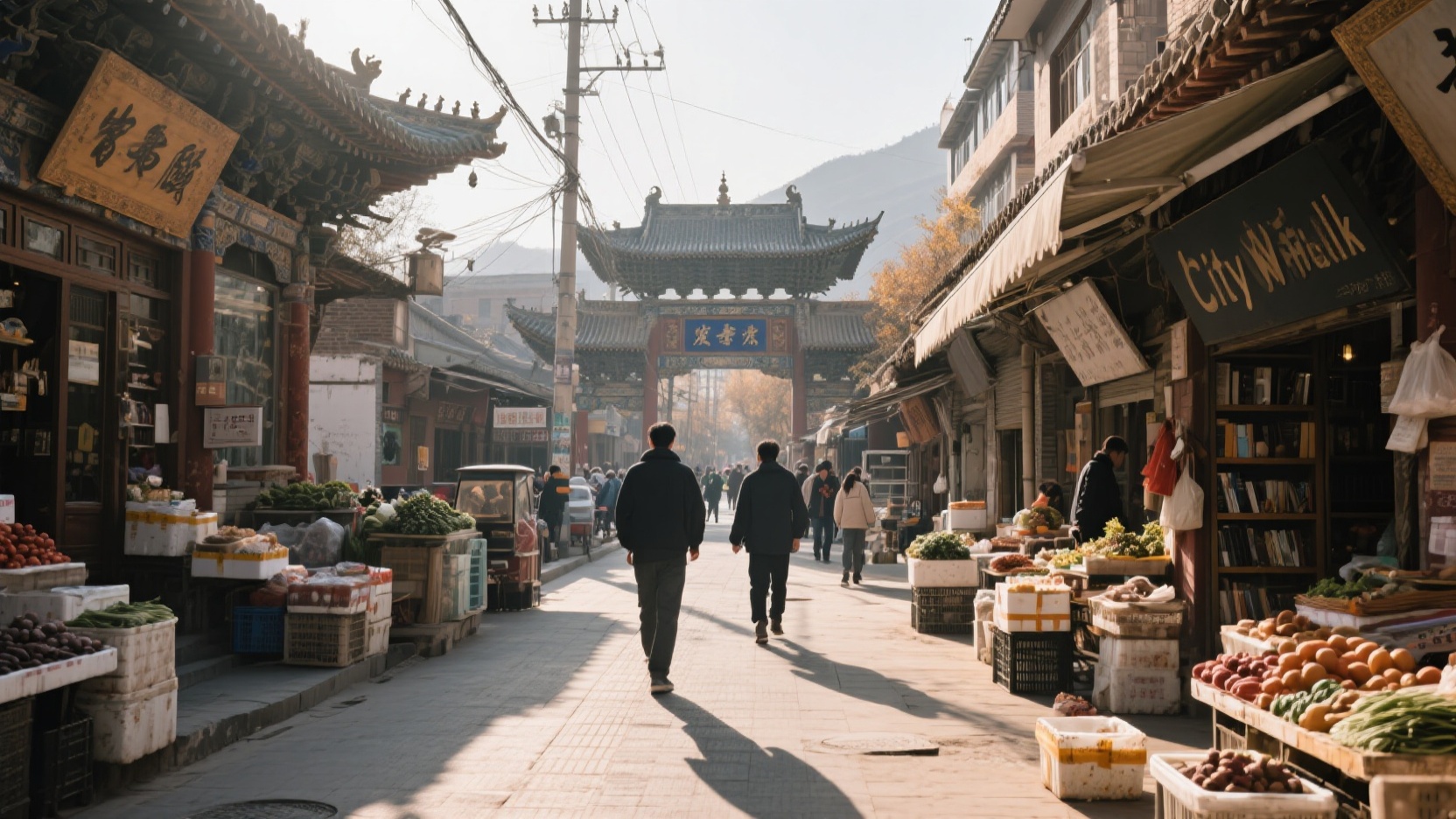
After exploring three old city routes in Lanzhou, I've compiled this Citywalk guide to the least circuitous and most photogenic route. It's approximately 3.8 kilometers long, including two side streets, perfect for an autumn or winter afternoon to dusk, or for a solo stroll or weekend photoshoot. The Zhengning Road Night Market and Zhongshan Bridge South Square are already packed with people, but the true essence of Lanzhou lies within a ten-minute walk on either side. This route starts from Xiguan and is entirely on foot, without backtracking.
Starting point of Xiguan: Zhangye Road and the City God Temple, first examine the market structure of the Qing Dynasty.
Walking time: Approximately 3 minutes from Exit D of Xiguan Subway Station to the City God Temple. Don't be deterred by the chain stores on Zhangye Road Pedestrian Street; the Lanzhou City God Temple is nestled on the north side of the pedestrian street. The entrance is small; you'll find secondhand stalls and old locust trees once you walk inside. Blogger's camera angle: Stand at the east entrance and use a low angle to photograph the roof ridge of the main hall and the tree canopy, cropping out the shop signs on the ground floor. Why it's worth stopping for 5 minutes: The painted decorations on the beams and rafters are faded, but the lack of renovation preserves the market traces from the Qing Dynasty to the Republic of China, making it suitable for photographing "old buildings under the gray tones of Northwest China."
After leaving the City God Temple, don't rush to cross the street. Walk west to Muta Lane. This section, which takes about 5 minutes, is the entry point for the transition from the old city to the community.
Muta Lane - Jinta Lane - Dazhong Lane: The corner of the vegetable market and time-honored brands are framed together.
Muta Lane isn't long. At its entrance are vegetable stalls and beef noodle shops, and the area is steamiest before 10 AM. The blogger's camera angle: At the lane entrance, power lines overlap with distant high-rises; standing on the south side, a vertical composition captures the "crowding of old and new." Why stop for 5 minutes? There are no touristy scenarios here, only the movements of old residents carrying vegetables and students eating noodles—a glimpse into the daily rhythm of Lanzhou life. Continuing east into Jinta Lane for about 4 minutes, several old brick and wood courtyards are found. The brick carvings on the lintels are only half-remaining, and the paint on the doors is cracked. Camera angle: A half-open wooden door framed against the brick wall—ideal for low saturation.
Walking north for another 6 minutes from the east entrance of Jinta Lane leads to Dazhong Lane. While Dazhong Lane has become somewhat more organized after recent renovations, the fruit stalls and sugar-coated cake stalls at the entrance still retain a sense of community. Lunch is a good option here, with established dessert shops and beef noodle shops all within walking distance. Camera position: Shoot from a low angle northwards from the south entrance, capturing the shop signs and pedestrians, avoiding overly dense storefronts. Reason to stop for 5 minutes: The "sweet and savory" flavors of Lanzhou snacks are most concentrated in this short section.
Branch Line 1: Tongwei Road Republican-era architectural belt and Yellow River pocket park
Turn west from the north entrance of Dazhong Lane and walk along Tongwei Road for about 8 minutes. Several brick and wood office buildings from the 1930s and 40s are preserved along both sides of Tongwei Road, with intact blue brick walls and wooden lattice windows. Some units are not open to the public, but the facades along the street are worth seeing. The blogger's camera position: standing on the east side of the road to photograph the facades of the buildings on the west side, using the roadside trees as the foreground. Why it's worth stopping for 5 minutes: The proportions of the window frames and the moldings of the doorways in these buildings are rare in Lanzhou, creating a good contrast with tourist photos of the iron bridge.
Walk along Tongwei Road to the Yellow River for about 5 minutes. This is the end of Branch Line 1 and also a pocket park that serves as a buffer for the main line. Don't just take pictures of the three characters "Zhongshan Bridge." Go to the stone railing on the west side of the square to take a panoramic photo of Zhongshan Bridge and White Pagoda Mountain. The photos will be even better when the color temperature is bluish in the evening. After you've finished looking at the view, you can turn back along the same route and return to the main line via Jiandao Lane.
From Jiandao Lane to Jiuquan Road: an old schoolyard alley and a courtyard house made of blue bricks.
It's about a 5-minute walk back to Jiandao Lane from Tongwei Road. Jiandao Lane is short and narrow, its name derived from the old site of an arrow-lined road from the Qing Dynasty. Now, only traces of a community bulletin board and an old-fashioned barber chair remain. The blogger's camera angle: shooting the depth of the lane from the south entrance, preserving the patina of the walls on both sides. Why it's worth stopping for 5 minutes: It lacks the trendy labels of popular tourist destinations, but its scale most closely reflects the lifestyle of old Lanzhou.
About a 6-minute drive south from Jiandao Lane onto Jiuquan Road, you'll find a traditional courtyard house made of blue bricks, the former site of the Eighth Route Army's Lanzhou office, which is free to visit. The brick and wood structure and historical photographs inside fill in the gaps in this route's modern history. Suggested camera angle: photograph the screen wall and eaves inside the courtyard, avoiding crowds.
Side story 2: A glimpse through the wall separating the Gongyuan Lane vegetable market from the Qing Dynasty Zhigong Hall
Turning into Gongyuan Lane from the middle section of Jiuquan Road, this side street is about 600 meters long and takes about 15 minutes round trip. First, you pass a community vegetable market, its most vibrant colors appearing before the market closes in the afternoon; the butcher's lamps, vegetable baskets, and plastic tarpaulins all have a film-like quality. The blogger's camera position: standing at the alley entrance and shooting inwards, the vendors' movements silhouetted against the backlight. Why it's worth stopping for 5 minutes: This vegetable market isn't a tourist attraction, but it's the best glimpse into the daily diet of Lanzhou people.
Continue westward around to the Cuiying Gate side, where you can see the massive roof of the Qing Dynasty Imperial Examination Hall (Zhigongtang) through the wall. Don't force your way into the hospital area; just take photos along the wall. Camera position: Use a telephoto lens to compress the wall and roof ridge, avoiding tangled electrical wires. Reason for stopping for 5 minutes: The Gansu Imperial Examination Hall is an important piece of evidence of Northwest China's cultural heritage. The sheer size of Zhigongtang, nestled within modern architecture, makes it even more impactful.
End point at Nanguan and conclusion: Leave the night market for the buffer zone, and the alleyways for dusk.
Turn back onto Jiuquan Road from Gongyuan Lane and head south for about 10 minutes to reach the Nanguan Ethnic Flavor Street. This can be your final stop, but it's not recommended to rush directly into the night market stalls. First, find an independent bookstore or cafe near the Nanguan intersection to sit down. If you look along the way, you'll see vintage clothing stores with semi-underground entrances and vinyl record corners; the storefronts are very small, so slow down your pace. The blogger's camera angle: Sitting by the window in a bookstore to capture the streetlights gradually brightening is more photogenic than going into the night market.
This route divides Lanzhou into three layers: the ground floor of buildings dating from the Qing Dynasty to the Republic of China, the middle section of community life, and the buffer zone between the Yellow River and the night. The entire route, excluding the side trails, is about 3.8 kilometers; with the two side trails, it's about 4.8 kilometers, and you should allow about 4 hours. The blogger summarizes: Zhengning Road is great for eating, but Citywalk aims to provide a "readable Lanzhou." Avoid weekend mornings; try to start on a weekday afternoon when the light is most stable. Practical Tips: Wear non-slip shoes, as some old alleyways have slippery paving stones; ask before taking photos at the secondhand stalls near the City God Temple; only view the Zhigong Hall from behind a wall, do not enter the hospital; independent bookstores and vintage clothing stores have small storefronts, so only use navigation to look up when you reach the alley entrance; in autumn and winter, it gets dark early in Lanzhou, so it's recommended to start walking before 2 PM.