
A 4km walk in Jiaxing | The best Citywalk at 2:30 pm (Blogger's personally tested and recommended list of places to avoid)
I tried three times before I dared to compile a route that would turn Jiaxing into an "open-air architectural museum." The first time, I followed the navigation from Yuehe to Zicheng, but was interrupted by traffic on Zhongshan Road and couldn't find any continuous old streets. The second time, I went in the opposite direction, wandering into a dead end between Shaonian Road and Xiexi Street, missing the tail end of the busiest morning market. The third time, I simply ignored the map and walked along the shaded area inside the city moat, finally connecting several points into a main Citywalk route of about four kilometers, suitable for starting at 2:30 pm, and leaving two branch routes for those with more time.
I. From Zicheng Watchtower to the Church of the Holy Mother's Appearance: First, observe the "layers of time" in Jiaxing.
This section is about 1.1 kilometers long, taking about 18 minutes on foot. It's recommended to start at the south gate of the Zicheng Ruins Park. Don't rush into the visitor center; first, walk around to the lawn at the southeast corner of the watchtower. Lower your camera to frame the stone lions, the watchtower's hipped roof, and the glass curtain wall behind them—this is Jiaxing's most visually striking example of the layering of ancient and modern elements. Stop for five minutes, not just to take standard photos, but to observe the repair marks from different dynasties on the watchtower's brick walls: dark gray represents old bricks, light gray represents recent repairs, and the grout lines are inlaid with small shell-shaped ash from the Republic of China era.
Walking north along Fuqian Street, you'll see the twin towers of the Church of the Epiphany just one intersection away. This section of the Republican-era skyline is quite unique; the church wasn't completely restored to "brand new," instead retaining its weathered, grayish-white hue. The best vantage point is along the old western wall of the church, using sycamore leaves as a foreground to photograph the twin towers. The reason it's worth watching for five minutes is quite specific: the pits and dents in the mortar on the exterior walls create shadows around 3:30 PM, resembling a charcoal sketch.
II. From Xiexi Street to Funan Street Market: A side street, offering glimpses into local life.
Leaving the Church of the Holy Mother's Apparition, walk west along Xiexi Street for about 0.6 kilometers. In ten minutes, you'll smell the aroma of the market. There's a side road here: if you only take the main route, find a street-side stall selling fried dough sticks and sesame cakes near the north gate of the Xiexi Street market. Stand at the entrance and use a telephoto lens to capture the "steaming heat from the market steamers alongside the old gatehouse's eaves." Why is it worth watching for five minutes? Because this is the place in the old town with the fastest pace of conversation—the Jiaxing dialect, the sounds of fish being gutted, and the clanging of scales all blend together, creating a more authentic experience than any travel guide. The blogger personally tested this; the market starts closing up around 4 PM, so to capture the lively atmosphere, you need to arrive before 3:30 PM.
Branch Line A leads west from the market onto Meiwang Street, a distance of about 1.2 kilometers, taking about 20 minutes. This branch line is for those who appreciate the former residences of Republican-era intellectuals: Zhu Shenghao's former residence and Shen Junru's former residence are both tucked away on either side of Meiwang Street, their entrances inconspicuous and easily missed. For optimal camera angles, choose the bamboo shadows and white walls of the residence's courtyard, perfect for low-saturation portrait photography; stop for five minutes to look around and read a passage from a reproduction of Zhu Shenghao's Shakespearean translation manuscript – more satisfying than visiting ten cultural and creative shops.
III. Vinyl Records and Vintage Clothing on Shaonian Road: Another side road, for those who don't want to rush.
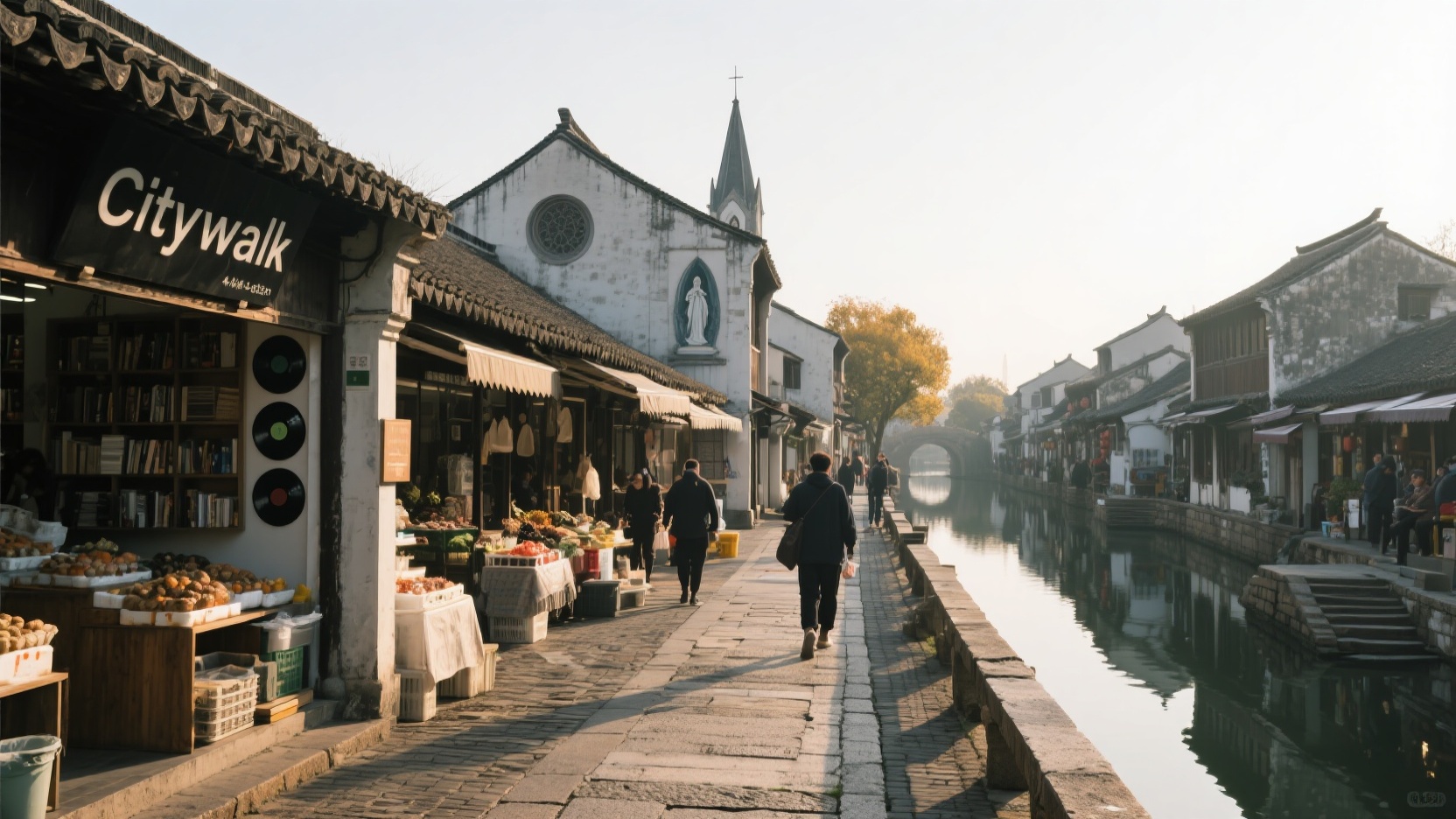
It's about 0.7 kilometers north of the market along Shaonian Road, a 12-minute drive. Shaonian Road is lined with plane trees, and the afternoon light filtering through the leaves at four o'clock is perfect for quick, easy photos. There are a few small shops along this road without any "Instagrammable" signs: a vinyl record shop on the second floor, accessible via a side iron staircase; a vintage clothing store tucked away at the corner of an old foreign trade building, its storefront simply a handwritten wooden sign. I won't list the shop names, because once you reach the middle of Shaonian Road, look up and you'll see the building with the vinyl record covers on the second-floor windows. The independent bookstore next door displays its new books at the entrance, and the coffee shop on the corner isn't particularly impressive, but sitting outdoors watching the plane tree leaves fall onto the pages of old books is the most cinematic moment along this route.
This section branches into a sub-route, B: turning right from the north end of Shaonian Road into the old Zhonghe Street community, walking 1.5 kilometers back to Yuehe, about 25 minutes. This sub-route passes mostly former dormitories from the 1990s and old-fashioned newsstands. There's an old-fashioned barbershop that's been open for many years, its rotating sign still turning. The camera is positioned next to the exercise equipment in the community pocket park, using foxtail grass as a foreground to film people playing chess. Why is it worth watching for five minutes? Because there are no tourists here, only the slow-paced movements of Jiaxing residents after work.
IV. From Ping Shan Pocket Park to Moon River Dusk: Dedicate Time to Blues and the Riverbank
The distance from Shaonian Road back to Pingshan Park is only 0.4 kilometers, a six-minute walk. Pingshan is the most easily overlooked pocket park in Jiaxing's old city—a small hill with a pavilion, yet it's a favorite spot for local elderly people to play chess. The best vantage point is halfway up the stone steps, looking up at the pavilion's corner and the intertwined branches of the old locust tree. After five minutes, you'll understand why Jiaxing people live their lives like the gentle slope here—not steep, not rushed, but with shade at every step.
Walking from Ping Mountain along the inner side of the city moat to the Yuehe Historic District is about one kilometer and takes sixteen minutes. Don't enter from the main street of Yuehe; instead, go to the north side of Yuehe Bridge and wait for the sky to turn blue. This vantage point offers a simultaneous view of the old river wharf, red lanterns, and the wakes of cargo ships on the canal. It's worth watching for five minutes, as this is the only "moving" scene along the entire route: as cargo ships pass, the river water overflows the last step of the wharf, like washing the old houses.
5. Make this route a "returnable" Citywalk.
The main route is about 3.8 kilometers long, and with the two branch routes, it's about 5.1 kilometers long. A pure walking trip takes about 80 minutes, but it's recommended to allow 3 to 4 hours. It's not the kind of tourist attraction you can rush through in one go; rather, it's a route where you can branch off at any point and return at any time. The blogger's biggest piece of advice is: don't come on weekend mornings, as Shaonian Road and Yuehe River will be packed with tour groups, and the market will lose its vibrant, fresh atmosphere after 10 am.
Practical Tips: First, I would recommend October to November, when the plane trees turn yellow, the river water turns blue, and the weather is pleasant for walking. Second, try to wear non-slip flat shoes, as there are many moss-covered bricks in the old alleys. Third, you don't need to specifically look for restaurants; the snack shops near the Xiexi Street market mainly serve fried dough sticks and shumai, and you can eat very comfortably for just a few dozen yuan per person. Fourth, if you want to photograph the blue-toned Moon River, remember to stand on the bridge 20 minutes before sunset, and don't wait until it's completely dark to press the shutter.