
Zhengzhou Old City Walk | Blogger's Personal Review: 4km Cultural Citywalk with 2 Branch Routes (Autumn/Winter Limited Edition)
I. East Street Confucian Temple & Shang City Ruins: The First Confrontation Between the Red Wall and the Earthen City Wall (Main Route 0-15 minutes)
Start from Wenmiao Station on Metro Line 3 or the entrance of Zhengzhou Confucian Temple. Don't rush in; first, walk around to the red wall on the east side of the temple. The blogger's camera angle: shooting upwards from the base of the red wall, waiting for one or two local elderly people to pass by on bicycles. The foreground is the gray tiles peeking out from the top of the wall, and the background is the rammed earth platform of the Shang Dynasty ruins in the distance. Why it's worth stopping for five minutes: Zhengzhou Confucian Temple is one of the few Ming and Qing Dynasty architectural complexes that has preserved its complete axis. The oxidized mottled red walls and the rough earthen walls are perfectly framed together, instantly capturing the "city upon city" texture of Zhengzhou.
Walking west along East Street, the Shang Dynasty Ruins Park is on your right. It's recommended to avoid the main road and follow the paths along the inner side of the park. This walk takes about eight minutes, and you can see locals practicing Tai Chi and walking their thrushes in the evening. You can take low-angle photos of the paths on the grassy slopes, where modern buildings are hidden behind the trees, leaving only a section of the earthen-yellow city wall visible.
2. City God Temple - Nanshuncheng Street - Pingdeng Street: The dividing line between the old town's vibrant atmosphere and creative shops (Main route 15-35 minutes)
Crossing Shangcheng Road, we arrived at the Zhengzhou City God Temple. The side gate of the temple is often overlooked; the blogger focused on the stone drums and threshold of the side gate, waiting for a draft to blow through the incense burner before pressing the shutter. Why five minutes of viewing time: the colors on the opera stage and the glazed screen wall are softest around three or four in the afternoon, allowing for the capture of very accurate Ming and Qing dynasty color blocks.
Continuing south and turning onto Nanshuncheng Street, you enter the real residential area. Low-rise shops line both sides of the street, selling watch repair, grain and oil, and traditional steamed cakes. After about ten minutes, you'll see a shop with a queue of people buying glutinous rice balls (yuanxiao). Don't remember the shop's name; just look for steam rising from the edge of the aluminum pot. Focus the camera on the steam and the backs of the people in line—this is the most authentic "community market corner" in Zhengzhou's old city.
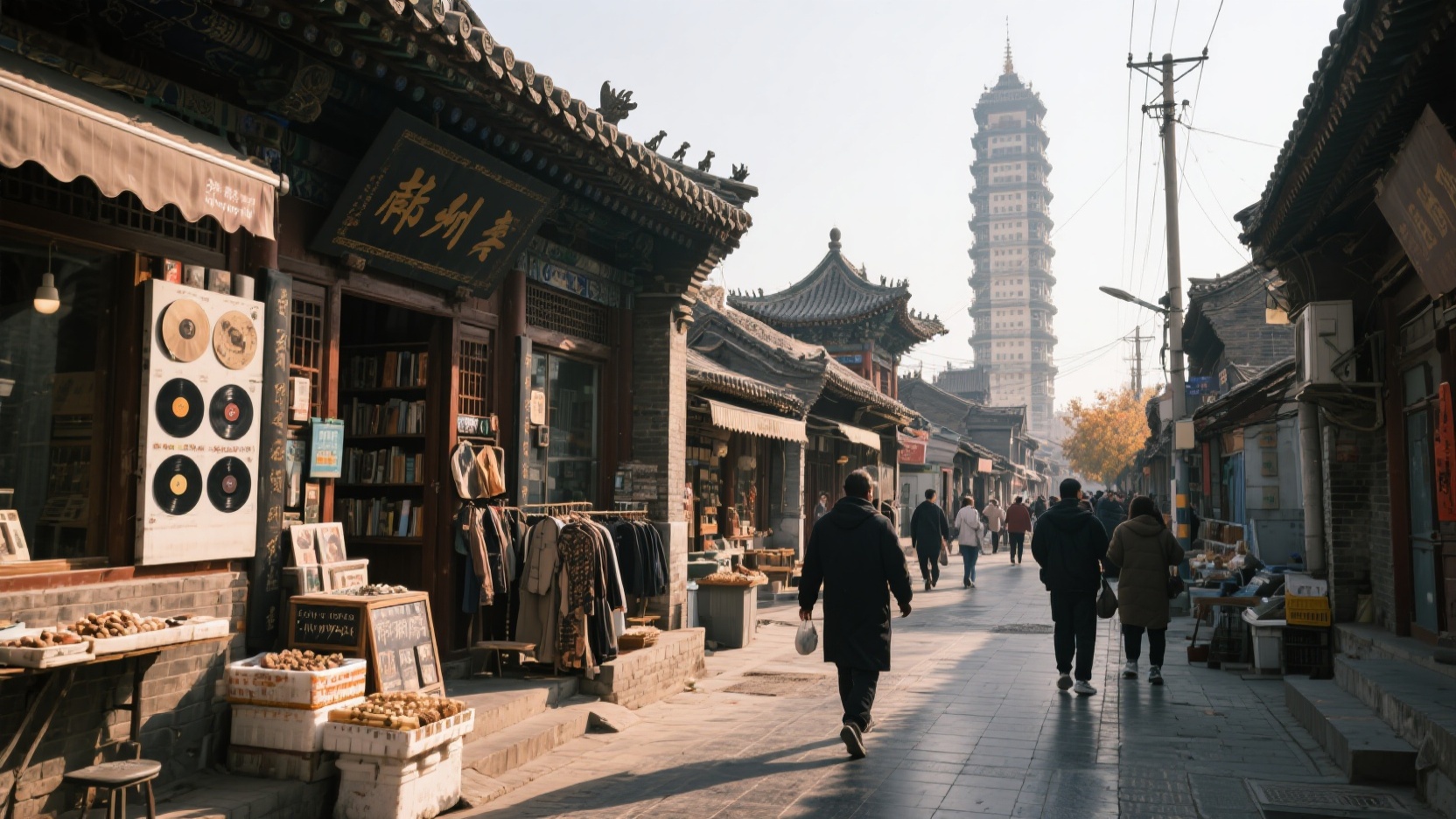
Turning west from Nanshuncheng Street, you'll find Pingdeng Street, a cultural and creative street that has been renovated in the last two years. It features independent bookstores, coffee shops, and a vinyl record store. This is a place to slow down and explore; the side entrance is located in the middle of Pingdeng Street.
3. Branch Road 1: The "capillaries" of Nanxue Street—Shuyuan Street—Tangzi Alley (round trip on the branch road takes about 20 minutes).
Turning south from the middle of Pingdeng Street onto Nanxue Street, the street immediately quiets down. This street is narrow, with several gatehouses in the style of the Republic of China era still preserved on both sides. The blogger's perspective: Standing at the corner of Shuyuan Street, using the gatehouses as the foreground, waiting for someone to pass by on an electric scooter to create depth in the shot. Why the five-minute pause: The brick carvings and lintel inscriptions on these gatehouses haven't been uniformly restored; instead, they retain traces of repairs from different eras, revealing the rise and fall of a family.
Continuing along Tangzi Alley, you'll often see elderly people playing chess or preparing vegetables at the alley entrance. Don't point your camera directly at them; take a couple of quick photos with your phone first. At the end of the side path is the back entrance of a community vegetable market, next to residential buildings. Around 5 PM, the warm yellow lights at the market entrance illuminate the scene, creating a very photogenic view against the backdrop of faded chalk price tags.
4. Branch Road 2: Daishu Hutong—Peichangmiao Street—Beishuncheng Street Farmers Market (round trip approximately 25 minutes)
After returning to Pingdeng Street, head west through Daishu Hutong. The name of this hutong itself has a story; it was a place where people used to write legal documents and family letters. The blogger's perspective: Standing in the middle of the hutong, photographing the roof ridges of the single-story houses on both sides and the crisscrossing power lines, leaving plenty of white space above the sky. Why watch for five minutes: In the mornings or evenings when there are no shared bicycles wandering into the hutong, the bluestone slabs reflect the sunlight, making it feel like stepping into Zhengzhou in the 1990s.
Turning north from Peichangmiao Street, the vegetable market on Beishuncheng Street is the most vibrant stop on the entire route. Stalls selling spicy soup base, fried dough twists, and sesame paste stretch from the street into the buildings. The camera is positioned at the street corner to capture the depth of the scene, carefully avoiding the shop signs and focusing only on the goods and gestures. The reason for stopping for five minutes is that here you can see the most authentic state of food preparation for Zhengzhou people before the Spring Festival and other holidays—colors, sounds, and smells are all captured in the same frame.
V. End point: The vinyl record and vintage clothing corner in the backstreet of Erqi Square (Main route 35-60 minutes)
Return to Pingdeng Street from Beishuncheng Street, then walk along West Street towards Erqi Square. Don't go directly to the front of Erqi Tower for photos yet; instead, turn into the back alleys of Dehua Pedestrian Street. There you'll find one or two vintage clothing stores and vinyl record shops. The storefronts are small, so pay attention to the second-floor windows. The blogger's perspective: Standing at the corner of the stairs, I photographed the reflection of record covers on the wall and a vintage jacket hanging by the window, creating a contrast of warm and cool tones. Why it's worth watching for five minutes: These shops aren't chain stores; the selection of items depends heavily on the owner's mood that week, giving it a blind box-like, exploratory feel.
Walking to the overpass at Erqi Square, the main route is about four kilometers long, plus two branch lines, totaling about six kilometers. If it happens to be between 5:30 and 6:00 pm in autumn or winter, the lights on the overpass will be on, making it a perfect time to take a slow-exposure shot of the Erqi Tower overlapping with the old city streets.
Blogger's Summary and Practical Tips Checklist
This route isn't rushed; four hours is just right. The first two times I took it, I was obsessed with finding "perfect spots for photos," and ended up missing many details that only locals would linger in. The third time, I learned to hang the camera around my neck, observe what people in the alleys are doing, and then decide whether to press the shutter.
The best time to visit is from late October to March of the following year, when the air is clear and the slanting sunlight illuminates the walls of the old alleyways. Avoid Mondays, as the Confucius Temple and City God Temple may be closed. Do not drive into the old city; taking Metro Line 3 to the vicinity of the Confucius Temple is the safest option. Within the branch line, shared bicycles are difficult to turn around, so walking is actually faster.
The peak hours at the market are from 4:30 PM to 5:30 PM. If you want to shoot establishing shots, go in the afternoon; if you want to capture the lively atmosphere, go in the evening. The side streets are narrow, so don't stand in the middle of the road when shooting. Try to use a 35mm lens or the wide-angle end of your phone for fast shooting. Finally, a reminder: don't just take pictures without buying anything at the market. Buy a bag of sesame paste or fried dough twists; the vendors will be more willing to chat with you about old Zhengzhou.