
Spend half a day as a Kunming artisan: A guide to immersing yourself in folk customs, from the Stone Forest Torch Festival to Jinning Wutong Zouyin (a type of bronze inlay).
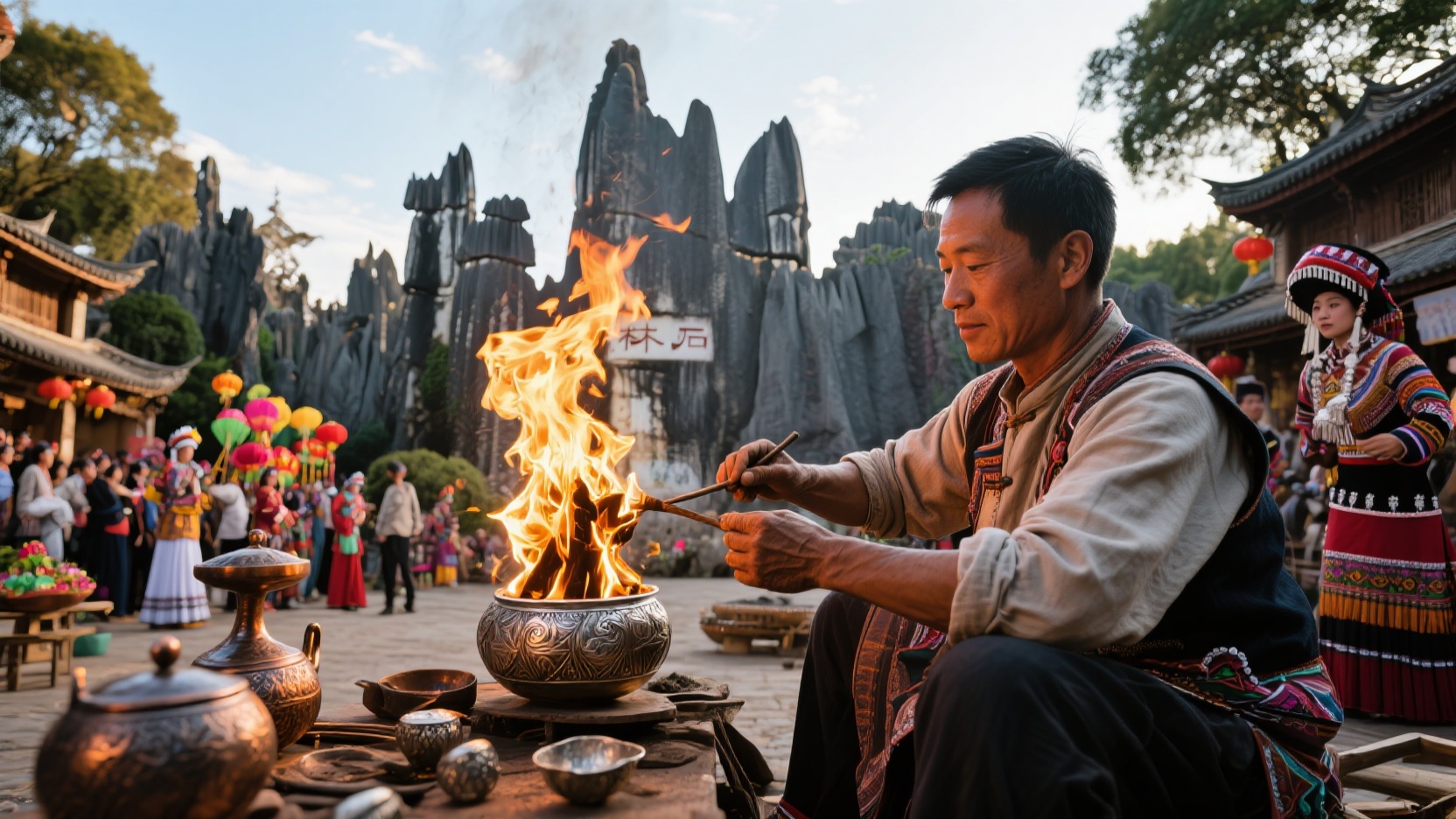
Kunming, framed by Dianchi Lake and Xishan Mountain, presents a tranquil daily life, but its true local culture lies hidden in festivals and workshops. To experience Kunming in depth, you don't have to just visit museums. You can follow the timeline to visit four sites: the Stone Forest Torch Festival on the 24th day of the sixth lunar month, the Guandu Intangible Cultural Heritage Training Center (accessible year-round), the Xishan Lantern Festival on the 3rd day of the third lunar month, and the Jinning Wutong Zouyin Workshop. At each site, you can sit down and participate, rather than just stand and watch.
Shilin Torch Festival: A nighttime fire display on the 24th day of the sixth lunar month.
The Torch Festival in Shilin Yi Autonomous County usually lasts for two to three days around the 24th day of the sixth lunar month, with the main venue often located in Changhu, Guishan, or the area surrounding the county seat. During the day, the highlights include bullfighting, wrestling, and a Yi embroidery market. The octagonal patterns and horsehair flowers on women's clothing are not merely decorations, but symbols of their ethnic origins. The real climax comes after nightfall: people light pine torches and parade along the field ridges and village paths, the flames forming moving lines.
Don't just stand under the stage during the experience. Follow the group, hold your torch level, and watch for the moment the elder sprinkles rosin powder onto the torch; that burst of fire is called "sending away evil spirits." Then the large three-stringed instrument (a traditional Chinese stringed instrument) begins to play, and the crowd forms a circle to dance the "Large Three-String Dance," a simple three-step, one-kick routine that you can catch in half an hour. Behind you is the Yi people's solar calendar and fire worship: in late June, when the rice is heading, torches are used to patrol the fields, drive away insects, and pray for a bountiful harvest; it's also a social occasion for young people. Wear durable shoes; torch ash will cover your shoulders—proof of your participation.
Intangible cultural heritage training in Guandu Ancient Town: Half-day handicrafts from paper cutting to pounding rice cakes
Guandu was once an important ferry crossing on the eastern shore of Dianchi Lake. Today, the intangible cultural heritage center in the ancient town brings together scattered skills into a half-day itinerary. It's perfect to set aside an afternoon: first, learn Yunnan-style paper cutting, then try your hand at pounding Erkuai (a type of rice cake). Paper cutting patterns can be chosen from "Golden Horse and Jade Rooster" or "Eight Views of Guandu." The veteran artisans don't teach complicated techniques; they only require you to use scissors to draw curved lines. After finishing, you can paste it onto a blank paper fan and take it home.
Even more laborious is pounding the rice cakes. Steamed rice is poured into a stone mortar and repeatedly pounded while still hot with a wooden mallet. Two people need to work in sync, one turning the rice while the other strikes the mallet. The resulting rice cakes are soft, warm, and fragrant with rice, and can be dipped in fermented bean curd or wrapped in red bean paste. This craft is related to the caravan trade: the rice cakes are firm and durable, and were once a staple food for travelers in central Yunnan. Sitting in the courtyard of the workshop and slowly making them gives you a more "local" feel than queuing on the main street of the ancient town. During the annual Spring Festival temple fair, temporary workshops for sugar painting and dough sculpting are also added, offering greater flexibility in scheduling.
March 3rd in Xishan: A Kunming Tune Interspersed in Lanterns and Yunnan Opera
The "Shua Xishan" festival on the third day of the third lunar month is a memory of Kunming's old city, more like a folk art gathering unfolding along the mountain. From the foot of Xishan towards Longmen, the trail is often lined with lanterns, Yunnan opera, antiphonal singing, and traditional snack stalls. The lanterns are called "Wei Huadeng" in Yunnan dialect. The movements are not about being regular, but about relaxing the hips and lightly twisting the feet. The lyrics are mostly in Kunming Mandarin, and the content ranges from tea picking to street jokes.
The most worthwhile thing to do is to squat beside a lantern troupe and watch a rehearsal. If invited, you can go down and learn a short "weibu" (a type of gait), swaying your arms and stepping on the beat—it doesn't matter if you make mistakes. Veteran Yunnan opera performers often sing in the afternoon, their facial makeup and high-pitched singing retaining traces of the Yiyang opera style brought by Ming Dynasty immigrants. Antiphonal singing is even more impromptu, usually with a topic given on the spot, and the audience can simply clap without singing. The Third Day of the Third Lunar Month originated from the Shangsi Festival's spring outing; Kunming people blend the mountains and rivers with opera, turning the festival into a mobile stage. Don't just rush through the mountains; the small stages halfway up are often more captivating than those at the summit.
Jinning Wutong Zouyin: A process where metal turns black after a single pass.
If you have patience for handicrafts, you can schedule a half-day or full-day session for Jinning's Wutong Zouyin (black copper inlaid with silver). This craft is prevalent in Jinning and its production involves processes such as copper smelting, chiseling, inlaying silver, and blackening. Tourists usually start by viewing the finished product and then try the simplest chiseling or polishing steps. The so-called "inlaying silver" involves embedding silver wire into the chiseled grooves, fusing them at high temperatures, and finally rubbing them repeatedly with sweaty hands. The copper surface oxidizes and turns black, while the silver patterns become even brighter.
The most counterintuitive aspect of the experience is that the "darkening" isn't a sign of dirt, but rather the beginning of a patina. The craftsman will explain that newly made objects are reddish, and their luster only develops after some use, thus each piece carries the marks of its user's time. Common patterns include plum blossoms, orchids, bamboo, chrysanthemums, geometric patterns, and cloud patterns, closely related to the Han Chinese scholar-merchant culture of Yunnan. Even if you can't make a complete piece, just chiseling a copper piece and observing the silver-working process will help you understand why it has long been a prestigious "literati gift" in Kunming.
These routes share a common thread: they don't aim to see the "complete performance," but rather to immerse participants in the process of production, parade, and learning. Festival dates are based on the lunar calendar; check local cultural centers or county/district tourism announcements before your trip. When participating in sacrificial rites and torch parades, do not step on the fire pit or take photos of the faces of those performing the rites. Spend half a day in Kunming, and you'll receive not just photos, but a handful of pine resin ash and a handful of rice cake incense.