
Hohhot Old Town Walking Route | My Personally Tested 3.8km Cultural and Artistic Stroll, Connecting Ming and Qing Dynasty Old Houses, Vegetable Markets, and Vinyl Shops (with 2 Side Roads Included)
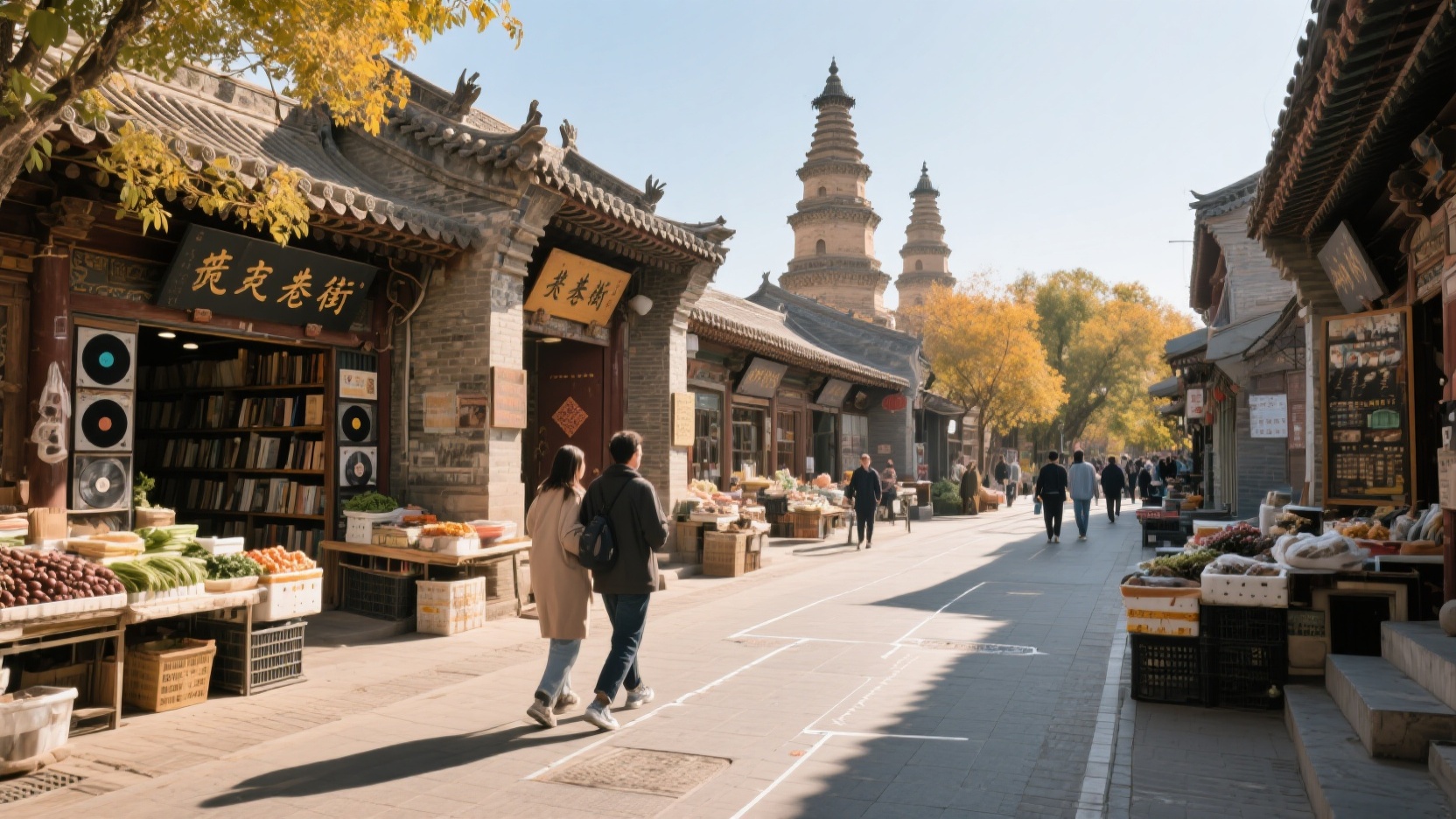
To avoid the tour groups with small flags waving around Dazhao Square, I chose to enter Kuanzhai Alley from the North Gate of the Old City on a weekday morning, leaving only an offline map on my phone. The main route is about 3.8 kilometers long, including two optional branch routes, and takes about 1.5 to 2 hours to walk; if you include stops at the bookstore, vinyl record store, and pocket park, you should allow at least half an afternoon.
I. East entrance of Kuanxiangzi Alley – Back Alley of the Great Mosque: Morning Market, Baked Goods Shop and Old Gate Tower
The first section is about 600 meters long, an 8-minute walk. The mornings in Kuanzhai Alley are noisier and more vivid than described in travel guides: residents on electric bikes, old men carrying mutton offal soup, and Hui women arranging baked goods in glass cabinets all appear on this narrow street simultaneously. The blogger positioned their camera slightly north of the middle of the road, using a 35mm focal length to capture the old gate towers on both sides and the flowing figures in the same frame. Why is it worth stopping for 5 minutes? There are no uniformly painted antique facades here; the brick carvings on the gate towers are a mix of new and old, and traces of handwritten shop names from decades ago can still be seen on the lintels.
In the middle of Kuan Alley, there's a small westward fork that leads to the back alley of the Great Mosque. This is branch line one, about 400 meters long, a 6-minute walk. The alley retains some Republican-era brick archways and a traditional "shop below, residence above" structure. In the mornings, you might occasionally see prayer hats drying in the sun and elderly people sunbathing in their doorways. Tip: The main road gets less crowded in the afternoon, but many shops start closing up; it's recommended to arrive before 9 am.
II. Sai Shang Old Street - Tongshun Avenue: Find the brick seams on the back side of the tourist street.
Cross Tongdao South Road from the west entrance of Kuanxiangzi Alley, enter Dazhaoqian Street, then turn into Saishang Old Street, about 700 meters, a 12-minute walk. This area is already a standard tourist street, but if you only walk along the main road, you'll miss the highlights. My habit is to suddenly turn into the alleys on the north and south sides halfway through. Position the camera near the east entrance, using a low angle to frame the stone slabs on the ground, the peeling paint on the brick walls, and the passing leather stalls. Why is it worth looking at for 5 minutes? Because the brick joints are real: repairs from different eras have left varying depths on the walls, which are more durable than newly built antique paint.
Tongshun Alley doesn't have to be just a snack street to pass through. On the north side, several old courtyard gates retain their original wooden hinges and iron door rings, and the steps in front of them have been worn into a distinct curve by footsteps. Branch line two branches southeast here into Xiaozhao First Alley, about 350 meters long, a 5-minute walk, where you'll find stalls selling secondhand books and antique items. Squatting down to browse through an 1980s pictorial magazine, or watching the stall owner clean old wooden objects with a brush, is a much more authentic experience than buying souvenirs.
III. Wuta Temple Back Street—A Community Cultural Hub on the Edge of the Old City
Emerging from Tongshun Avenue, continue southeast along Wuta Temple Back Street for about 900 meters, a 13-minute walk. This section marks the departure from the core tourist area and into the residential area where the old and new towns meet. You'll see independent bookstores with dark green window frames, community cafes with three folding chairs at the entrance, and vinyl record stores hidden on the second floor that require knocking before entering. The camera is positioned opposite an old residential building, capturing the handwritten signs of the ground-floor shops and the clothes drying on the second floor in the same frame. Why stop and look for 5 minutes? Because this is the most seamlessly integrated state in the old town's renewal: upstairs are residences, downstairs young people are playing records, and the two coexist peacefully, yet surprisingly harmoniously.
The shops here are usually small and don't have eye-catching light boxes. I pushed open the door of an independent bookstore, where the owner was putting old books in transparent plastic bags. Inside, there were vinyl samples of Inner Mongolian folk songs. Whether I buy anything or not is secondary; sitting for a while and flipping through local documents, I suddenly understood what elements Hohhot had actually preserved in its urban renewal process.
IV. University Road Cultural Mall—An Afternoon of Vintage Clothing, Vinyl Records, and Tree-lined Avenues
Leaving Wuta Temple Back Street, head south along Xilinhot South Road and then turn onto University Road, about 1200 meters, an 18-minute walk. This section is a bit long, but the path is lined with the walls of old government compound buildings and rows of poplar trees. In the afternoon, dappled sunlight filters through the sidewalks, making it anything but monotonous. The area near the Cultural Mall is where independent bookstores, vinyl record stores, and vintage clothing shops are more concentrated; some are located in the semi-basement of residential buildings, requiring you to descend a few steps. For the best camera position, I recommend the pedestrian overpass at the west gate of the Cultural Mall. Use a medium to long telephoto lens to shoot from above, capturing the almost closed canopy of trees on both sides of University Road. The light is best around 3 PM, with traffic and pedestrians moving through the shadows, creating a scene reminiscent of an old movie.
Vintage clothing stores draw the curtains when you try on clothes. I tried on a 90s denim jacket, but it didn't fit, and the owner casually gave me an old brooch—these kinds of uncommercial moments are something you don't encounter in chain stores. Record stores might only be open for half a day, so check if there's a small light on at the entrance before going in, otherwise you might end up empty-handed.
V. Manduhai Park West Street Pocket Park: Urban Respite After a Long Walk
The final stretch, about 400 meters and a 6-minute walk, ends in a pocket park on the west side of Manduhai Park. It's not a tourist attraction; it only has a pergola, a few old elm trees, and some benches. But precisely because of its tranquility, it allows the density of the streets and alleys accumulated along the way to slowly dissipate. The camera is positioned at the park's west entrance, using a wide-angle lens to frame the perspective of the pergola and the high-rise residential buildings in the background. Why stop for 5 minutes? Here, you can see elderly people playing chess, children rollerblading, and hear the wind rustling through the elm leaves—the perfect ending to this route.
Reaching this point, the main route is approximately 3.8 kilometers long. Your feet might be a little tired, but you won't feel like you've walked in vain. If time permits, I suggest sitting on a bench for a full fifteen minutes before deciding whether to turn back and find a café for a coffee.
The blogger summarizes: This route isn't suitable for first-time visitors who only want to check off the Dazhao Temple, nor for those seeking a dense concentration of attractions. It's better suited for those who view Hohhot as a "walkable city": wanting to discover the unspoiled details of the old town amidst old buildings, markets, secondhand bookstores, and vinyl record shops. The entire route has a gentle slope, making it beginner-friendly; the only thing to watch out for is the electric bikes in the alleyways.
Practical Tips: Tip 1: Arrive at Kuan Alley before 9 AM when the morning market is still open and the lighting is soft. Tip 2: The entire route is approximately 3.8 kilometers. Including stops at bookstores and vinyl record shops, it's recommended to allow 3.5 to 4 hours. Tip 3: There are many electric bikes in the old town alleys; avoid standing in the middle of the road when taking photos. Tip 4: Some independent bookstores and vinyl record shops only open around 1 PM; you can explore the outdoor sections first in the morning. Tip 5: If you can only choose one of the two branch routes, prioritize the Xiaozhao First Alley used book stalls; it's shorter and offers better photos. Tip 6: Autumn, from September to October, is the most comfortable time. In winter, the ground is prone to icing, and some outdoor used book stalls may not be open.