
7 Fresh Seasonal Delicacies from Guangzhou | A Limited List Available Only During Certain Seasons (Blogger's Personal Tests to Avoid Pitfalls)
After pursuing the "eat what's in season" philosophy for ten years along the Liwan Canal, I've discovered that the true culinary threshold in Guangzhou isn't found in trendy restaurants, but rather in the seasonal corners of the wet markets.
This article doesn't focus on shrimp dumplings or roast goose; instead, it lists seven seasonal delicacies that Guangzhou locals eat according to the calendar. Many of these are only available for two weeks, so missing them means waiting another year. I traveled to several production areas in Zengcheng, Nansha, and Conghua to compile this list of seasonally limited-time dishes.
I. From Qingming to Guyu: Stir-fried buckwheat vegetables with roasted pork and mugwort cakes are Guangzhou's "harbingers of spring".
Buckwheat sprouts are at their most delicious around the Qingming Festival. They are thinner than scallions and more fragrant than chives, with a hint of spiciness. The Cantonese say, "Buckwheat sprouts are crisp around Qingming, but after Qingming no one buys them," because after Grain Rain (a solar term), the fibers become coarser and tough when stir-fried. The most authentic way to eat them is stir-fried with roasted pork belly with skin on, using only the top section and stir-frying quickly over high heat without adding water. The result is a sweet, spicy, and crisp dish, with the pork fat perfectly complementing the wild flavor of the buckwheat sprouts.
Don't miss the Ai Ci (mugwort glutinous rice balls) at the same time. Around Qingming Festival, Hakka villages in the northern suburbs of Guangzhou and Conghua harvest the tenderest tips of mugwort, blanch them, extract the juice, and knead it into glutinous rice flour. Unlike the Qing Tuan (green glutinous rice balls) of Jiangnan, it has a thicker, chewier skin, a stronger herbal aroma, and the filling is often roasted peanuts and sesame seeds or red and green bean paste. Steamed and served on banana leaves, it tastes best when chilled.
II. From Summer Solstice to Minor Heat: Lychee Fungus and Tree-Ripe Lychees – Don't Miss Out, or You'll Have to Wait Another Year
Lychee mushrooms are the shortest-lived, top-quality delicacy in Guangzhou's summer. They only grow near termite mounds under lychee trees, sprouting on stormy nights after the summer solstice, and their value drops as soon as the sun opens. Locals in Zengcheng and Conghua go to pick them in the early morning with flashlights; the ones with mud still on their stems and unopened caps are the most prized. The cooking method is extremely simple: steam them with only oil and salt; the resulting broth is even more flavorful than chicken soup. If the caps have opened, the "flowering" mushrooms are used in soups or steamed with chicken.
At the same time, Zengcheng lychees are also a once-in-a-lifetime event. Guiwei, Nuomici, and Xianjinfeng each have their own unique charm. Guiwei lychees, ripened on the tree two weeks after the summer solstice, are the crispest and have a fragrance of osmanthus. Locals buy lychees with the branches and leaves attached, as the flavor diminishes every hour after they are removed from the branch. To avoid feeling too hot after eating them, grab a handful of Conghua yellow-skinned lychees and chew them with the peel on. They are sweet and sour with a lingering aftertaste. There's an old saying: "Eat lychees when hungry, eat yellow-skinned lychees when full."
III. From the Beginning of Autumn to the Cold Dew: Newly Reclaimed Lotus Roots from Nansha, So Soft and Powdery They Deceive the Tongue
Many tourists are unaware that Xinken in Nansha, Guangzhou, has lotus roots grown in brackish water. Harvested after the beginning of autumn, these lotus roots accumulate starch throughout the summer, becoming very starchy when cooked, and the fibers remain connected even when broken. Locals choose Xinken lotus roots by their short, round segments, yellowish-brown skin, and the muddy aroma emanating from the holes when cut open.
The most classic way to eat it is with mung beans stuffed with lotus root and served with pork rib soup, or sliced into thick slices and pan-fried into lotus root cakes. After the Cold Dew solar term, the starch in lotus root gradually turns crisp, making it only suitable for stir-frying and no longer starchy. So, if you want to enjoy that sandy texture, you must go when it's cool in autumn.
IV. Around the Winter Solstice: Zengcheng Late-Season Cabbage, the "King of Cabbage" after Being Bruised by Frost.
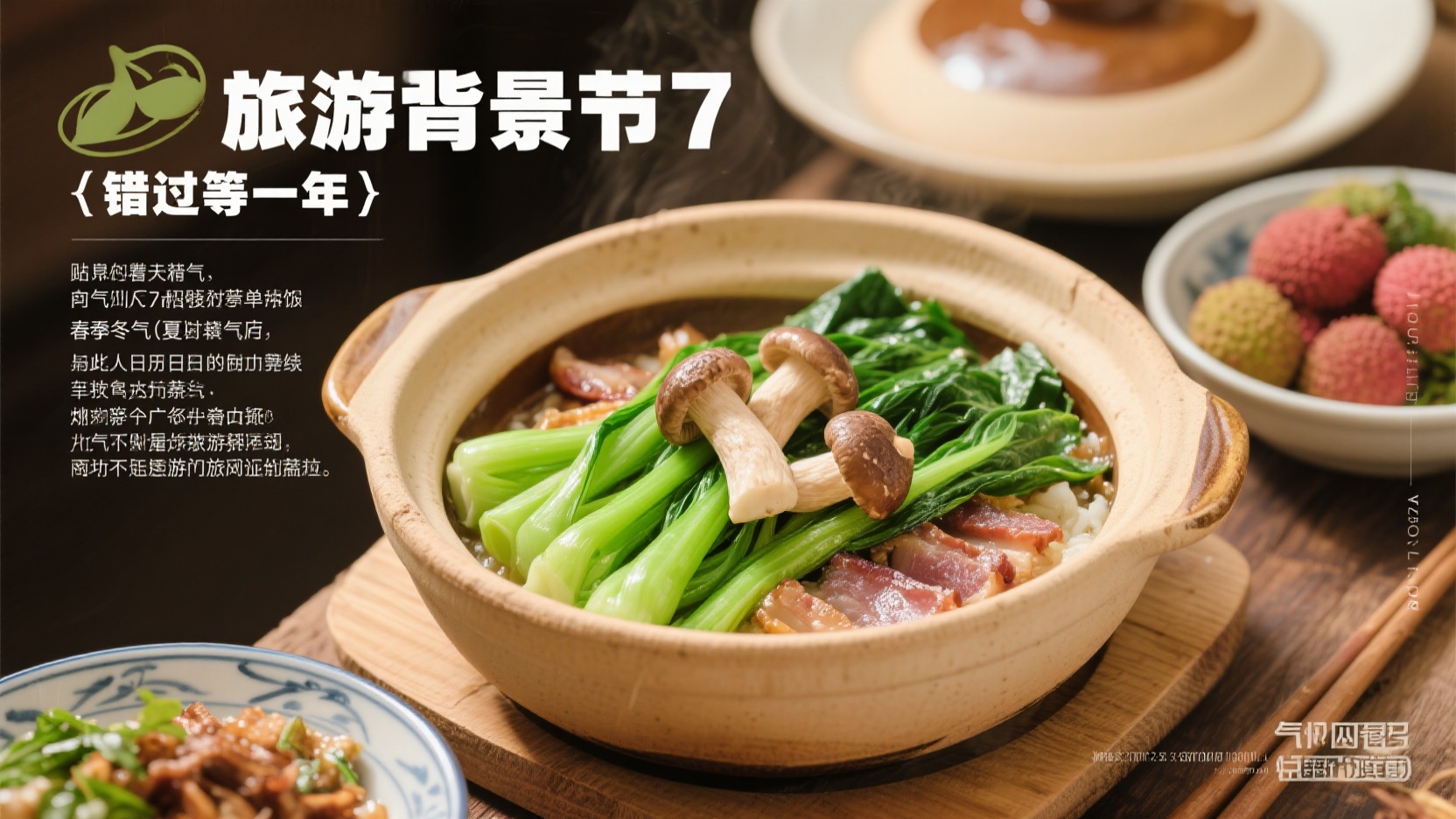
Zengcheng late-season choy sum is Guangzhou's proudest vegetable in winter. It's much better than ordinary choy sum, and it's sweetest after being touched by frost around the winter solstice, with thick but tender stems. Locals say, "Winter solstice arrives, choy sum is sweet," as late-season choy sum that hasn't been touched by frost always has a slightly bitter taste. The first year I went too early, and it tasted like ordinary choy sum; I only accepted it after the winter solstice.
Locals eat it in a "luxurious" way: they only eat the tenderest main stem and flower buds, peeling off all the outer leaves. It can be blanched or stir-fried with cured meat; the juice is sweet and savory like sugar water. Once this dish is on the table, all other green vegetables have to take a backseat.
V. The North Wind Rises: Claypot Rice with Preserved Meats and the Fragrance of Preserved Meats at the End of the Year
Guangzhou's preserved meat tradition emphasizes "eating preserved meats when the autumn winds blow." After the start of winter, the north wind blows and the weather becomes dry, so locals begin to dry sausages, duck legs, and pork belly. Cantonese sausages have an aroma of wine and sugar, and the pork belly has a good balance of lean and fat. Only those dried in the north wind are dry, crisp, and fragrant; they simply cannot be dried in the humid, warm weather.
Claypot rice with preserved meats is a true test of cooking time and technique. The rice is layered in a clay pot, and the preserved meats are cooked together. Before serving, soy sauce is drizzled around the edge of the pot and left to sit for one minute before stirring. The rice crust should be golden and crispy, not bitter. Preserved meats are at their most flavorful around the winter solstice, and when paired with Zengcheng late-season bok choy, it's a classic way to enjoy a winter night in Guangzhou.
VI. Summary of Pitfalls and Seasonal Reminders
These limited-edition delicacies are either from remote areas or only appear briefly in a corner of the market. The pitfalls I encountered were mainly twofold: first, going too early meant it wasn't the right season, so the taste was completely off; second, ordering "year-round available" lychee mushrooms or late-season bok choy near tourist attractions for convenience meant they were mostly refrigerated or from other regions.
Practical tips: The golden period from the summer solstice to the minor heat is when lychee fungus and lychees overlap; late-season bok choy is most stable ten days before and after the winter solstice; go to the Liwan Market a week before Qingming Festival to look for buckwheat lees and mugwort cakes. Focusing on one or two production areas and markets during each period is more reliable than chasing after trendy shops.
Eating according to the seasons is the right way to experience a city.