
Spend half a day as a Wenzhou craftsman: A guide to seasonal intangible cultural heritage, from street-blocking celebrations and Dragon Boat Festival battles to blue-dyed cloth binding.
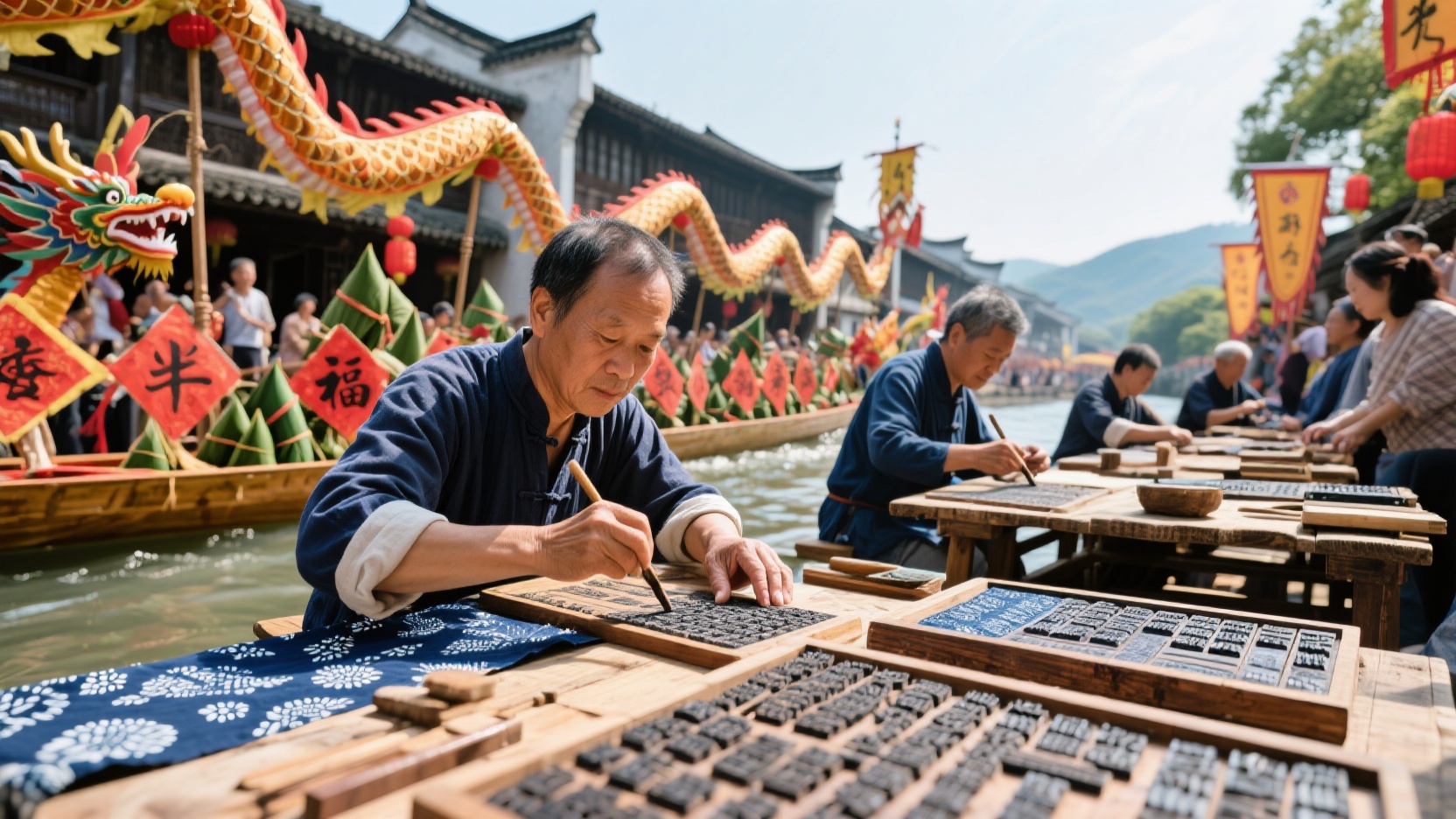
To truly understand Wenzhou, one must not only focus on its renowned landscapes, but also on its lunar calendar. Wenzhou's culture and art are not confined to glass display cases, but rather found in the festive decorations along its streets and alleys, the dragon boat races on the canals during the Dragon Boat Festival, the movable type workshops of Ruian, and the dyeing vats of indigo dyeing. To truly appreciate Wenzhou, follow the seasons and immerse yourself in its charm.
Lanjiefu: A grand market for blessings in the streets and alleys during spring.
The festival takes place from the first day of the second lunar month to the fifteenth day of the third lunar month. In the past, the area from Kanglefang to Fuqian Street in the old city of Wenzhou was the most bustling, but now it's mostly held after the Lantern Festival or during the spring. The core of the event is "blocking the street to pray for blessings." Colorful tents are erected along both sides of the long street, displaying "blessing gifts," lanterns, paper figures, and performances of dragon lanterns, stilt walking, and Wenzhou drum ballad singing. Some streets and alleys also revive "small decorations," using miniature tables, chairs, bowls, and cups to simulate everyday scenes, with exquisite details. In the past, merchants would display sacrificial animals in front of the tents, but now this has been simplified to cakes and seasonal fruits, but the act of "blocking the street" remains unchanged.
The experience doesn't have to be just that of a bystander. You can walk with the crowd from one end of the street to the other, and learn a phrase in Wenzhou dialect, "May you have peace year after year," from the elderly man tending the stall. Or you can sit in a bamboo chair and listen to a drum ballad, the lyrics of which often tell local legends; understanding about 30% is enough to get started. The "Lanjie Fu" (拦街福) originated from street rituals set up during the Ming Dynasty's resistance against Japanese pirates, and later evolved into a festival to welcome the gods. Only by walking the entire street can you truly grasp the Wenzhou people's deep-seated belief in the meaning of "peace."
Dragon Boat Festival: A Grand Promise on the Tanghe River
In Wenzhou, the Dragon Boat Festival is not just about watching dragon boats, but also about watching the "dragon fighting." The main battlegrounds are Huichang Lake and the Wenrui Tanghe River, which take place from the first to the fifth day of the fifth lunar month. Before the dragon boats are launched, there is a "water-launching" ceremony where the rowers wear uniform clothing, the dragon heads are draped in red, and cinnabar is applied to them before they begin paddling. Some dragon boat-making villages enter their busy season as early as the end of April, allowing visitors to closely observe the woodworking, tung oil application, and the craftsmanship of the dragon head carvers. If it happens to be the fifth day of the fifth lunar month, the banks of the Tanghe River are filled with spectators, and the drumming continues from dawn until afternoon.
Watching dragon boat races from the shore is all about listening to the drumbeats and watching the splashes. In Wenzhou, dragon boat racing is about momentum, not just timing. When two boats meet, they often race side-by-side, with rowers shouting in unison to the drumbeats. If permitted, you can tie a red ribbon to the dragon boat before the race begins, or touch the wooden dragon head carving. The fusion of water town beliefs and competition creates a sense of participation far superior to watching a performance at a tourist attraction.
Movable type printing: Working as a musicologist for half a day in Ruian
Dongyuan Village in Pingyangkeng Town, Ruian, still preserves the art of movable type printing, used for genealogy revision. The process can be experienced year-round, with the autumn revision season offering the best glimpse into the actual process. In the workshop, rows of old Song-style typefaces are arranged by rhyme. The genealogist first selects the characters, then typesets them on a wooden tray, applies ink, lays out paper, and uses a palm brush to make the print. There are tens of thousands of commonly used typefaces; just recognizing their positions takes many years. Even today, genealogists in Dongyuan Village use magnifying glasses to proofread the typefaces, and damaged typefaces are immediately repaired. This skill of repairing typefaces is itself an intangible cultural heritage.
Participants can start by selecting their own surname and then print a "福" (Fu, meaning good fortune) character or a small note. This craft is intertwined with Wenzhou's rich clan culture. After Wang Zhen improved movable type in the Yuan Dynasty, Wenzhou people applied this technique to genealogy printing. Sitting down and selecting characters for half a day is more intuitive than reading ten pages of printing history. With each printing, you can hear the subtle "rustling" sound between the wooden plate and the palm brush.
Blue Cloth Tie-Dye: Wedding Memories in a Jar of Indigo
Blue clamp-resist dyeing is a unique technique in southern Zhejiang, and dyeing workshops still exist in Yueqing and Cangnan areas of Wenzhou. Spring and autumn, with their pleasant temperatures, are the best seasons to experience it. The process begins with observing the carved clamping board, then learning how to fold and clamp white cloth tightly before immersing it in an indigo dye vat. After oxidation, the cloth turns from green to blue. Finally, the board is removed, revealing patterns such as "Hundred Children" and "Qilin Bringing a Child." The negative and positive lines on the clamping board determine the resist-dyeing area; the principle seems simple, but removing the board still takes your breath away. The "clamping" is crucial in clamp-resist dyeing; the tighter the clamp, the sharper the pattern boundaries; a slight looseness allows the blue to seep into areas that shouldn't be white.
In the past, blue-dyed cloth was an essential "hundred sons quilt" for weddings in southern Zhejiang, with the quilt cover carrying the family's wishes for offspring. Now, tourists can dye a small square scarf by themselves, and while waiting for the fabric to oxidize, listen to the dyer explain how the term "cloth-dyed cloth" was passed down from the Tang Dynasty to Wenzhou. After half a day, indigo stains their fingers, and the folk custom remains on their hands.
Wenzhou's festivals and folk customs are not tourist attractions, but rather part of daily life that requires physical participation. To truly experience being half a Wenzhou local, you must choose a festival, set aside half a day, dip your hands into the dye vat, listen to the drum performances, and immerse yourself in the crowds of people enjoying the street performances.