
A Night Tour Route in Shenyang | A Tested and Reviewed Route from Hunhe River to Xita (Night Owl Version) (3 Nights' Guide)
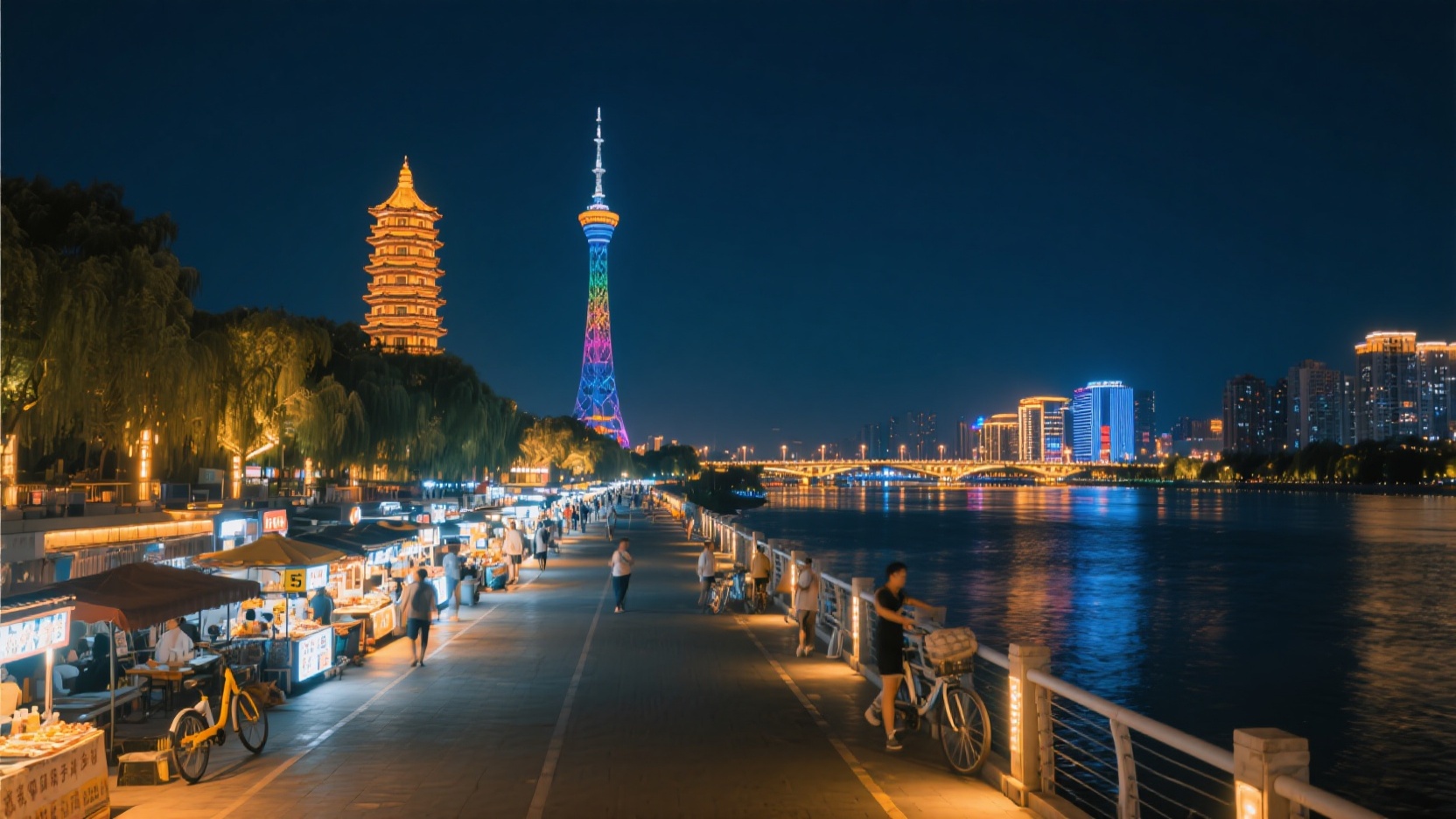
After three nights of exploring Shenyang, I avoided the daytime crowds at the Imperial Palace and Zhang's Mansion, focusing instead on scouting the Hun River and West Pagoda area. Finally, I devised a nighttime tour route from 6:00 PM to 11:30 PM that avoids rushing, detours, and tourist traps. This isn't for first-time visitors to Shenyang who want to see the city at night, but rather for those who wish to discover a different side of Shenyang. The entire route can be completed on foot and by shared bicycle, without relying on a car.
18:00 Hunhe River, Wulihe Section: From the moment the "Big Diamond" lights up, avoid crowding the steps on the south bank.
At 6:00 PM sharp, exiting from Exit B of Wulihe Station on Metro Line 2, it's about a 5-minute walk to the north bank of the Hun River near the Shengjing Grand Theatre. Shenyang doesn't have a sea, but the Hun River, an urban waterway, boasts a density of lights that rivals those of southern riverside cities after nightfall. The facade of the Shengjing Grand Theatre resembles a cut "diamond," and as the sky turns from blue to black, the lights gradually transition from silvery-white to warm yellow, creating the perfect atmosphere with their reflection in the river.
Based on personal experience, I suggest avoiding the waterfront platform directly beneath the theater, as it's the most crowded area with tour groups and live streamers. Walk east along the north bank path for about 800 meters, past the Hunhe Bridge, and you'll find a small viewing platform jutting out into the river. From there, you can simultaneously capture photos of the "Big Diamond," the Hunhe Bridge, and the illuminated lights of the distant Fumin Bridge. This section takes about 30 minutes to walk at a leisurely pace, and the evening breeze prevents it from feeling stuffy. In summer, the lights turn on around 7 PM, and the blues effect lasts only a few minutes, so remember to turn on your camera beforehand.
Around 7:10 PM, I grabbed a shared bike near Wulihe subway station, intending to head to the night market. Avoid riding on the south bank; there's a section of pedestrian path there where electric bikes and bicycles are mixed together, and the night lights aren't bright enough.
7:30 PM Rainbow Tower Night Market: Locals only eat three things; they don't eat everything from start to finish.
The ride from Wulihe Station to Caita Night Market by shared bike is about 3.2 kilometers, taking 18 to 20 minutes at a normal pace. Caita Night Market is a long-established night market in Shenyang, with stalls stretching along the south side of the TV tower, and it's never quiet even on weekday evenings. The first time I came, I walked the whole way, but I was so full after the first half that I could only look at the stalls for the second half. Later, I learned my lesson and only ate three things: Fushun spicy mixed vegetables, grilled chicken frames, and freshly stir-fried mung bean jelly.
Avoid these pitfalls: Skip the long queues at the "tourist kebab" stalls near the night market entrance; they're heavily seasoned but not very flavorful. The stalls further in, near the residential area exit, are where locals stop after work. Ask the vendor to grill the chicken frames longer; sprinkling sugar and vinegar is a local custom, not some weird dish. You can eat very well here for just a few dozen yuan per person, so don't order too many main dishes—save room for the Xita Tavern.
After leaving the night market around 9:00 PM, avoid taking a taxi near the TV tower, as the intersection is congested and parking is difficult. Shared bicycles are a faster option.
21:10 Xita Tavern: Rice wine with pollack, more rustic than trendy bars
After leaving the Caita Night Market, ride a shared bicycle west along Xibinhe Road for about 1.6 kilometers, which will take just over 10 minutes to reach Xita Street. Why choose a small bar instead of a livehouse? Shenyang Xita is the largest Korean ethnic minority area in Northeast China. After nightfall, Xita Street is densely packed with Korean-language signs. Locals' late-night snacks are not electronic music and craft beer, but a pot of homemade rice wine, a few grilled pollacks, and half a portion of spicy crab.
Based on my personal experience, most of the taverns in Xita are hidden on the second floor or semi-basement of buildings along the main street. The older the storefront, the better the food is likely to be. Start by ordering a pot of warm rice wine, followed by grilled pollack and mixed tofu. Some shops will offer complimentary side dishes. A slight buzz is just right; don't order too much spirits, as you'll be taking photos at night later. This stop lasts until around 11 PM, and feels most like a typical weekend night for a local in Shenyang.
Tips for choosing a restaurant: Restaurants with only Korean menus and no waiters soliciting customers are generally more reliable than chain stores with exaggerated neon lights. If you don't know what to order, let the owner arrange it according to the number of people; the average cost per person is between tens and hundreds of yuan.
23:00 Night photography and wrap-up at West Tower: 5 camera positions yielded better results than during the day.
After leaving the Xita Bar, don't rush back to the hotel. Xita Street is actually more suitable for taking photos after 11 PM. The blogger has compiled a list of 5 photo spots that were worth taking pictures at, based on personal experience: First, the observation deck on the north bank of the Shengjing Grand Theatre, a low angle with reflections on the water; second, the corner of the pedestrian walkway on the east side of the Hunhe Bridge, where you can capture car trails and building light strips in the same frame; third, the pedestrian overpass in the middle of the Caita Night Market, shooting from above the warm lights of the stalls and the flow of people; fourth, the pedestrian overpass in the middle of Xita Street, shooting down at the Korean-language shop signs and car headlight trails; fifth, outside the red wall of Xita Temple, avoiding electric vehicles, only capturing the red wall and streetlights.
This section is about a 5-minute walk from Xita Bar to the overpass in the middle of Xita Street, and then about an 8-minute walk along the street towards Xita Temple. You can basically finish taking photos and call it a day before 11:30 PM, just in time to catch the subway or a ride-hailing service. Note that the area outside the red walls of Xita Temple is a residential area, so please do not use flash to take photos of the residents' windows.
Blogger's Summary and Security Tips
This route is suitable for independent travelers who enjoy city night tours from summer to early autumn but don't want to crowd into daytime attractions. If you're traveling with elderly people or children, it's recommended to skip the Xita Bar and only visit the Hunhe River and Caita Night Market. In a four-day, three-night Shenyang trip, taking one evening to follow this route will allow you to see half again as much local life as you would during the day. The entire route is neither rushed nor circuitous, making it suitable for night owls who come to Shenyang for a weekend getaway.
Safety Tips: Do not wear noise-canceling headphones when riding along the Hun River at night, as some sections of the road are poorly lit; the Caita Night Market is crowded, so keep your phone and camera in your chest bag or inner pocket; do not ride shared bicycles after drinking at the Xita Bar, and do not walk through the back streets of old residential areas in Tiexi; when returning after 11 pm, it is recommended to take Metro Line 2 or a regular ride-hailing service, and do not take unlicensed taxis soliciting passengers on the roadside.