
Four Seasons of Intangible Cultural Heritage in Northeast China: A Half-Day Immersive Guide to Shenyang Temple Fair, Paper Cutting, Liao Porcelain, and the Westward Migration Festival
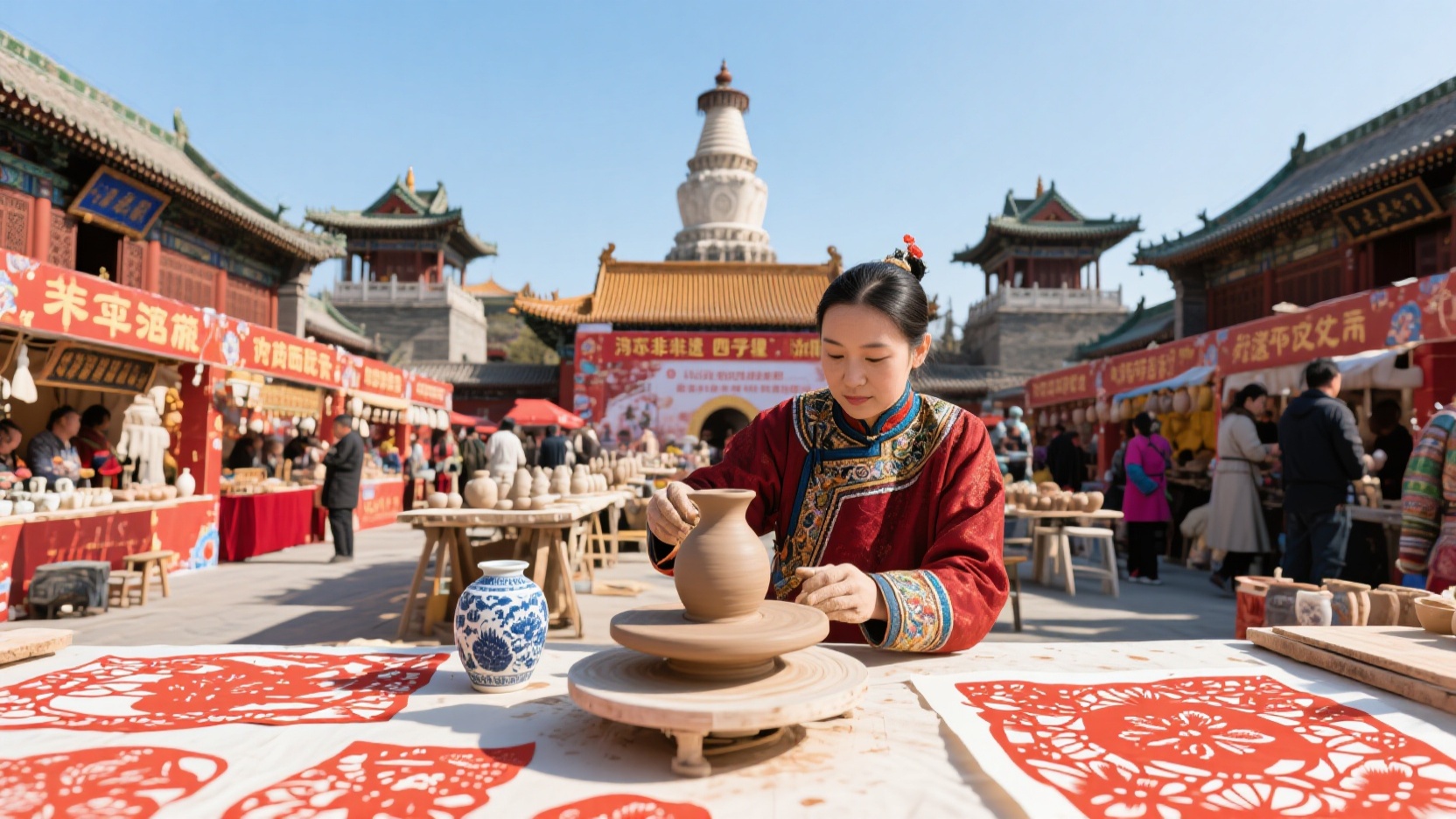
Shenyang's cultural density is often overshadowed by the Forbidden City and the Zhang Family Mansion. What truly captivates visitors are the everyday life of Shengjing scattered throughout festivals, temple fairs, and intangible cultural heritage workshops. Spend three half-days at the North Market attending the Imperial Temple Fair, cutting out a "grandma figure" at the paper-cutting table, and then picking up a small Liao porcelain cup. If the timing happens to fall on the 18th day of the fourth lunar month, the Westward Migration Festival in front of Taiping Temple will complete the most complete narrative of Northeast China.
Imperial Temple Fair: A grand Northeast market held between Shisheng Temple and Taiping Temple.
The Huangsi Temple Fair is not an appendage of a single temple, but a large market centered on the North Market, sandwiched between Shisheng Temple and Taiping Temple, the ancestral temple of the Xibe people. It is held primarily during the Spring Festival, Dragon Boat Festival, and National Day, reaching its peak in the first month of the lunar calendar. On winter mornings, the North Market is often enveloped in the aroma of charcoal fires and the sounds of folk dances and drums. Entering from the Shisheng Temple side, one can see stilt walking, folk dances, excerpts of Fengtian Luozhi dance, and dragon dances, before continuing along the main street towards Taiping Temple. Stalls sell not only snacks but also Manchu paper-cutting, dough figurines, rubbings of Liao Dynasty porcelain fragments, and knot tying. The real highlight of the fair lies in the "market sandwiched between two temples": Shisheng Temple is a Lama temple built by imperial decree during the reign of Emperor Huang Taiji, while Taiping Temple is the ancestral temple of the Xibe people. It's recommended to stop in front of the westward migration relief at Taiping Temple and remember the images of the groups facing away from Shengjing (Mukden). Then, return to the stalls to look for folk symbols related to the westward migration. If you have time, first look at the westward migration route map, then look for the "Xili Mama" rope knot image, which is a rope totem used by the Xibe people for recording events. If you visit during the first month of the lunar calendar, you can also see the lantern procession and the "Jumping Official" performance. These are not fixed attractions, but rather part of the old Shenyang New Year customs in the North Market.
Manchu paper-cutting: Using "grandma people" to cut out prayers from shamanistic beliefs
Shenyang Manchu paper-cutting is represented by projects such as "Early Spring Branch Manchu Paper-cutting," characterized by "no drafts, sharp cuts, and intricate openwork." The experience usually begins with a square piece of red paper, folded in half without altering the cut, and followed by the inheritor to cut out a "Momo figure"—a standing figure with slightly apart arms and extremely simplified facial features, sometimes wearing a flower crown or holding a willow branch. In Manchu folk beliefs, the Momo figure is regarded as an ancestral and protective deity, pasted on walls or windows to protect the home and children. After completing the main body, willow stripes, fire patterns, or ancestral rope patterns can be added; the scissors should not be too precise, as small cuts retain the rustic charm of northern paper-cutting. The instructor will remind you of the cutting order: small to large, inside to outside, and use your fingernail to pry open the cut rather than tear it. The entire session lasts about forty minutes to an hour, suitable for combining with a half-day trip to the Imperial Temple Fair, transforming the symbols seen in the market into your own handmade memories.
Liao porcelain throwing: using northern clay to recreate the glaze colors of the border between grassland and farmland.
Liaoning is an important site for the discovery of Liao Dynasty ceramics. Shenyang and its surrounding areas frequently yield Liao white porcelain, Liao sancai (three-color glazed pottery), and vessels resembling chicken-crest ewers. Unlike the experience of fine porcelain in the south, Liao porcelain workshops use local clay with a noticeable granular texture. When throwing the clay, the heel of the hand must be used to press it firmly, keeping the center of gravity low to prevent collapse. Because northern clay has a high sand content and absorbs water quickly, hands should be frequently moistened, but not excessively; when lifting the clay, the fingertips should be used to apply even pressure from the bottom outwards. The craftsman usually starts by teaching how to knead the clay and find the center, then makes a small cup or jar; next, the foot is trimmed, string patterns are carved, or simplified lotus petals are added, and finally, a milky white or light green glaze is applied. The foot trimming is a highly distinctive step in the Liao porcelain experience: a slightly wide foot ring is shaved with a bamboo knife, retaining the knife marks, rather than being polished to an industrial smoothness. The core aesthetic of Liao porcelain is "imperfection": the foot ring retains the turning marks, the carved patterns do not require symmetry, the glaze is thick and warm, and the crackles are fine. Sitting in front of the rotating wheel for forty minutes provides a better understanding of how the porcelain-making traditions of the Khitan, Bohai, and Central Plains converged around Shengjing than simply looking at ten pieces of Liao white porcelain from outside the display case.
Xibe Ethnic Group's Westward Migration Festival: On the 18th day of the fourth lunar month, listen to a recitation and the Belen dance.
Every year on the 18th day of the fourth lunar month, the Taiping Temple area holds the Westward Migration Festival. In 1764, the Qing government conscripted Xibe soldiers and their families from Shengjing to migrate westward to Yili, Xinjiang, to guard the border. Before their departure, they held ancestral worship ceremonies at Taiping Temple, and this day has since become the most important commemorative day for the Xibe people. On that day, there are sacrifices and recitations in front of the ancestral temple, recounting the ethnic group's memories of the westward migration journey; in the afternoon and evening, people gradually form a circle to dance the Beren dance. The Beren dance movements mostly imitate horseback riding, archery, harvesting, and carrying loads, with a rhythm that gradually increases in speed, and footwork mainly consisting of tapping the ground, following along, and stomping. Tourists don't need to stand outside the circle holding up their phones; they can join the outer circle to learn a basic set of steps: relax your body, let your arms swing naturally with your shoulders, and pay attention to the rhythm of the accordion or dombra. When you're dancing until you're sweating, the historical term "westward migration" is no longer just text on a display board, but a tangible sense of migration and reunion.
These four activities can be experienced independently or combined into a two- to three-day Shenyang intangible cultural heritage tour: the Huangsi Temple Fair and Manchu paper-cutting are suitable for half a day, Liao porcelain throwing is suitable for the afternoon, and the Westward Migration Festival should be arranged according to the 18th day of the fourth lunar month. A cultural and artistic tour of Shenyang should not only focus on static exhibits. Only by sitting down and using scissors, throwing a piece of clay, and learning a Beren dance can one truly step into the folk customs of Northeast China.