
Shanghai's Wutong Corner Line | I walked this 4km Citywalk six times before daring to compile this (Autumn Avoidance Version)
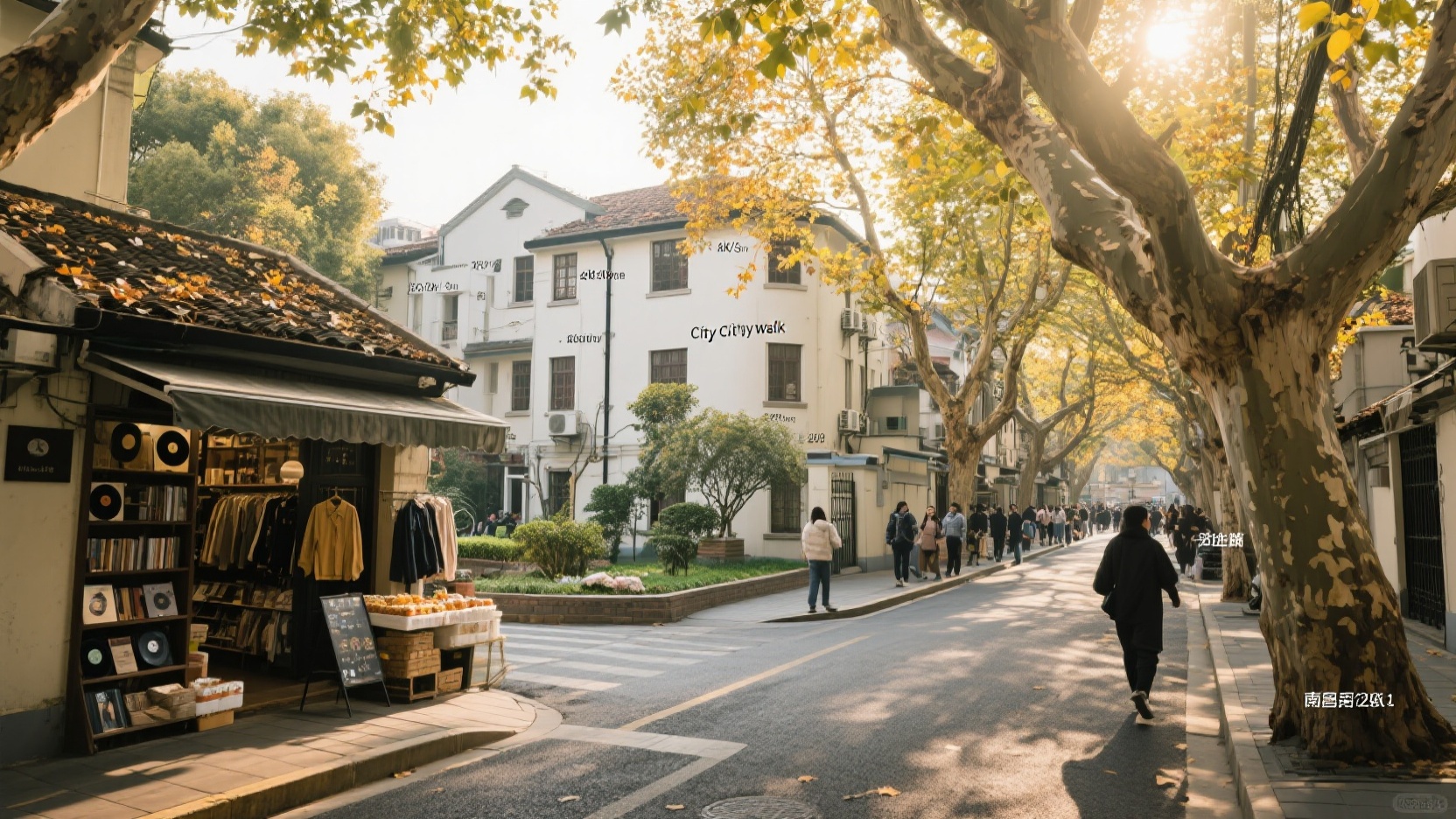
The first time I followed the popular route along Wukang Road, I was pushed along by the crowds at the Wuyuan Road intersection for twenty minutes, and my camera was full of pictures of the backs of people. Later, I changed my approach: starting from Nanchang Road, I used Sinan Road and Fenyang Road as the main axis, with a main route of about 4 kilometers and two branch routes totaling about 1.5 kilometers. This avoided the most congested 800-meter stretch of Anfu Road, but instead connected old villas, farmers' markets, vinyl record stores, vintage clothing stores, and pocket parks into a one-way route.
Route outline: 4km main route + 2 branch routes, best entered before 10:00 AM.
Let's start with the basic structure of this route. It begins at Shaanxi South Road Metro Station and ends at Jiashan Road Metro Station, a main line of approximately 4 kilometers, taking about 1 hour and 40 minutes on foot. If you plan to stay along the route, it's recommended to allow 4 hours. The best time to visit is late November to early December, when the plane tree leaves haven't been swept away and the sunlight is just right; enter Nanchang Road before 10 AM on weekends to avoid the crowds. There are two branch lines, one turning from Sinan Road to Xiangshan Road and the other from Fenyang Road to Taojiang Road, each about 700 meters long, taking no more than 20 minutes round trip.
Starting point of Nanchang Road: Vegetable baskets and "New Youth" magazine are placed on the same street.
The starting point is Exit 7 of Shaanxi South Road Metro Station, then walk east along Nanchang Road for about 10 minutes. This street is short, but it offers a glimpse into Shanghai's most authentic "community spirit": on one side is the French-style corridor of the Science Hall, and on the other, elderly people carrying groceries stand in front of small vegetable shops picking out water chestnuts. The blogger's camera position is under the red brick wall opposite the Science Hall, using a low angle to capture the shadows of the plane trees within the French arched windows; why stop and watch for 5 minutes? Because before 9 a.m., the light slants through the plane trees from the east, creating a dappled, dancing effect on the wall—the same light and shadow as on Wukang Road, but without a dozen phones held up simultaneously.
Walk two minutes further east, near the old Yuyangli neighborhood, and you'll find a sign pointing to the former site of the editorial office of *New Youth* magazine. Don't rush to take a picture; turn into the alleyway first and stand there for a while. The carved decorations on the lintels of the old Shikumen houses and the bamboo clotheslines framed together are more pleasing to the eye than a frontal photo. Slow down your pace on this section; the calls of vendors from the local grocery stores and the steam from the coffee machines will blend together, creating a unique background soundscape on Nanchang Road.
Sinan Road Branch Line 1: Turn onto Xiangshan Road, and listen to the falling leaves in front of the former residences from the Republic of China era.
From the intersection of Nanchang Road and Sinan Road, head south for about 12 minutes to reach Sinan Road. Don't rush to Fuxing Middle Road on the main road yet; the first fork in the road is on Gaolan Road: the Orthodox Church of Our Lady on the west side, and Xiangshan Road on the east side. The round trip on the branch road takes about 15 minutes and is recommended for those wanting to see former Republican-era residences and poetry bookstores. In front of the main entrance of the Orthodox Church of Our Lady, use a wide-angle lens to photograph the dome and the plane tree branches forming a triangle. Sit down and wait two minutes; a flock of pigeons will fly by. Why is it worth spending 5 minutes looking at it? This Byzantine-style chapel stands out strikingly in the plane tree district. At 3 pm in late autumn, warm light shines on the blue-green dome, resembling an empty shot from an old Shanghai film.
Continuing along Xiangshan Road, the walls surrounding Sun Yat-sen's former residence are not high, and when the iron gate is half-closed, you can see the steps of the old Western-style house from the street. It's not recommended to rush into the museum; just take a picture of the "wall and lampposts" under the plane trees on the opposite side of Xiangshan Road, because the real beauty of this side street lies in the undulating road surface and the tightly closed old wooden doors on both sides. If it rains, the reflection of the bluestone slabs will turn the whole street into a low-saturation film, which is actually more photogenic than on a sunny day.
Fenyang Road Branch Line 2: Qinfang Bailou Back Street, Shanghai suddenly became quiet.
Returning to Sinan Road and continuing south, after passing the intersection with Fuxing Middle Road, walk southwest for about 15 minutes to reach Fenyang Road. This section passes by the outer wall of the Shanghai Conservatory of Music. If you happen to be there on a weekday morning, you can faintly hear etudes coming from the practice rooms. Don't take photos from the main entrance; instead, go around to the opposite side of the small white building on Fenyang Road, using the plane tree leaves as a foreground to frame the white old villa and wrought iron railings. Why is it worth spending 5 minutes here? Because there's no sense of ceremony like at an exhibition entrance; instead, it feels like a private residence forgotten by time, perfect for taking a photo of the "architectural fabric of Shanghai's old concessions."
The second branch line is at the intersection of Fenyang Road and Taojiang Road: turn onto Taojiang Road and the small loop of Dongping Road, a round trip of about 20 minutes. The Taojiang Road and Dongping Road area is home to old Western-style houses from the Republican era, such as the former residence of Song Ziwen and Chiang Kai-shek's "Ai Lu," but most of them are not open to the public. The camera is positioned at the corner of the wall at the end of Taojiang Road, using a telephoto lens to compress the depth of the blue brick wall and the plane trees lining the road. The reason for stopping for 5 minutes is very personal: there are almost no tourists on this road, only local uncles walking their dogs, and you can hear the faint sound of their shoes crushing sycamore fruits.
Yongjia Road to Jiashan Road: A farmers' market, vinyl record stores, and vintage clothing shops are hidden in the shade of plane trees.
Walking southwest from Fenyang Road along Yueyang Road or Yongjia Road for about 20 minutes, you'll reach the area around Yongjia Road and Jiashan Road. This is the most vibrant and down-to-earth part of the entire route. First, pause for a moment in front of a small vegetable shop at the intersection of Yongjia Road and Jiashan Road: the clover and shepherd's purse in bamboo baskets still have mud on them, and the noodle shop exudes the smell of alkaline water. Position your camera diagonally opposite the shop, wait for an elderly person carrying a plastic bag to pass by, and capture this "everyday life in a corner of Shanghai's Wutong District." Why is it worth stopping for 5 minutes? The scenes of familiar faces buying groceries in the heart of Wutong District, the city center, are closer to the local Shanghai than any tourist hotspot.
A three-minute walk north along Jiashan Road reveals a vintage clothing store tucked away on the second floor of an old Western-style house, its window displaying only an old top hat and a potted Monstera deliciosa. A little further down the street, a vinyl record shop is hidden next to a bubble tea shop; pushing open the door, you'll hear jazz music. Both places are unassuming, so I wouldn't recommend queuing; just glance at the windows as you pass by. Nearby, there's also a pocket park less than 200 meters away, with a few benches under three sycamore trees—perfect for letting your freshly bought coffee cool down before continuing on your way.
Blogger's Summary and Practical Tips List
The blogger summarizes: This route is best enjoyed on Sundays or Mondays; avoid Saturday afternoons as the crowds on Sinan Road will double. The main 4-kilometer stretch isn't difficult, but the cobblestone streets and fallen plane tree leaves can be slippery in the rain, so wear flat shoes. It doesn't focus on a large number of "check-in points," but rather connects some of the most culturally rich corners of Shanghai's Wutong District, making it ideal for a leisurely solo stroll or a weekend getaway from the crowds on Wukang Road.
Here are some practical tips: First, try to enter Nanchang Road around 9 AM; the corners of the neighborhood grocery stores offer the best photo opportunities. Second, you can choose only one of the two side routes: choose Xiangshan Road if you like old residences from the Republican era, or choose Taojiang Road if you prefer quiet old villas. Third, bring a telephoto lens; the shop windows on Taojiang Road and Jiashan Road are worth compressing the depth of field for. Fourth, there are no mandatory expenses throughout the trip; cafes and bookstores cater to all budgets, with prices ranging from tens to hundreds of yuan per person. Fifth, cloudy days produce better photos than sunny days, but be careful of slippery old alleyway tiles on rainy days.