
Nantong Night Walk Map | A Non-Tourist Riverside Night Tour Route I Compiled After Three Nights of Walking (Avoiding Pitfalls + 5 Camera Spots + Summer Test)
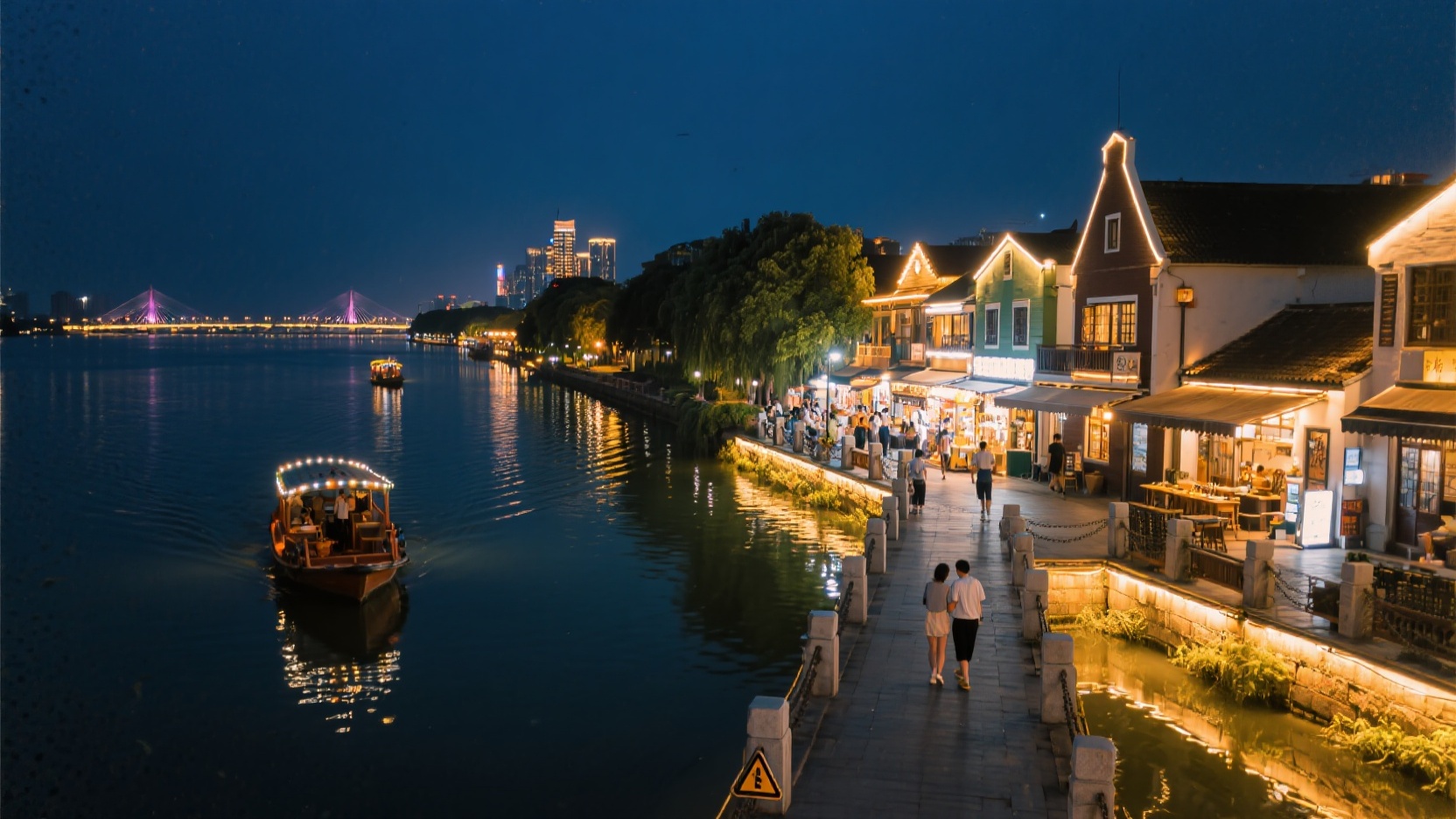
To verify whether Nantong's night tour only has one cruise route, I walked from Wenfeng Park to the Yangtze River for three consecutive nights, experiencing all the pitfalls of road closures due to construction, night market shutdowns, and teahouses not accepting late-night customers. In the end, I settled on this one-way route from 6:00 PM to 11:30 PM. It connects the sunset over the Haohe River, the lights of the Yangtze River, the local night market, and the guqin teahouse into one line, suitable for those who want to wander around without a specific destination.
18:00-19:15 Southeast section of the Haohe River: Enter at dusk, do not wait until dark to circle the river.
My mistake on the first night was waiting until 7:30 PM when the lights came on before going to the Haohe River. As a result, the Yiqiao and Nanyuanqiao areas were packed with people taking pictures of the reflections, and there were no good spots along the stone railings. The next day, I changed my approach and started from the south gate of Wenfeng Park at 6:00 PM, slowly walking north along the southeast bank path. I ended up seeing the softest light of the day: a blue sky pressing down on the Haohe River, the TV tower not yet fully lit, and the shadows of the dawn redwood trees reflected in the water, making for even better photos than the night view.
This section is about 1.5 kilometers long and takes 15 to 20 minutes to walk, without needing to cycle. The riverside path is narrow, shared bicycles are prohibited, and pushing a bike will be even slower. We reached the west side of the sports park at exactly 7:10 PM. There are benches nearby where you can sit and wait for it to get completely dark. Don't linger too long on this first section, because the riverside area is the main attraction later on.
19:20-20:10 Riverside Park Embankment: 20 minutes by shared bicycle, avoiding the road construction section at the North Gate.
From the southeast bank of the Haohe River, scan a shared bike, head south along Chengshan Road, then turn onto Hongqiao Road. It's about 4.5 kilometers, and I measured the ride in 20 minutes. Here's a pitfall: the north gate of Binjiang Park is currently under construction. If you follow the navigation, you'll end up on a dead end. The correct way is to enter from the small entrance on the south side near the river embankment. Ask the water vendors nearby for the exact location; that's more reliable.
Once inside, you must dismount and push your bike. The riverbank walkway is about 800 meters long, and it takes about 10 minutes to walk to the lighthouse. The lights along the Yangtze River are completely different from the city lights; there are no large-scale illuminations, only navigation lights, the portholes of ferries crossing the river, and low-lying strips of light from Changshu and Zhangjiagang on the opposite bank. Langshan Mountain is just a dark shadow. After 7:50 PM, the river breeze will get cool; it's best to bring a light jacket in summer. This 20-minute bike ride plus 10-minute walk is the section of the entire route that most feels like "leaving Nantong city."
20:20-21:30 Holland Street Night Market: A popular spot for local students, more night-viewing friendly than South Street.
From the south entrance of Binjiang Park, it's about an 18-minute bike ride, roughly 5 kilometers, to reach Holland Street Night Market. This is a spontaneously formed late-night food area near Nantong University, with few tourists; it's mostly students and local residents. On my first night, I arrived at 9:40 PM, and a third of the stalls were already packing up. On my second night, I entered at 8:20 PM, just in time for the busiest time.
The proper way to eat here isn't at one all-you-can-eat stall, but rather by walking around the main street first, checking which stalls have the best wok hei (wok aroma) before turning back. I particularly liked a stall selling brown sugar lotus root starch; the owner would add a spoonful of dried osmanthus flowers. There were also a few unsigned fried skewer shops with sweet and salty sauces, typical of Nantong. The whole street costs only a few dozen yuan per person, and two people can try five or six different dishes for less than the price of a proper meal. Remember not to take photos while walking; you might bump into your equipment amidst the frying pans and crowds.
21:40-23:00 Southwest Camp Old House Teahouse: Mei'an Qin School is more Nantong than a bar.
About a 15-minute bike ride from Holland Street Night Market, I ventured into the Southwest Camp Historical and Cultural District. Many shops were closed at night, leaving only a few lanterns illuminating the old brick walls. Of my three choices for nightlife, I opted for an old-style teahouse instead of a pub or live music venue. The reason was that Nantong boasts a rare city-named guqin (a seven-stringed zither) school, the "Meian Qin School." Listening to a piece of guqin music in an old house with a courtyard felt more in tune with the city's essence than any craft beer.
The teahouse has no performance time limit; you can sit until closing time with just a cup of inexpensive covered-bowl tea. The guqin player usually plays two or three short pieces before 10 PM, after which the tea drinkers chat quietly. The old house is a wooden structure with excellent acoustics, so it's not suitable for loud noise. If you're not interested in the guqin, there are small bars and live music venues in the next alley, but the atmosphere becomes just another generic nightlife. I suggest arriving before 9:40 PM to secure a spot near the courtyard and not miss the final notes of the guqin performance.
Night Shooting: 5 Camera Positions and Safety Tips
Night Shooting Spots: Spot 1: The stone railing north of Yiqiao Bridge on the Haohe River, showing the TV tower and its reflection in the river; blue tones create a more three-dimensional effect than pure black. Spot 2: Directly west of the lighthouse in Binjiang Park, using the riverbank railing as a foreground, waiting for a ferry to cross the river to enter the frame. Spot 3: The second-floor corridor east of Holland Street, capturing the neon lights of the night market and the smoky aroma of cooking pots; a telephoto lens is better than a wide-angle lens. Spot 4: The courtyard of the old teahouse in Southwest Camp, capturing the lanterns and wooden eaves; do not use flash. Spot 5: On the return trip, shoot the Haohe River from the north side of the South Street Bridge; the lights on the opposite bank are just coming on, making it the best spot for the final shot.
Four safety tips: First, do not linger alone on sections of the river embankment without streetlights; take photos in groups or move to well-lit areas near the lighthouse. Second, shared bicycles must be returned within designated electronic fences; parking is prohibited near the north gate of Binjiang Park, and forcibly locking them will incur a dispatch fee. Third, night markets are crowded and noisy; use lanyards for your phone and camera, and avoid taking photos while eating fried skewers. Fourth, remember to bring mosquito repellent and a light jacket for summer night outings; the temperature along the river is three to four degrees lower than in the city, and you may catch a chill when cycling back to the city.
This route takes about five and a half hours, with no turning back, and it perfectly captures the waterfront lights, everyday life, and guqin music of Nantong. Daytime cruises on the Haohe River can't offer the details that can only be seen on foot, and the hour spent at the teahouse brings the night tour back to a more relaxed, seated experience. It's recommended to go on a Friday or Saturday in the summer when the night market and teahouses are most open; if you only have weekdays, be sure to visit the night market section around 8:00 PM.