
These 5 kilometers in Haikou | My secret Citywalk list of arcade streets that I walked three times before daring to share (including 2 branch routes to avoid crowds)
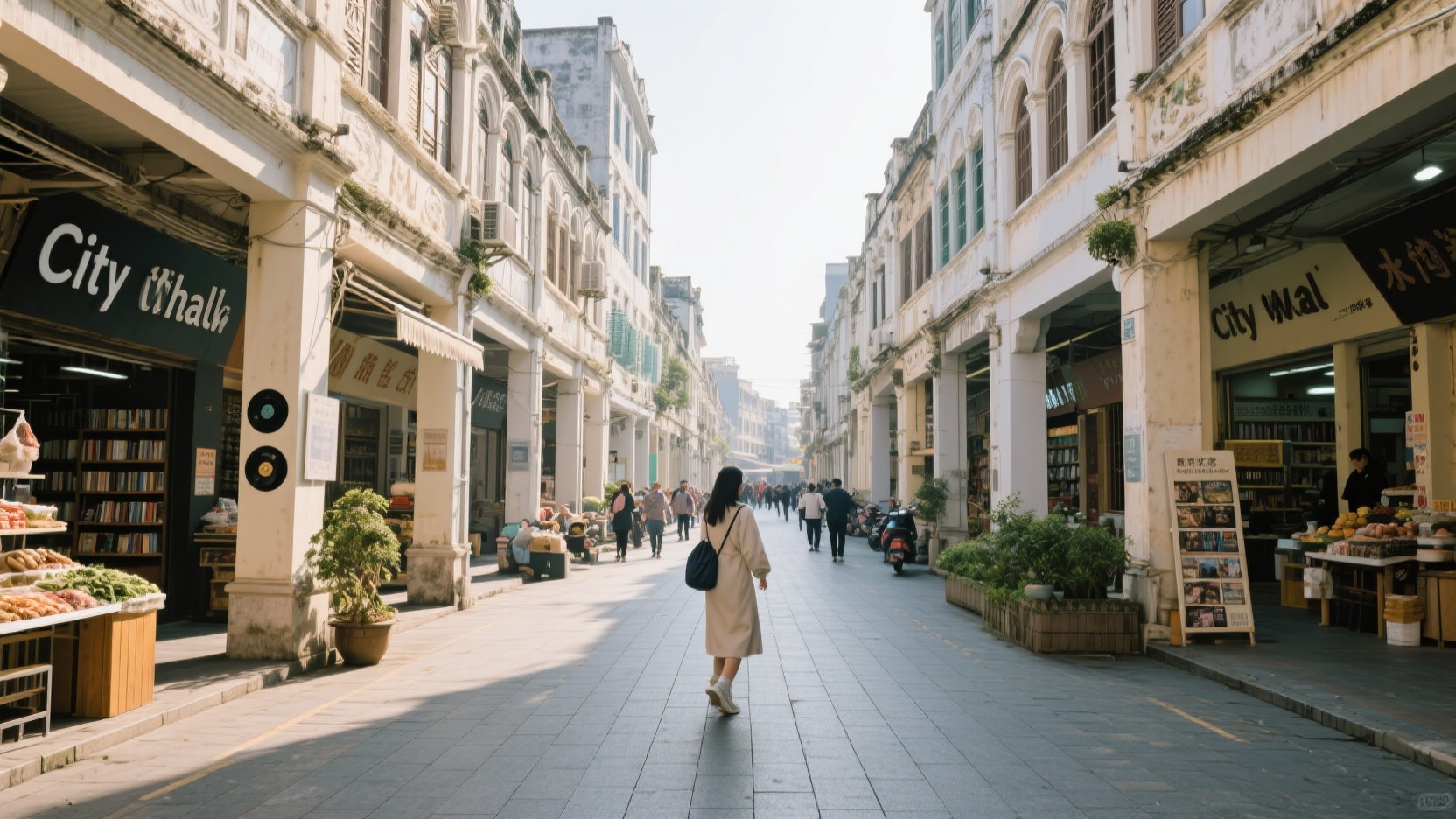
First-time visitors to Haikou often mistake the Qilou Old Street for a single street, simply walking from one end of Zhongshan Road to the other and considering it a complete visit. I did the same on my first two visits, but on my third, I realized that the most worthwhile part of Haikou isn't any particular building, but rather the vibrant life within the five-kilometer stretch from the Bell Tower to People's Park, a blend of Qilou buildings, farmers' markets, vinyl record shops, and the sounds of Hainanese opera. I retraced this route three times over three days, avoiding tour group routes, and developed it into a main route with two branch lines.
A quick overview of the main route: a 5-kilometer "arcade-style living belt" with no backtracking.
The main route starts from the Bell Tower in Haikou and ends at East Lake in People's Park, approximately 3.8 kilometers long. Two branch routes diverge at Shuixiangkou and Bo'ai North Road respectively, extending the route to 5 kilometers. The overall sequence is: "Bell Tower—Zhongshan Road—Shuixiangkou—Dongmen Market—Bo'ai North Road—West Gate—People's Park". It is recommended to start in the afternoon from November to March of the following year, when the sunlight shines obliquely on the arcade buildings and the temperature is suitable for walking.
If you only want to follow the main route, it will take about two hours; however, the real time-consuming part of this route is the "5-minute stops," so it is recommended to allow more than three hours.
First section: From the Bell Tower to Zhongshan Road, don't look at the arcade buildings yet, first see how they were used (about 10 minutes walk).
Starting from the Haikou Clock Tower, the camera was positioned outside the railing on the north bank of the Haidian Creek, placing the clock tower, coconut trees, and the old customs house in the same frame. Why stop for five minutes? Here you can see the relationship between Haikou's "sea" and its "city." Around four o'clock in the afternoon, the clock tower chimes on the hour, and the old residents of Haikou unconsciously adjust their watches; on the opposite bank of the creek are newly built high-rises, while the old ferry still rests nearby—the city's transformation is fully captured in this single frame.
Walk about 400 meters along Changdi Road to enter Zhongshan Road. Don't stand in the middle of the road; crouch down under the pillars of the arcade buildings to capture the perspective lines of the arches, or find an open window on the second floor to photograph the clotheslines. Why stop for 5 minutes: Many arcade buildings on Zhongshan Road aren't empty shells; people still live on the second floor. In the afternoon, the slanting sunlight illuminates the parapets and gray plasterwork, making them more visually appealing than the "Arcade Old Street" plaques. This section of the walk takes about 10 minutes.
Hidden in the middle section of Zhongshan Road are independent bookstores and cafes: one bookstore is tucked away on the second floor, with a staircase so narrow you can only pass sideways; across the street, a cafe with its old wooden shutters is preserved. The camera is positioned against the light from the bookstore window, capturing the spines of the books against the street, and at the cafe's entrance, showing the old paving stones. The five-minute stop isn't because of the abundance of shops, but because the commercial aspect of this street hasn't completely overshadowed the residential areas.
The second section: from Shuixiangkou to Dongmen Market, the vegetable market is the stomach of the arcade buildings (about 15 minutes walk).
Turning from Zhongshan Road into Shuixiangkou, the density of spicy soup rice and seafood stalls immediately increases. The camera position is at the three-way intersection of Shuixiangkou, shooting from a low angle with the signs and clotheslines in the same frame. Why stop for 5 minutes: the back of the arcade buildings is more authentic than the front; bamboo poles extend from the second-floor balconies, low tables are placed at the entrance on the first floor, and in the evening, the smell of coal stoves mixed with the sea wafts out. This alley is narrow, allowing a perfect view of the original "houses above, shops below" structure of the arcade buildings.
The entrance to Dongmen Market is Haikou's most vibrant and colorful scene. Position your camera against the light on the side of the entrance, capturing the crowds and the red and blue sunshades, without using flash. Stop for five minutes to look at the dried seafood, local pickled vegetables, and vinegar stalls. This isn't just about buying groceries; it's about observing the diverse tastes of Haikou residents. Continue along Bo'ai North Road, where old cloth shops and couplet shops line the street. Capture close-ups of the craftsmen writing couplets by hand. Aim your lens at the shop doors and arcade pillars—a living example of Haikou's old-style "front shop, back residence" layout.
Two branch roads branch off: one offers views of the sea, the other of the old town (each about a 10-15 minute walk).
Branch Line A leads north from the waterway entrance to the Haidian Creek. The camera is positioned near the old wharf's iron railings, capturing the old ship piers and the new buildings on the opposite bank. A five-minute stop is made to observe fishermen mending their nets and small boats leaning against the bank—evidence of the arcade buildings as a port area. Branch Line B turns from Bo'ai North Road onto Jiefang West Road and then towards Xinhua South Road. The camera is positioned between the old cinema wall and the shadow of a large banyan tree, capturing the gray tones of the arcade buildings and old work unit dormitories. A five-minute stop is made to observe the old-style barbershop and herbal tea shop, lacking the uniform signs typical of tourist areas.
You don't need to complete both of these branch routes: if you're in a hurry, choose route A, which takes about 20 minutes round trip; if you prefer the old town, choose route B, which takes about 25 minutes round trip. On my third scouting trip, I only took route A and then returned to the main route from Bo'ai North, which didn't affect my pace at all.
The third section: from the West Gate to People's Park, ending at a pocket park (approximately 15 minutes walk).
Walking from Bo'ai North Road to the West Gate Market, it's quieter and more like a local's daily life than the East Gate Market. Position the camera against the light at the market entrance, capturing the vendors and the cobblestone path. Stop for five minutes to admire the Li ethnic silver jewelry, old clocks, and Republic-era cigarette labels at the antique stalls. No need to ask prices; just watching the gestures between the vendors and buyers is fascinating. Nearby alleys also have vintage clothing stores and vinyl record shops. One shop, on the second floor of an arcade, has only a handwritten sign hanging at the entrance; pushing it open reveals another era.
After exiting the west gate, walk towards People's Park and enter Donghu Pocket Park. Choose a good spot with your camera at the pavilion in the middle of the lake and the Nine-Turn Bridge to capture the reflection of the coconut palms; or take photos of amateur Hainanese opera performers by the stone benches by the lake. Stop for 5 minutes to listen to locals sing Hainanese opera and play chess – this is the easiest way to experience local culture in Haikou. Exiting from the north gate, you can return to the arcades along Datong Road without backtracking.
Blogger's Summary and Practical Tips List
What impressed me most about this route wasn't the arcade buildings themselves, but the fact that the arcade streets are still used by locals as markets, fabric shops, stages, and living rooms. You don't need to specifically look for "photo spots"; just stand at the intersection for five minutes, and you can see the rhythm of life in old Haikou.
Practical Tips: First, it's recommended to start after 2 PM, as the lighting is better for photographing the arcade buildings and gray-plastered structures. The Dongmen Market is also busiest after its lunch break. Second, wear comfortable walking shoes, as the paving stones under the arcade pillars are uneven, and some alleys are so narrow that people can't walk side by side. Third, the spicy soup rice at Shuixiangkou and the snacks near Ximen are relatively inexpensive; you can eat a very local meal for just a few dozen yuan per person. Fourth, most vinyl record shops and vintage clothing stores only open after 4 PM, so don't try to find them in the morning. Fifth, there are few public restrooms throughout the area, so it's recommended to use the facilities near the Bell Tower or in People's Park. Sixth, if you want to avoid crowds, avoid the Dongmen Market area during the week before the Spring Festival and on weekend afternoons.