
A leisurely stroll through Guiyang's 4km old street | Blogger's personally tested list to avoid common pitfalls: Capture the Republican era feel without crowding Jiaxiu Tower (Autumn Afternoon Edition
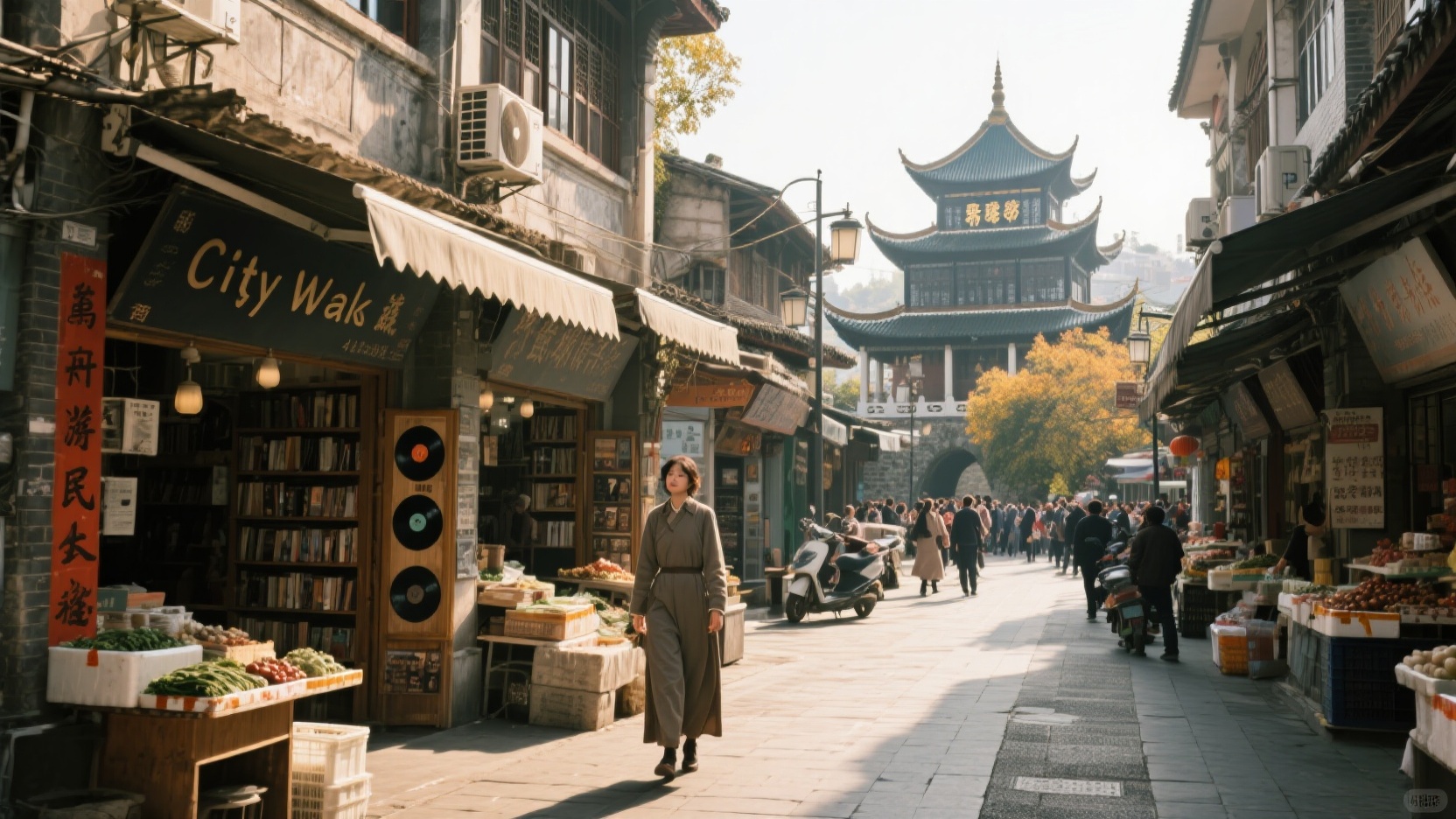
On my third trip to Guiyang, I removed the "must-visit artsy spots" from my list. The first two times, I followed the guidebooks, only to find Jiaxiu Tower packed with people and Diantai Street reduced to a bubble tea shop with a new sign. This time, I started from Shengfu Road and explored about 4 kilometers of the old city on foot. Instead of chasing trends, I truly appreciated Guiyang's Republican-era heritage and the vibrant local life. It's perfect for an autumn afternoon, when the slanting sunlight casts shadows on the old walls, making even the farmers' market look like old film reels.
Provincial Government Road Stone Slab Street—Yantang Street: From the entrance to the vegetable market during the Republic of China era
Descending from the east end of Shengfu Road, the stone slabs are worn smooth and shiny, and the gray brick buildings on both sides form a rare continuous architectural landscape from the Republican era in Guiyang. Standing diagonally opposite the old bank building in the middle section, using a telephoto lens to frame the vertical lines of the old wall and the passing electric vehicles, this spot most resembles a "mini-Shanghai." It's worth stopping for 5 minutes: the old window lintels and slogans from the last century superimposed on the wall look more like an urban archaeological site than any exhibition board.
Walk west along the stone-paved road for about 600 meters, or 10 minutes, and turn into Yantang Street. The vegetable market grows naturally along the slope. An auntie selling houttuynia cordata arranges her vegetables in a fan shape, and an old calendar is still pasted on the lampshade of the meat stall. The camera position is on the entrance slope, shooting from above the stalls and the movement of baskets; I stopped for 5 minutes because of the hawking sounds and the aroma of chili peppers, the roots of the artistic shops behind.
Radio Street Main Alley—Dajue Abode and Vinyl Store: Guiyang's 300-meter stretch with the highest concentration of artistic and cultural elements.
Turning back from Yantang Street to Diantai Street, it's about a 400-meter, 6-minute walk, with plane trees pressing down on the skyline. Dajue Jingshe is a late Qing Dynasty/early Republican era Chinese-style pavilion nestled among residential buildings, its wooden window grilles and plasterwork well-preserved. The camera was positioned at the corner of the staircase of an old apartment building opposite, capturing the pavilion and the old mailbox downstairs in the same frame; the everyday use of cultural relics is the true source of Guiyang's art and culture.
Walking less than 200 meters further, I passed an independent bookstore with a vinyl record listening area. The door was small, and the owner had pasted the covers of the day's recommended records on the wooden door. I stopped for five minutes because after browsing the vinyl records and going upstairs, the window faced a clothesline and flower pots, offering the best angle for taking "a montage of life in Guiyang's old city." I ordered an inexpensive hand-drip coffee and sat for half an hour, which was a perfect way to escape the noise of the market.
Side Route 1: Junzi Lane—Vintage Clothing Stores and Pocket Parks at the Foot of Old Walls
Turn into Junzi Lane from the old courtyard gate with stone lions in the middle of Radio Street, walk about 300 meters, or 5 minutes. The lane narrows to about two people side by side, and along the way there are vintage clothing stores near air-raid shelters and pocket parks converted from old walls. The camera position is at the corner of the air-raid shelter, and the vertical composition captures the old leather suitcases and damp stone walls in front of the vintage clothing stores, giving it a strong Hong Kong film feel.
Five minutes is a private moment: In the pocket park, there's a long, leaning paper mulberry tree whose roots have cracked an old wall. At four in the afternoon, sunlight filters through the wall and falls on the stone benches. There are no tourists here, only elderly people playing chess and cats waking from their afternoon naps. You can skip this if you're in a hurry, but if you want to browse for vintage items or capture the feeling of ruins, I recommend setting aside 20 minutes.
Wenchang Pavilion City Wall - Humen Lane: A Perspective of Ming and Qing Dynasty City Walls and Old Street Churches in One Frame
Exiting from the south entrance of Diantai Street, walk about 600 meters (10 minutes) to reach the old city wall of Wenchang Pavilion. Don't go up to the city tower; it's just a backdrop for tour groups. The free pocket park at the foot of the city wall is more worth photographing. The texture of the old city wall's stone slabs juxtaposed with the glass curtain wall in the distance creates a striking contrast between old and new in Guiyang. Position your camera at the northwest corner of the city wall, using a medium telephoto lens to capture silhouettes of the weeds on the wall and the elderly people drinking tea.
Walk about 500 meters (8 minutes) west of Wenchang Pavilion and turn into Humen Lane. Here you'll find the quietest church in the old town and several independent cafes in old residential buildings. Stop for 5 minutes: the church spire peeks out from behind the gable of the old building, the evening sunlight turning the wall a warm gray; at the entrance of the lane, steam occasionally rises from the sugar sesame balls, framed alongside the cold brew cafe sign, perfectly illustrating the local "old and new mix".
Branch Line 2: Minsheng Road Farmers Market – Huguo Road: Locals' afternoon tea isn't in cafes, but at the food stalls.
Continue southwest from Humen Lane for about 700 meters, or 10 minutes, until you reach Minsheng Road. This is the wildest section: butcher shops, spice stalls, and carts selling bowl-shaped steamed buns are crammed together, and the downhill stone steps are worn smooth by countless footsteps. Squatting on the steps, capturing the steps of pedestrians carrying vegetables, baskets, or making phone calls, creates a more authentic, story-driven effect than a typical street photography setup. The five-minute stop is because the vendors, while not actively soliciting your attention, will leave you with the last basket of slightly tattered pastries.
The trip can end after reaching Huguo Road, or you can spend another 15 minutes going to Jiaxiu Tower to see the night lights. But I would recommend finding a riverside teahouse, sitting down, ordering a cup of local green tea, and putting your camera away. This side route is perfect for switching from "strolling" to "sitting." You've already had enough visual stimulation from the previous sections, and the river breeze will soothe your tired feet.
Blogger's Summary and Practical Tips
The main route stretches approximately 4.2 kilometers from the east entrance of Shengfu Road to Huguo Road, and including two branch routes, it takes about 3.5 to 4 hours to walk at a leisurely pace. Its biggest difference from the common online "Jiaxiu Tower + Radio Street" tourist trap is that it places the farmers' market in front of the artsy shops and integrates the old buildings into the walking experience, rather than using them as a backdrop. The best time to start is in the afternoon of autumn, when the autumn light in Guiyang is warm, the old walls don't reflect light, and you can even catch the sidelight of the Humen Lane Church in the evening.
Tips: 1. Wear non-slip shoes, as there are many slippery stone steps on Yantang Street and Minsheng Road; 2. Bring a 35mm or 50mm prime lens, as a telephoto lens will miss the turning points of the alleys; 3. Vintage shops and record stores only open after 2 PM, so don't go there in the morning and miss them; 4. When taking photos at the market, nod first to indicate your presence, and don't take photos of the vendors' faces directly; 5. The entire trip costs only a few tens to a hundred yuan per person, mainly for coffee and tea, and no reservation is required.