
Become an artisan, not a tourist: A half-day immersive guide to the Polo Festival, Zhucun Qiqiao Festival, and lion dance crafting.
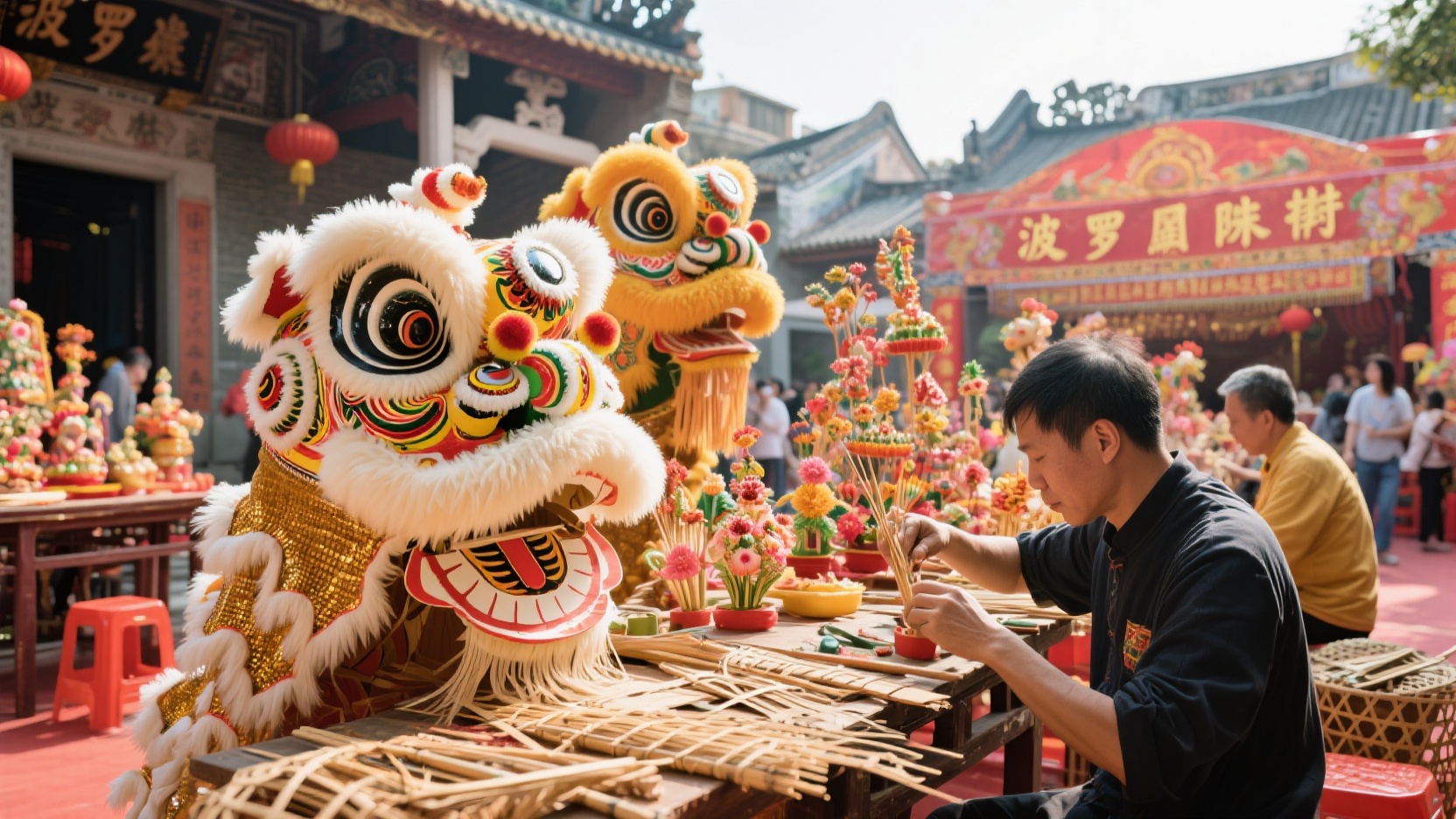
Guangzhou's culture and art aren't displayed in glass cases, but rather in the lunar calendar and the warmth of your hands. To avoid the hustle and bustle of tourist attractions, choose a traditional festival or a handicraft workshop. Spend half a day following the locals through a process, lighting incense, or weaving bamboo strips. Only then can you truly understand why Lingnan culture has been so vibrantly preserved to this day. The following four experiences, arranged chronologically, cover Guangzhou's most representative festival customs and intangible cultural heritage scenes, perfect as "slow entries" in your itinerary.
The Guangfu Temple Fair in the first month of the lunar calendar: Experience all the handicrafts of Lingnan in one place in the streets and alleys.
Around the 15th day of the first lunar month each year, the Beijing Road and City God Temple area in Yuexiu District, Guangzhou, hosts the Guangfu Temple Fair, which typically lasts for seven days. It brings together artisans specializing in pith painting, Guangcai (Guangzhou porcelain), Guang embroidery, copperware, olive carving, and cake molding, creating a mobile intangible cultural heritage workshop. The focus isn't on buying, but on witnessing the process – copperware craftsmen hammer out the curves of pottery, Guangcai painters add gold lines to plain porcelain plates, and cake mold makers carve fish leaping over dragon gates onto pear wood with wooden mallets. Some stalls offer short hands-on experiences, allowing visitors to paint a small Guangcai piece or make a woodblock print, a process that takes 20 minutes to an hour. The fair also includes Cantonese opera excerpts, lion dance parades, and lantern displays. It's recommended to start with this event to quickly gain a comprehensive understanding of Guangzhou's intangible cultural heritage before delving deeper into any particular aspect.
The second month of the lunar calendar, the Polo Festival: Experience a thousand-year-old temple fair at the South China Sea Temple.
The Polo Festival is a traditional temple fair held annually from the 11th to the 13th of the second lunar month at the Nanhai Temple in Huangpu District, Guangzhou. It is one of the best-preserved sea god worship activities in Lingnan. The Nanhai Temple was first built in the Sui Dynasty, and ancient merchant ships often worshipped the South China Sea God here before setting sail, thus the fair has a strong Maritime Silk Road background. The experience begins with the "Five Sons Paying Homage to the King" procession, where the procession carries statues of the five sons of the South China Sea God in front of the temple, accompanied by gongs, drums, and parasols. Afterwards, visitors can enter the market in front of the temple to find "Polo Chicken"—not food, but a lucky charm made of clay and decorated with colorful feathers, said to be related to the Polo tree at the Nanhai Temple and the tribute envoys who traveled from afar. Elderly people make Polo Chickens on-site, coloring and attaching feathers; visitors can sit and help make one, which takes about an hour. Polo Rice Dumplings are also a limited-edition item at the fair, wrapped in banana leaves and slowly cooked over a wood fire, perfect for enjoying after the event. The Polo Festival remains a living folk custom. When taking photos of the parade, please do not disrupt the procession and keep quiet in the worship area.
Qixi Festival in Zhucun: Understanding the ingenuity of Lingnan women through the "Bai Qiniang" (a traditional folk custom).
Around the seventh day of the seventh lunar month each year, Zhucun Village in Tianhe District, Guangzhou, transforms its ancestral hall into a handicraft exhibition space, a custom known as "Bai Qiniang" (摆七娘). Zhucun is one of the villages that best preserves the Qixi Festival culture in Lingnan. "Qiniang" refers to the Weaver Girl. In the past, women would begin making miniature figures, flowers, birds, and lanterns using materials such as rice grains, pith paper, sesame seeds, and sequins several months before Qixi. On the evening of Qixi, these were displayed in the ancestral hall for people to admire, and a "Worshiping the Seven Sisters" ceremony was held. The focus of the experience is not on the spectacle, but on understanding the logic of the craftsmanship: a sesame seed makes a flower petal, a handful of rice grains builds a pavilion, the folds of clothing on figures are pressed out with pith paper, and the scales on the dragon boat model are pieced together with sequins. Some ancestral halls offer "Qixi Doll" making experiences, where visitors can complete a rice flower or a small doll under the guidance of villagers, taking anywhere from forty minutes to two hours. When entering the ancestral hall, please treat it as a space for worshipping gods and ancestors, and do not touch the offering table or exhibits.
Lion head making: In Yongqingfang, bamboo strips are tied into a lion head.
The Guangzhou Intangible Cultural Heritage Street and Yongqingfang area are home to workshops for lion dance, Cantonese porcelain, and Cantonese embroidery. Among these, lion head making is ideal for a half-day in-depth experience. Traditional Southern Lion head making involves four steps: "tying, covering, writing, and assembling." First, the lion head skeleton is woven with bamboo strips, then covered with gauze paper, followed by painting patterns with oil paint, and finally, pom-poms, a bronze mirror, and whiskers are added. The workshop usually begins with tying the frame, where participants learn how to reinforce the bamboo strips with gauze paper at the intersections, and then add color to the lion head. The colors of the lion head have historical significance—yellow represents Liu Bei, red represents Guan Yu, and black represents Zhang Fei, each corresponding to different celebratory occasions. The character "王" (king) is written on the lion's forehead, and two coins are painted on the back of its head, symbolizing courage and resourcefulness. Finally, "dotting the eyes" is the finishing touch; according to custom, the lion only gains its spirit after the eyes are dotted. Completing a small lion head ornament takes about two to three hours and is more memorable than simply buying one.
You don't need to visit all four sites at once. If you visit after the Spring Festival, you can first visit the Guangfu Temple Fair; if you arrive in the second month of the lunar calendar, don't miss the Polo Festival; go to Zhucun around Qixi Festival; and on weekdays, you can participate in lion dance making in Yongqingfang area. Instead of rushing around according to the guide, why not choose one site and sit down to be a local craftsman for half a day? This is closer to the daily life of Guangzhou than any souvenir.