
Don't wade in puddles on Barkhor Street when it rains in Lhasa | Local's Guide to Avoiding Pitfalls: 6 Indoor Art Venues You Can Spend a Day In—No Getting Rained or Sunburned
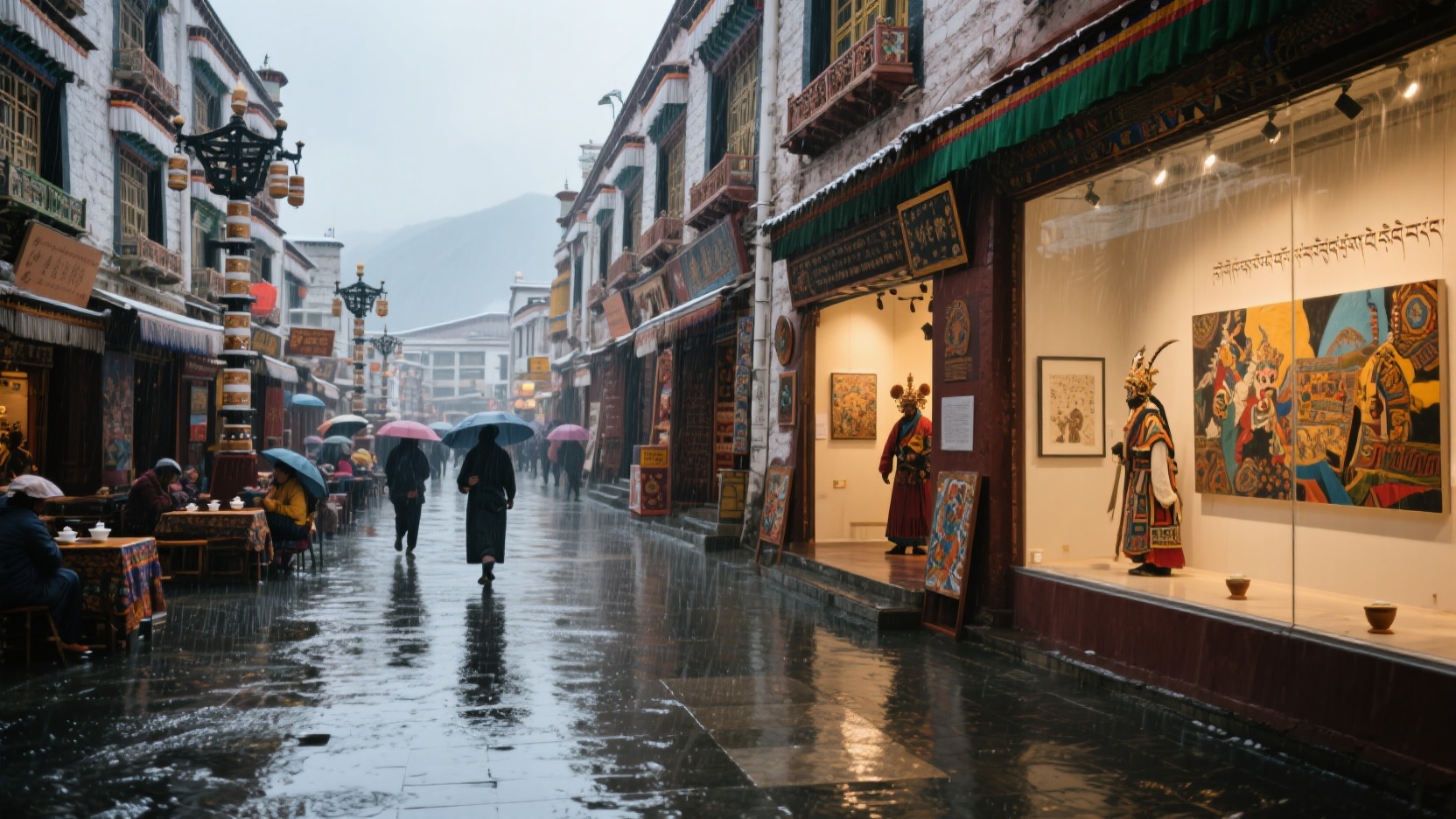
First stop: Tibet Museum, to finish filling in the gaps in the history of Tibetan art.
Don't go to Potala Palace Square for the morning breeze; head straight to the Tibet Museum. Here you can see all of Tibetan history, Thangka paintings, Buddha statues, and folk artifacts in one place—a much more informative experience than squeezing into outdoor temples. Whenever I bring friends, I always allow at least two and a half hours.
Advance reservations are required through official channels. The museum is closed on Mondays. In winter, they start clearing the area around 4:30 PM, so don't stay out too late. There are many restaurants nearby, including Tibetan and Nepalese restaurants along Norbulingka Road, with prices ranging from tens to hundreds of yuan per person.
If you have absolutely no idea about Tibetan Buddhist art, I suggest you come here to learn first, then you'll have a better feel for the other spots. Bad weather has absolutely no effect here; in fact, it's quiet and less crowded.
Second stop: Tibet Library, a place locals really do go even on rainy days.
If the rain and snow haven't stopped after you leave the museum, you can head over to the Tibet Library for some shelter. It's not frequented by tourists; it's mostly frequented by local students and researchers. The library has a rich collection of Tibetan and Chinese books, making it a quiet place to browse through art books.
No reservation is needed. It's closed on Mondays, and you can spend about an hour there. For dining nearby, you can go back to Norbulingka Road or Beijing West Road. There are Tibetan-style light meals and Nepalese food available, costing only a few tens of yuan per person.
The most worthwhile items to browse in the library are the ancient Tibetan books and Thangka paintings. Many details that can't be seen in other exhibitions can be found here at your leisure. If you have children, the children's reading area can also keep you occupied for quite some time.
Third stop: Tibet Art Museum, contemporary Tibetan expression within an old cement factory.
After lunch, I went straight to the old cement factory area on Beijing West Road, where the Tibet Art Museum is located. This museum, transformed from an industrial site, is itself a large-scale installation. The rough cement frame combined with contemporary Tibetan art is more interesting than many popular Instagrammable spots.
You can spend about one and a half to two hours there. Reservations are required, and the museum is closed on Mondays. There are many Sichuan restaurants and Tibetan hot pot restaurants in the vicinity of Beijing West Road, with prices ranging from tens to hundreds of yuan per person. If you don't want to go far, you can have lunch or afternoon tea there.
The exhibitions here aren't updated frequently, but the permanent collection of Tibetan contemporary art is clearly structured. The interplay of light and shadow on the concrete walls on a rainy day actually creates a more atmospheric experience than on a sunny day.
Fourth stop: Yoshimoto-oka Art Center, the renovation of the old building is more interesting than the exhibition.
After leaving the art museum, I returned to the vicinity of Barkhor Street and went into the Jibengang Art Center. This is a rare art space in Lhasa that has been transformed from an ancient building. The building itself is an ancient Qing Dynasty building, but it hosts contemporary art exhibitions, creating a very strong contrast.
You can spend about an hour there, but you need to make a reservation in advance. It's closed on Mondays. For food nearby, don't go to the main street; turn into the alleys of Barkhor Street. Hidden there are places like steamed bun shops, beef pie shops, and yogurt shops, where you can eat comfortably for just a few dozen yuan per person.
The best part is that as soon as you turn into the alleyway after a rain, it instantly becomes quiet. The exhibits change frequently, but the building's courtyard, fragments of murals, and wooden structure alone are worth the time.
Fifth stop: Handicraft workshops in the inner streets of Barkhor Street; rainy days are perfect for touching Thangka paintings.
Don't step into puddles on the main street of Barkhor Street; the real gems are hidden in the side streets. Many of the Thangka painting studios, Tibetan incense workshops, and bronze carving shops are open to visitors, and you can even try your hand at making them.
No reservation is needed, and most workshops are open year-round. You can spend one to one and a half hours there. For meals, continue to eat in the alleys of Barkhor Street. Tibetan noodles, fried potatoes, and sweet tea will cost a few dozen yuan per person, but avoid the tourist-oriented shops on the main street.
There's an advantage to strolling through the inner streets on a rainy day: fewer tourists mean the artisans are more willing to chat with you. What you see are no longer mass-produced souvenirs, but works of art being created.
Sixth stop: Indoor Tibetan opera and concert hall, much more comfortable than live performances.
Many travel guides will recommend visiting the Princess Wencheng Live Theater, but that's outdoors, so it's unusable in rain or snow. The truly comfortable option is an indoor Tibetan opera art center or theater, where you can watch a traditional Tibetan opera or song and dance performance, with heating and seating.
The performance lasts approximately one and a half hours. Reservations are not required, but it's recommended to check showtimes and purchase tickets in advance on ticketing platforms. There are no fixed closing days; the schedule is subject to availability. Nearby dining options include noodle shops, Sichuan restaurants, or Tibetan-style casual meals, with prices ranging from tens to hundreds of yuan per person.
The singing and mask performances of Tibetan opera, when watched in a small indoor theater, are actually more impactful than on a large scale. In winter, when the temperature drops below zero, this place is a lifesaver.
In conclusion
Tip 1: Don't ask locals where they go when it rains; they'll most likely tell you they'll "stay home," but they actually use this indoor route themselves.
Tip 2: Many venues in Lhasa are closed on Mondays, so don't plan this route on a Monday, or you'll be turned away.
Tip 3: When the temperature drops below zero in winter, museums and art galleries are well-heated, but there is a large temperature difference between indoors and outdoors, so remember to adjust slowly when going in and out.
Tip 4: The cobblestone streets inside Barkhor Street are still slippery on rainy days, so it is recommended to wear non-slip shoes and not to wear cloth-soled shoes for taking photos.
Tip 5: This route is suitable for all seasons, especially for those traveling with elderly people, children, or those who are interested in Tibetan culture but don't want to be exposed to the elements.