
Guilin Night Tour (5 Hours) | A Route from Riverside Lanterns to Late-Night Teahouses, Compiled After Three Nights of Research (with Flight Attendance List)
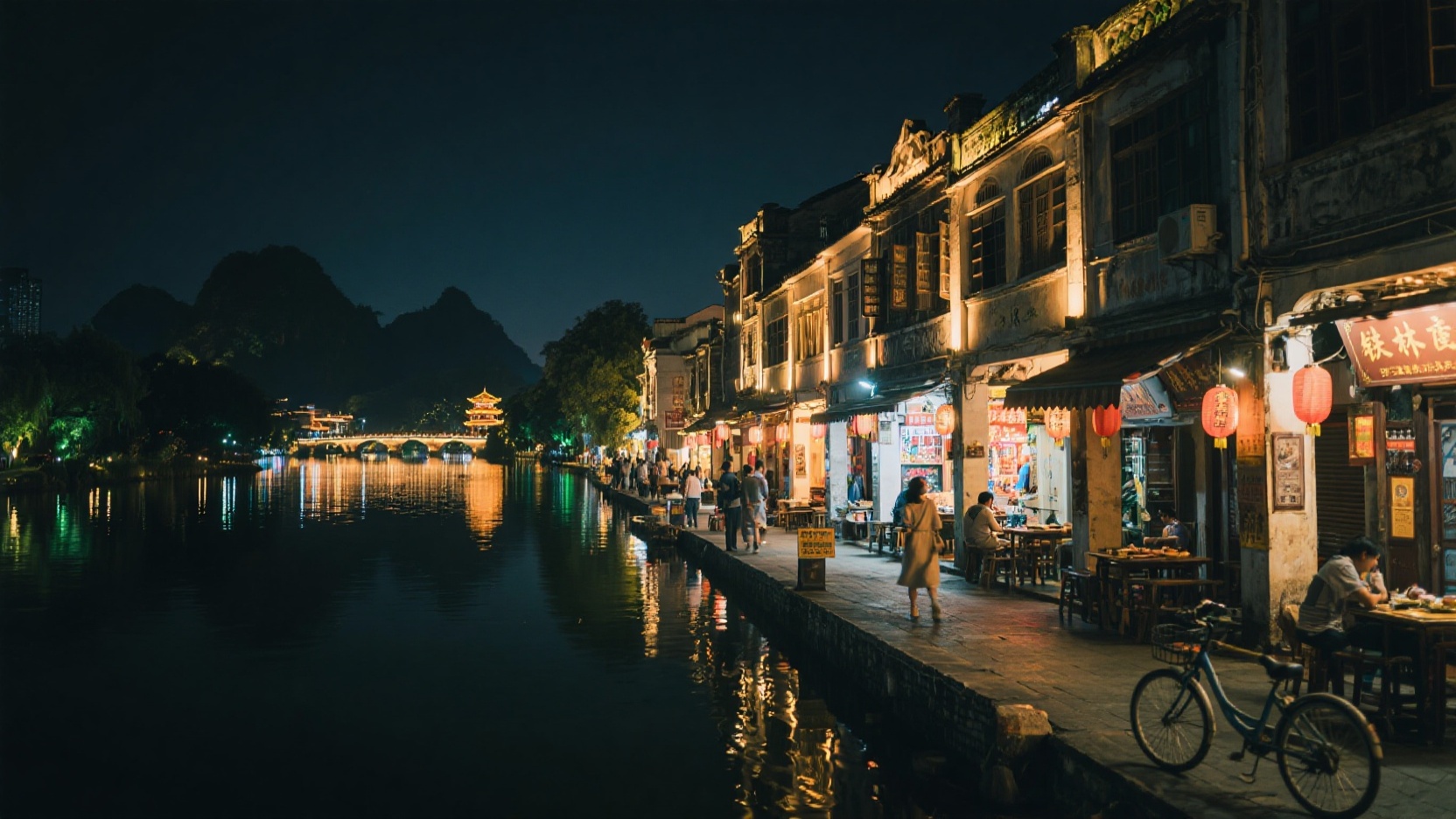
After completing this night tour route, I decided to postpone my daytime itinerary in Guilin. It's not that the scenery isn't beautiful during the day, but rather that Guilin truly transforms from a "tourist city" to a "local life scene" from dusk till late at night. I stayed here for three nights, and the pitfalls I encountered on the first two nights included: taking a boat tour but the deck was so crowded that you could only take pictures of heads, following the navigation into a pedestrian street packed with tourists for barbecue, and turning into an alley without streetlights on my way back to the hotel late at night. On the third night, I replanned my entire route from 6:00 PM to 11:30 PM, avoiding boat tours and the bar street, and instead using walking and shared bikes to connect the lakeside lights, local night markets, and old teahouses.
The following route is suitable for independent travelers who enjoy city strolls and want to experience Guilin's night economy, especially during the spring and autumn seasons when the temperature difference between night and day is not significant.
18:00-19:15 | From Shanhu to Ronghu, a special lakeside trail after the tourists have left.
At exactly 6 PM, I turned into Shanhu Lake from the underpass next to Wenchang Bridge Wharf. By this time, most tour buses had left, leaving only locals taking an evening stroll along the lake. The Sun and Moon Twin Towers of Shanhu Lake had just been lit up, and the sky was still a deep blue. Standing on the waterfront steps on the north shore, I could take photos of both the towers and their reflections simultaneously, and importantly, I didn't have to compete with tourists on the boats for a good spot. Walking west along the lake shore for about ten minutes, I passed a glass bridge. The lights on the bridge reflected on the water, creating a quieter, more futuristic feel than during the day.
After entering Ronghu from Shanhu, avoid the main road and stroll slowly along the Beidou Bridge in the center of the lake and the ancient South Gate side. The warm yellow lights of the ancient South Gate tower cast a long reflection on the surface of Ronghu. Around 7 pm, there are almost no boats passing by, so the reflections are clearest when taken at this time. This section took me about forty minutes and is completely free. The only thing to note is that some of the stone slabs along the lake are slightly slippery.
After exiting from the ancient south gate of Ronghu, shared bikes are parked at the intersection. Scan one and ride towards Tiexi, which takes about fifteen minutes.
19:15-21:00 | Tiexi Community Night Market, the entrance to Guilin locals' late-night dining spot
The Tiexi Night Market is a completely different world from the pedestrian street frequented by tourists. There aren't rows of neatly arranged specialty shops here; instead, there are more dessert carts, barbecue stalls, and pickled fruit stands extending from the Caishikou market. On my first night, I made a mistake, rushing to queue for skewers at the entrance, only to later discover that the Guilin rice noodles and water chestnut cakes hidden deep within the residential area were the real favorites among locals. On my third night, I learned my lesson and first went around to the dessert carts at Caishikou for a bowl of chilled liangbuliang (a traditional Cantonese dessert), then slowly strolled further in.
This night market starts setting up around 6 PM, and is most popular from 7:30 PM to 9 PM. The most popular stalls don't have "trendy" signs; the people queuing are mostly local residents. A decent barbecue meal costs only a few dozen yuan per person, and sweet soups and pickled vegetables are sold by portion, catering to all budgets. It's recommended not to eat too much here, as there are teahouses and late-night sweet soup options later.
After leaving Tiexi Night Market, ride a shared bicycle towards Wangcheng, then follow Zhongshan Middle Road to Zhonghua Road. It takes about fifteen minutes. Be aware that there are many electric bikes on this section of the road during the evening rush hour, so do not ride side-by-side with other vehicles when using the non-motorized vehicle lane.
21:00-22:45 | Step into an old arcade teahouse and listen to a piece of Gui opera singing.
After leaving Tiexi, I specifically reserved the latter half of my nighttime stroll for the intangible cultural heritage of Guilin's opera. Hidden among the old arcade buildings along Zhonghua Road are several teahouses catering only to regular customers, becoming even more lively after 9 PM than during the day. The one I chose had no neon signboard; its facade was an old wooden door, and the first thing you smelled upon entering was the aroma of osmanthus tea. The owner would arrange a cappella performances based on the guests that evening, including Guilin opera and Cai Diao opera, and sometimes even Wenchang (a type of folk opera). It wasn't necessarily a formal stage; it felt more like a regular gathering of local opera enthusiasts.
Sit down and order a pot of osmanthus tea or monk fruit tea; it costs a few dozen yuan per person and you can listen for over an hour. First-timers might not understand the lyrics, but sitting in the courtyard of an old arcade building, watching the master musicians play the dulcimer and bamboo clappers, the atmosphere itself is a treasure that's easily overlooked in Guilin's nightlife. Note that you shouldn't make loud noises in the teahouse, and it's best to ask before taking photos.
I left the teahouse at around 10:45 and walked back to the Li River for about 15 minutes to digest my food.
22:45-23:30 | Back to the Li River, a blue-toned night view ending with a bowl of sweet soup.
For this last stretch, I recommend descending to the Binjiang Road promenade from the south side of Jiefang Bridge. From here, you can see the dark outline of Zizhou Park on the opposite bank and the scattered building lights of Qixing District. Around 11 PM, the traffic on Binjiang Road decreases, and the river becomes very calm, contrasting sharply with the bustling core area of the Two Rivers and Four Lakes. Walking south along the riverside promenade, you can reach the outer perimeter of Elephant Trunk Hill Park, but you don't need to enter the scenic area; just catching a glimpse of the Elephant Trunk Hill's outline across the river is enough.
If you still have room in your stomach, you can find a local dessert shop near the intersection of Binjiang Road and Zhengyang Road and have a bowl of hot osmanthus lotus root starch or chilled mung bean soup. It only costs a few yuan per person. I usually sit there until 11:30, watching the last few tables of customers leave, before taking a taxi back to the hotel. This section is about a half-hour walk. It's windy by the river, so it's best to bring a light jacket in spring and autumn.
Blogger's Summary and Practical Tips List
This night tour route takes about five and a half hours in total, with sections dedicated to the lakeside lights, Tiexi Night Market, old teahouses, and a night walk along the Li River. There's no need to rush or queue at the cruise ship dock. For night photography, I've compiled five tested shooting locations: First, the waterfront steps on the north bank of Shanhu Lake for photographing the Sun and Moon Twin Towers, a low angle with reflections; second, shooting outwards from inside the ancient South Gate Bridge at Ronghu Lake, a framed composition that produces excellent photos; third, next to the dessert cart at the entrance of Tiexi Night Market, using the backs of diners as a foreground; fourth, the tea smoke and wooden tables and chairs in the courtyard of the old teahouse, backlit for a cinematic feel; fifth, the walkway south of Jiefang Bridge for photographing the reflections of the Li River and the lights on the opposite bank.
Four safety tips: 1. Some sections of the lakeside walkway have no railings, so don't take pictures while walking, and don't walk while taking pictures; 2. When riding shared bicycles at night, avoid the bus lane and change lanes in advance before entering Zhongshan Middle Road; 3. When there are many people at the night market, wear your backpack in front, scan the code to pay and confirm the amount before leaving; 4. After the event ends late at night, take the main road back to the hotel, and don't take shortcuts through old alleys.