
A Stroll Through Chengdu's Streets | A List of Artsy Citywalks I Tested Three Times Before Sharing (Autumn Edition)
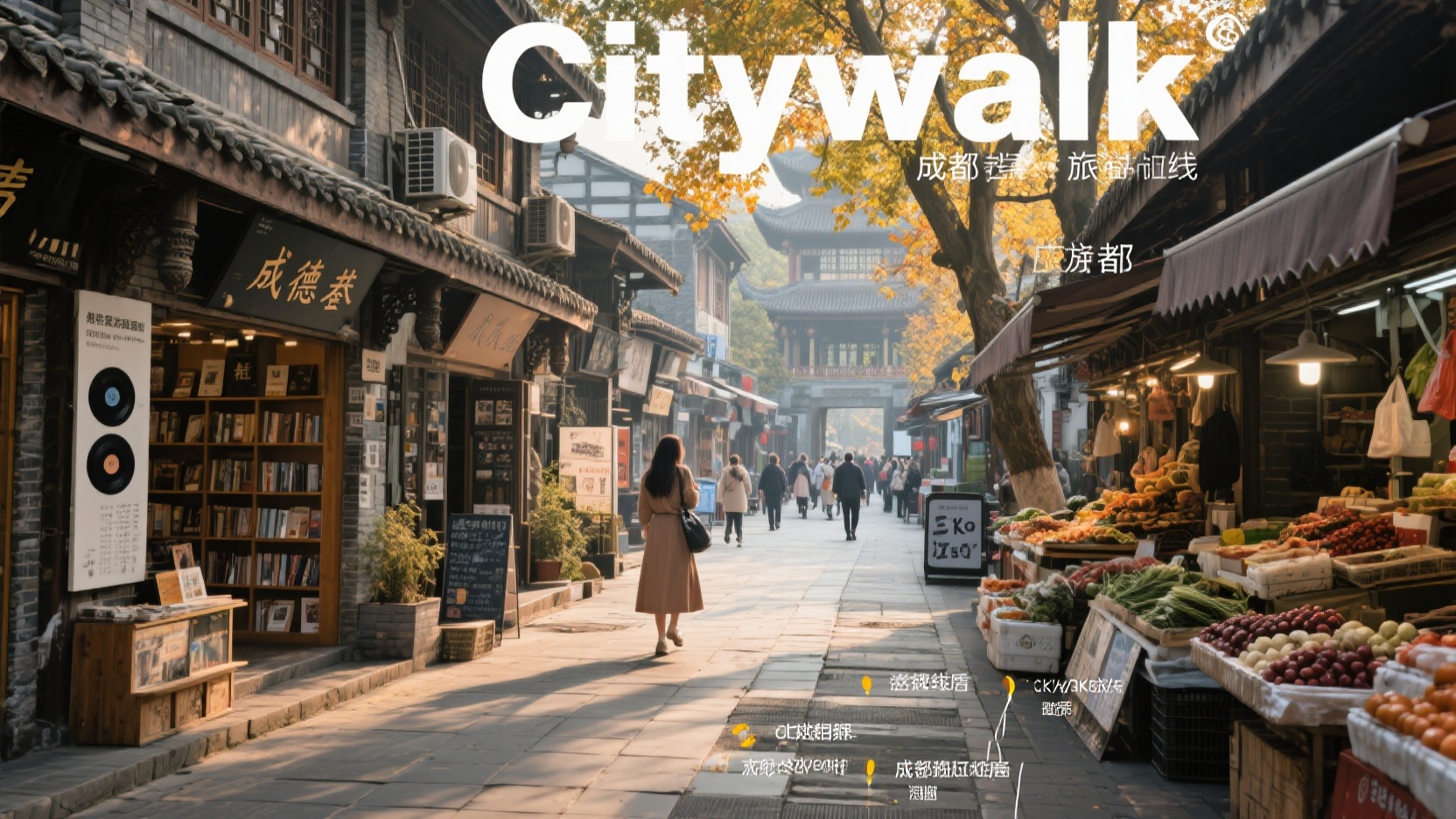
This is my fifth time specifically coming to Chengdu to walk this route. The first three times, I either got led into dead ends by the navigation or missed the morning market on Longwangmiao Main Street, turning a three-kilometer trip into a six-kilometer one. Later, I broke the route down into a "main line + two branch roads," and finally got the hang of it. This route starts from Chongde Lane and ends at Hejiang Pavilion, with a total length of about 3.8 kilometers. It's suitable for people who want to avoid the crowds in Kuanzhai Alley but still want to see old buildings, street corner markets, independent bookstores, and riverside pocket parks in half a day.
Route Overview: Why this street, not Yulin or Fangcao?
Many people who come to Chengdu for an artsy Citywalk head straight to Yulin or Fangcao Street. But if you want to see the "foundation of old Chengdu," the section from Chongde Lane to Shuijingfang offers more depth. The main route is about 3.8 kilometers long, taking about an hour and a half on foot, but with photos and shop visits, you'll need at least three hours. Two branching paths are hidden on Qinglian Shangjie and Dianjiangtai Hengjie respectively; one leads to the river, and the other into a local market.
The best time is to set off before 9 a.m. on a weekday in autumn, so you can catch the bustling market while the light is soft. Avoid going out in the afternoon in summer, as there's less shade.
Section 1: From Chongde Lane to Tangba Street, old houses, bookstores, and the first side road.
Entering from the east entrance of Chongde Lane, it's about a 300-meter, eight-minute walk. The blogger positioned their camera at the junction of the old wall and the newly built glass roof of Chongde Lane, using a medium telephoto lens to shoot upwards, capturing both the gray bricks of the traditional Sichuan houses and the elevated walkways. Why is it worth stopping for five minutes? Several houses here are traditional Sichuan courtyards from the Republican era. After renovation, many old wooden beams have been preserved, and the midday sun filters through the gaps, giving it a more "original" feel than many paid ancient towns.
Continue west for 500 meters, a 12-minute walk, and you'll enter Tangba Street. This street has been featured in overseas travel magazines, but don't just photograph the street sign. The street features independent bookstores and two tiny cafes, one of which tucks a vinyl record rack next to a bookshelf. The best spot on Tangba Street is where the bookstore's outdoor display area is framed alongside the street sign, using a 35mm lens to capture the ambiance. The reason for stopping for five minutes is that the boxes of old books displayed outside the bookstores are updated during the day, often revealing local gazetteers or rare photography collections.
Branch Road 1: Turn right at the intersection of Qinglian Shangjie Road and walk 400 meters to Tianxianqiao South Road. You can turn ahead to the riverside promenade opposite Hejiang Pavilion. This section is best walked after 4 PM, as the backlight will make the river surface appear like shattered silver. The main route continues back to Tangba Street.
Second section: Longwangmiao Main Street and Gengjia Lane, the corner of the vegetable market and a corner of the Qing Dynasty ancestral hall.
Turning from Tangba Street onto Longwangmiao Main Street, it's about a 600-meter, 15-minute walk. The blogger positioned their camera at the entrance to the vegetable market in the middle of the street, standing on the steps of the old teahouse opposite, shooting from above, capturing the red peppers at the vegetable stalls, the bamboo baskets, and the old houses with gable roofs in the background. Why is it worth stopping for five minutes? This is one of the few street corners in Chengdu where you can still hear the "Qingyang District accent" in the morning; shoppers aren't in a hurry, and vendors aren't rushing to collect change.
Continue walking 200 meters, or five minutes, to Gengjia Lane. Don't photograph the front facade; instead, go around to the narrow side alley and use a vertical composition to photograph the overlapping of the old walls and the electrical meter box. It's worth stopping for five minutes because several exposed brick walls and wooden windows retain traces of habitation from the 1940s onwards, and bougainvillea planted by residents themselves grows at the base of the walls, making it much more authentic than the imitation antique streets.
Section 3: From Jiaochangba to Dianjiangtai, passing the vinyl shop, vintage clothing store, and the second branch line.
Turning back from Gengjia Lane to Longwangmiao Main Street and continuing east, it's about 900 meters, or a 20-minute walk, to Jiaochangba Street. The blogger's camera was positioned at the T-junction in the middle of Jiaochangba, facing a gray-green residential building. At 2 PM, the sunlight shone perfectly on the old rattan chair on the second-floor balcony. Nearby, there's a small vinyl record store located on the ground floor of the residential building. During the day, it often plays jazz, and the owner allows you to browse without listening. The reason for stopping for five minutes was that the store's record categories weren't based on genre, but rather on "suitable for listening on a cloudy day in Chengdu" or "suitable for listening while walking"—very personal.
Branch road two: Turn from Jiaochangba Street onto Dianjiangtai Heng Street, and walk about 250 meters to find the community pocket park. The park is mostly frequented by local elderly people playing chess, and there are old benches under the pergola. If you want to take some photos of local life, you can stay here for fifteen minutes; if you don't want to be disturbed, just walk through. Along the way, you'll also find a vintage clothing store without a prominent sign, with more men's clothing than women's.
Continue south along Dianjiangtai Street for about 500 meters or 12 minutes. The shop signs on both sides start to get shorter. Try to put your camera away during this section and avoid taking pictures of residents' windows.
Section Four: From Shuijingfang to Hejiangting, the aroma of Ming and Qing dynasty wines mingles with the riverside scenery.
Turn from Dianjiangtai Street onto Shuijin Street, and walk about one kilometer (25 minutes) to reach the Shuijingfang Museum. The blogger positioned their camera under an old plane tree diagonally opposite the museum, using a telephoto lens to compress the plane tree, the blue tiles, and the old bicycles parked along the roadside. It's worth stopping for five minutes: the Shuijingfang site is a brewing workshop from the Ming and Qing dynasties. The museum's exterior brick walls and the blend of old and new facades are highly distinctive, especially at dusk, resembling a movie scene.
Finally, walk along the riverside promenade to Hejiang Pavilion, about 400 meters and 10 minutes. Here, the Fuhe River and the Nanhe River converge. My camera position is by the stone railing on the east side of the pavilion. I wait for the blue hour lights to come on before taking the picture. The reason for stopping for five minutes is that you can see Chengdu slowly transition from the bustling old streets to the quiet water. After a day of walking, this section is the most like the "end of the city."
Blogger's Summary and Practical Tips
This route is truly worthwhile not because of its numerous tourist attractions, but because it connects the "old Chengdu where people still live" with the "small shops that young people are rediscovering." Don't rush; it's worth spending half a day walking the 3.8 kilometers.
Tip 1: For the morning market, head to Longwangmiao Main Street. It's best to arrive before 8:30 AM, as many stalls close after 9:30 AM. Tip 2: The vinyl record store and vintage clothing store have irregular opening hours; it's recommended to go on weekend afternoons. Tip 3: Branch route one is suitable for sunset photography, while branch route two is suitable for capturing everyday life. Don't try to cram both into half a day; it will be too rushed. Tip 4: There are almost no decent public restrooms along the route; you can borrow one after making a purchase at a cafe. Tip 5: This route is not suitable for strollers due to the narrow alleys and numerous steps.