
Changsha Old Town Stroll Route | Blogger's Personal Test of the 4.2km Cultural and Artistic Citywalk, Flowing Through Old Streets, Bookstores, Vintage Vinyl Records, and Clothing Stores (Includes 2 Si
On my first two trips to Changsha, I devoted my time to the Hunan Provincial Museum, Yuelu Mountain, and art galleries along the Xiangjiang River. While the routes seemed quite "artsy," I always felt something was missing. This summer, on my third visit, I deliberately stayed in an old apartment behind Chaozong Street and spent three consecutive mornings walking aimlessly along the cobblestone streets, finally piecing together this cultural and artistic Citywalk that truly belongs to the fabric of the old city. The main route is approximately 4.2 kilometers long, taking 1 hour and 20 minutes on foot, excluding shopping and coffee breaks. Each stop below is marked with a camera angle personally tested by the blogger and a reason why it's worth stopping for 5 minutes.
Section 1: Chao Tsung Street to Lian Sheng Street, cobblestone streets and church buildings in the same frame (approximately 20 minutes walk).
Entering from the west entrance of Chao Zong Street, don't rush into the alley. Choose a spot on the half-step in front of the Chao Zong Street Church, and raise the lens about 30 degrees. This will allow you to compress the church's gray dome and the quilts drying in the old residential buildings behind it into the same frame. It's worth stopping for 5 minutes, because the water stains, ivy, and rusty drainpipes on the church's exterior walls are not artificially aged, but rather the natural artistic texture that has grown from the old city.
Walk east to the former site of the Jin Jiu event, but don't go inside. Move the camera back to the barbershop across the street, using the reflection in the glass window to frame the blue brick entrance, and wait for a resident carrying a bamboo basket to pass by. Stop and watch for five minutes because this short 200-meter stretch crammed with Qing Dynasty cobblestones, a Republican-era mansion, and 1990s security grilles—three time periods superimposed in the same viewpoint—is itself a historical montage of old Changsha.
When you reach the intersection of Liansheng Street, you will see a pocket green space. The main route continues into Xiyuan Beili. Those who want to see more of the community vegetable market can take branch line 1 (details below).
Section 2: Xiyuan Beili to Tai'anli, featuring revisitable Republican-era mansions and pocket parks (approximately 15 minutes walk).
Xiyuan Beili is the most suitable section to stop along the entire route. I chose a spot next to the old well in the middle section, using a vertical composition and a focal length of about 50mm to capture the depth of the arcade pillars on both sides. Waiting for someone on a motorcycle to pass by, the image naturally conveyed the sense of speed of the old town. The reason for stopping for 5 minutes was very specific: the Republican-era mansions here weren't enclosed as a tourist attraction, but rather had their wooden doors half-open, allowing you to hear the sounds of mahjong and cooking coming from inside. The grease stains on the electrical meter boxes at the entrances looked like traces left from the last century.
Turning from Xiyuan Beili into Tai'anli, you'll pass a pocket park enclosed by an old wall, where a few old rattan chairs are perpetually placed under several camphor trees. Take a low-angle shot from the park entrance, capturing the tree canopies, the curves of the old wall's top, and the outdoor air conditioners of the distant dormitory buildings. Stop for five minutes; this is a regular spot for nearby elderly people to play chess and prepare vegetables, a testament to the everyday aesthetics of the old town more vividly than any café's floor-to-ceiling windows.
Section 3: Education Street – Lotus Pond Market, a stopover at the street corner fireworks and pocket park (approximately 25 minutes walk)
Exiting from the south entrance of Xiyuan Beili onto Jiaoyu Street, you'll first see the circular roof of Zhongshan Pavilion at the intersection. Don't choose a direct view; instead, stand next to the newsstand at the intersection of Jiaoyu Street and Zhongshan Road, and use side-backlighting to photograph the juxtaposition of the circular dome and the air conditioners mounted on the exterior of the old dormitory building. Stop for five minutes, because Zhongshan Pavilion is one of the few modern buildings in old Changsha that hasn't been overly embellished; its peeling walls and moss-covered roof reveal the city's true history more vividly than the nighttime lighting.
Next, walk to the entrance of the Lotus Pond Market, the least "artsy" stop on the entire route, yet the one most worth stopping at. Set up your camera in front of a pickle stall next to the market, using a low angle of about 35mm to capture the awning, colorful plastic bags, chili baskets, and customers' hands all in one shot. Stop for 5 minutes, because Changsha's culture and art aren't just found in bookstores and exhibition halls; they're also hidden in the shouts and smells of these street-corner pickle stalls. Next to it is a small pocket park with stone tables and benches, perfect for sitting down and having a drink. Then, walk south along Cai E Road for about 1 kilometer and turn into Fengying Xili.
Section 4: Fengying Xili—Sujia Lane—Denglong Street, independent bookstores, vinyl records and vintage clothing (approximately 20 minutes walk)
Turning from Cai E Road into Fengying Xili, the air immediately quiets down. I chose a spot at the alley entrance where the old red brick building and the folding wooden windows of the cafe juxtaposed, waiting for someone to push open the door and snap a photo the instant they emerged. The doorway was filled with the dim, yellowish light of the old dormitory building. I paused for five minutes, because the independent bookstores and cafes in this alley have almost no "Instagrammable" feel; most are converted from the ground floor of old residential buildings, with wooden windows, cement steps, and old mailboxes at the entrances all retaining traces of 1990s-era dormitory buildings.
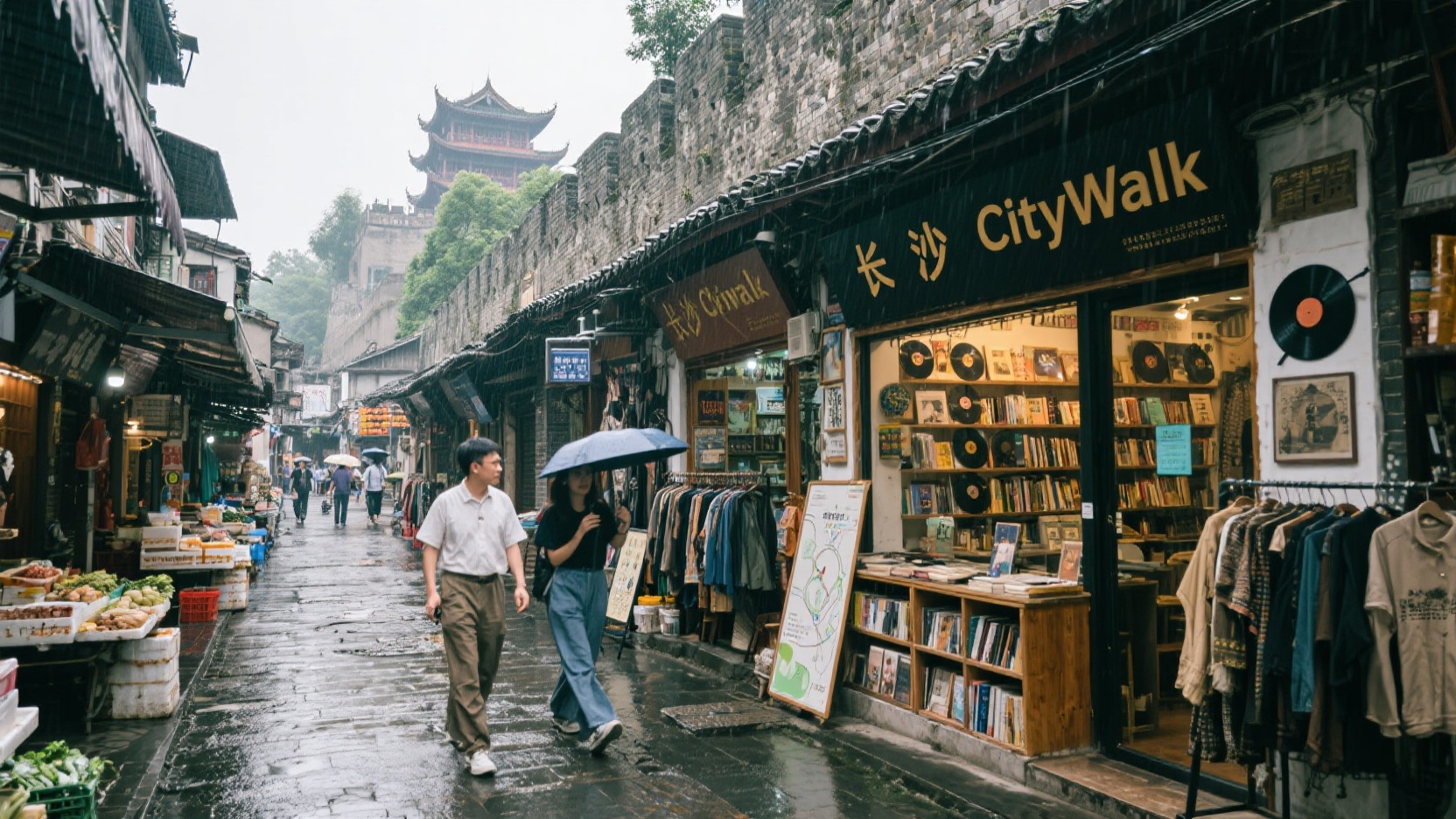
Walking towards Sujia Lane, you'll see vinyl record stores and vintage clothing stores alternating. Some don't have storefronts, just a wooden crate and a handwritten blackboard at the entrance. Position yourself half-crouched in front of a vintage clothing store, using a Monstera deliciosa in the foreground to obscure the cluttered upper part of the signboard, and capture half of the glass door and old leather shoes. It's worth stopping for five minutes because these stores don't pressure you to buy. Push open the glass door and you can hear the subtle background noise of the record players, a world apart from the hustle and bustle of Wuyi Square. I recommend walking slowly along this section; if you see a vinyl record store with an old wooden crate at the entrance, it's basically a local collector's haven.
Section 5: Tianxin Pavilion at the foot of the city wall—Baisha Ancient Well, the final silhouette of the Ming and Qing dynasty walls (approximately 15 minutes walk)
Walking southwest from Sujia Lane to the north wall of Tianxin Pavilion, you don't need to buy a ticket to enter the scenic area; just follow the walkway outside the wall. Take a photo from the nearby pedestrian overpass, using a focal length of 70mm or longer to capture the silhouette of the ancient city wall's crenellations against the modern high-rise buildings in the background. Stop for five minutes, as this section of the Ming Dynasty wall foundation is one of the few tangible Ming and Qing Dynasty relics in Changsha. The moss at the base of the wall, birdcages, and elderly people doing morning exercises naturally bring the old city streets and alleys you've walked through to a complete timeline.
Finally, we arrived at Baisha Ancient Well. We crouched down and pressed our cameras close to the well's edge, capturing the old-fashioned water ladles held by the residents drawing water and the reflection on the water's surface. We stopped for five minutes to watch the locals fetch water, wash their jugs, and chat – a "living culture" more precious than any urban sculpture. The main route is about 4.2 kilometers from here. If you plan to have coffee or shop, please allow a whole morning or afternoon.
Two branch roads: Take an extra kilometer to discover more hidden gems of Changsha.
Branch Line 1: At the intersection of Liansheng Street, head west for about 300 meters to the intersection of Tongtai Street and Youpu Street, a 10-minute walk. Position the camera directly opposite the old grain store sign, capturing the sunshade awning, handwritten price boards, and residents shopping together. Stop and observe for 5 minutes, as this community has remained largely unrenovated, serving as a "community commercial specimen" of Changsha in the 1990s. Many signs are fading, making it ideal for black-and-white street photography.
Branch Line 2: When you reach the intersection of Fengying Xili and Denglong Street, head south and walk about 400 meters to the Xiwemiaoping Ancient Archway, a 12-minute walk. Set up your camera on the steps of a nearby convenience store, using the archway as a foreground to frame the residential buildings and utility poles behind it. Stop and look at it for 5 minutes. Because this archway is a Ming Dynasty relic surrounded by residential buildings, it's inconspicuous and easy to miss, but it instantly gives you an understanding of what "Changsha-style cultural layering" means.
Blogger's Summary and Practical Tips Checklist
This old town citywalk is perfect for those who want to avoid crowds, enjoy architectural photography and independent shops, and is also great for walking on rainy or light rainy days, as the cobblestone streets and old walls look even better when wet.
"Avoid weekend afternoons": Independent bookstores and vinyl record stores usually open in the afternoon, and weekend afternoons are the busiest. You can choose to start at 10 am on a weekday, first walk around Chao Zong Street and the wet market, and then stroll around Fengying Xili in the afternoon.
"Wear old shoes": The cobblestone paths and trails along the walls can be slippery when it rains, so a pair of old, non-slip shoes is more important than any other equipment. The main route is about 4.2 kilometers long, and with the side routes, it's only about 5 kilometers long. It doesn't require much physical exertion, but you should allow time for shopping.
"Don't insist on entering every old building": Many mansions and old dormitories from the Republican era are still inhabited. Take a few photos at the entrance and leave without disturbing the residents. Cafes and bookstores offer affordable to mid-range prices; a cup of hand-drip coffee is enough to secure a quiet afternoon seat.