
Become a Half-Day Craftsperson in Yinchuan: A Practical Guide to Intangible Cultural Heritage Crafts such as Shehuo (a type of folk performance), Helan Inkstones, Hua'er (a type of folk song), and the
If a "cultural and artistic tour" in Yinchuan only stops at museums and historical sites, it's difficult to truly experience the rhythm of this city. The real local culture is hidden in the processions of festivals and parades, in the stone dust of intangible cultural heritage workshops, and in the melodious strains of folk songs. The following four routes all revolve around festival customs and hands-on experience with intangible cultural heritage, allowing visitors to sit down and participate or sing along at each stop, rather than simply taking photos from behind fences.
Spring Festival folk performances and "Intangible Cultural Heritage for the New Year" markets: Drum Tower Street from the third to the fifteenth day of the first lunar month
The festival is held from the third to the fifteenth day of the first lunar month. The main route for the Shehuo (folk performance) parade is along the area from the Drum Tower to the Jade Emperor Pavilion and Xinhua Street in the old city of Yinchuan. A "Celebrating the New Year with Intangible Cultural Heritage" market is also set up at Yinchuan Cultural City during the same period. The Shehuo procession includes stilt walkers, land boats, dragon dances, and Yangko dances. The most noteworthy performance is the "Spring Official's Song," where the leader, dressed as the Spring Official, improvises a rhyming verse, ranging from good weather and abundant harvests to the opening of shops. After watching the parade, it's recommended to head straight to the market and find the intangible cultural heritage stalls. Hui paper-cutting stalls often have red paper and samples, with designs mostly inspired by Helan Mountain rock paintings, Xixia script, and flowers and birds. Beginners can start by cutting a symmetrical "round flower" or "Hui doll." Another worthwhile activity is making the clay whistle, a traditional Hui wind instrument. Made from Yellow River clay shaped like a bull's head or an oval, holes are made with bamboo sticks, and the whistle is dried to produce a deep, single note. Making your own clay whistle with your own pitch is more memorable than buying a ready-made one.
Helan inkstone carving: Carving the shape of the Helan Mountains on the stone.
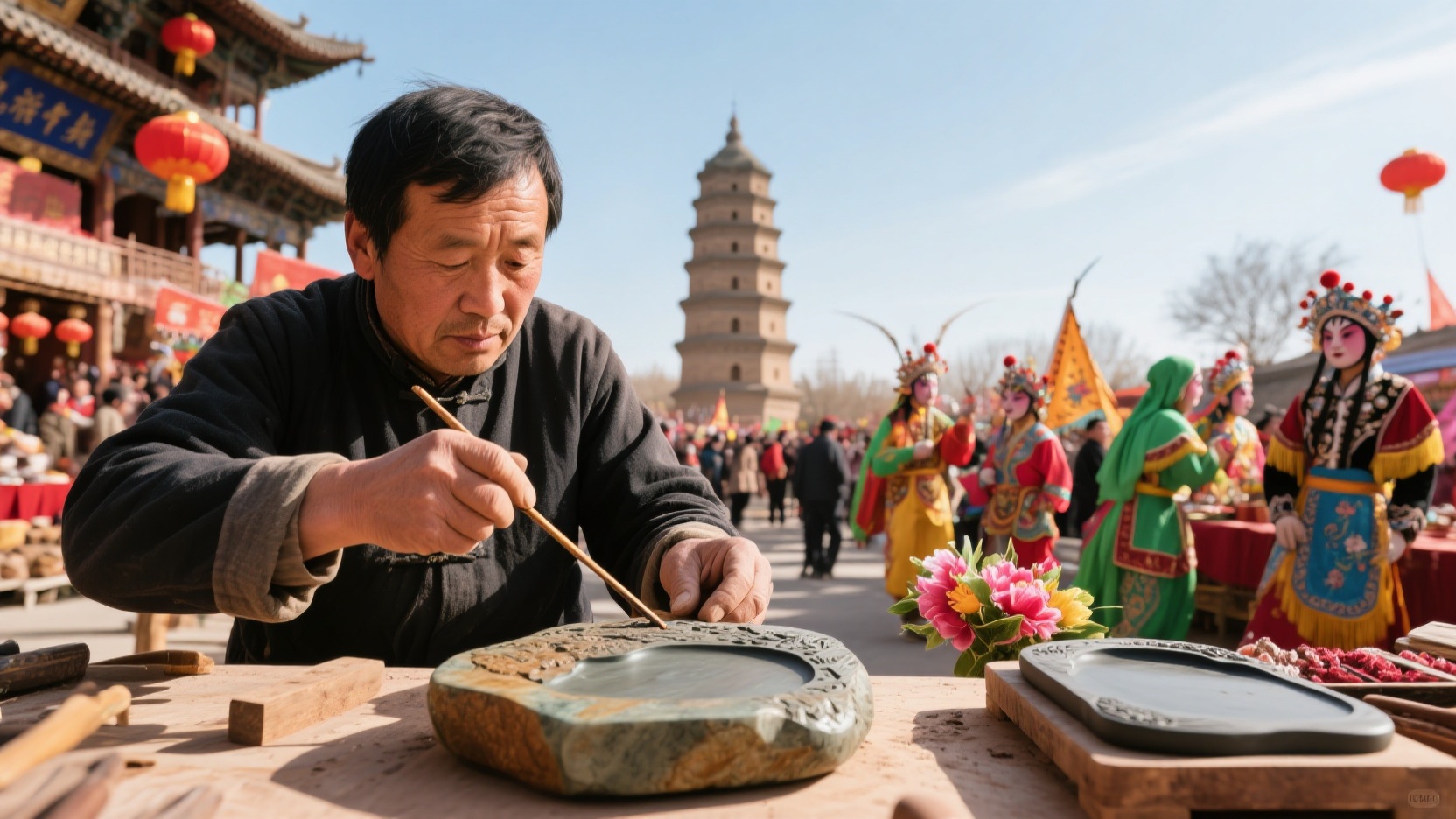
The craft of making Helan inkstones is a national intangible cultural heritage of Ningxia. Experiences can be had year-round, with workshops concentrated in Yinchuan Cultural City, Zhenbeibao, and the surrounding areas of Xixia District. Helan stone is prized for its "purple base and green hue," with a deep purple and bean-like green, and a fine texture. The experience usually begins with a piece of raw, irregularly shaped stone. First, sketch a mountain shape, Xixia characters, or a leaf on the surface with a pencil, then use a flat chisel to trim the edges and a round chisel to refine the lines. Beginners don't need to strive for perfection; the key is to learn to "cut according to the material," following the natural color layers of the stone, using purple for the mountain body and green for the vegetation. After two to three hours, through rough and fine grinding, the stone will develop a warm luster and can be used as a paperweight or seal blank. Helan stone is named after Helan Mountain. Records of its mining and inkstone making date back to the Qing Dynasty. In the past, it was primarily used to make inkstones, and due to its serene color, it was associated with the imagery of "Helan Snow in the Sunshine" and "Mountain Shape on the Desk."
Hui folk songs and mouth harps: Learning a line of "White Peony Song" at a song festival
Every year in May and June, the "Hua'er" festival is concentrated around Yinchuan. Performances are often held in the rural cultural squares of Yongning and Helan, as well as at the Yinchuan Intangible Cultural Heritage Exhibition Hall. Community squares also organize antiphonal singing around Eid al-Fitr and Eid al-Adha. Hua'er is a folk song shared by many ethnic groups in Northwest China. It was listed as an Intangible Cultural Heritage of Humanity in 2009, and Ningxia Hua'er is known for its delicate and melodious style. Don't just be a listener at the event; you can start by learning the mouth harp. The mouth harp can be made of bamboo or metal. When playing, the reed is placed between the lips and plucked with a thin string or fingers. The pitch is changed by opening and closing the mouth. Beginners can produce a long "humming" sound, and with practice, they can imitate birdsong. Then learn a couple of classic tunes from the singers, such as "White Peony Tune" or "Hezhou Tune." The lyrics often begin with "Climbing up the high mountain to look at the plains" or "The white peony is dazzlingly white," using metaphor to evoke feelings. The mouth harp was originally a small musical instrument used by Hui women to express their emotions in their courtyards. It was called "the flower in the heart." Although the sound was not loud, it could draw people into the tender feelings between the loess soil and the Yellow River.
Beita Temple Fair: Qinqiang Opera and Traditional Crafts on the 15th Day of the Seventh Lunar Month
Haibao Pagoda, a landmark of Yinchuan's old city, is commonly known as the North Pagoda. Around the 15th day of the seventh lunar month each year, a large temple fair forms in the square outside the pagoda and surrounding streets. The fair is densely packed with stalls, primarily featuring intangible cultural heritage crafts during the day: Helan inkstones, paper cutting, sugar blowing, dough figurines, and Qinqiang opera troupes performing face painting on stage. You can stand backstage and watch the actors apply their base colors, eyebrows, and headdresses, and even learn a traditional opera "cloud hand" or "pose" from them—the movements may seem simple, but require precise hand-eye coordination. In the evening, excerpts from traditional operas begin, often featuring classic Qinqiang pieces like "The Case of Chen Shimei" and "The Flaming Steed," with high-pitched singing and recitations incorporating Ningxia dialect. Haibao Pagoda was originally built during the Sixteen Kingdoms period and has been rebuilt many times; "North Pagoda Sunset" was once one of the eight scenic spots of old Yinchuan. The 15th day of the seventh lunar month is a time for prayer and ancestor worship before the autumn harvest, giving the temple fair a strong sense of local ritual. Even without praying for blessings, listening to a piece of Qinqiang opera and watching old opera fans tap their chairs to the beat can reveal another side of Yinchuan's old city.
Yinchuan's culture and art aren't displayed in showcases, but rather found in the streets and alleys where folk performance troupes pass by, in the stone dust from the Helan stone mill, in the vibrating reeds of the mouth harp, and in the Qinqiang opera at the Beita Temple Fair. Choose a festive occasion, get your hands dirty, wake your ears, and spend half a day as a local without rushing.