
Traditional crafts at the foot of the city wall | Spend half a day as a craftsman in Guanzhong at temple fairs and workshops
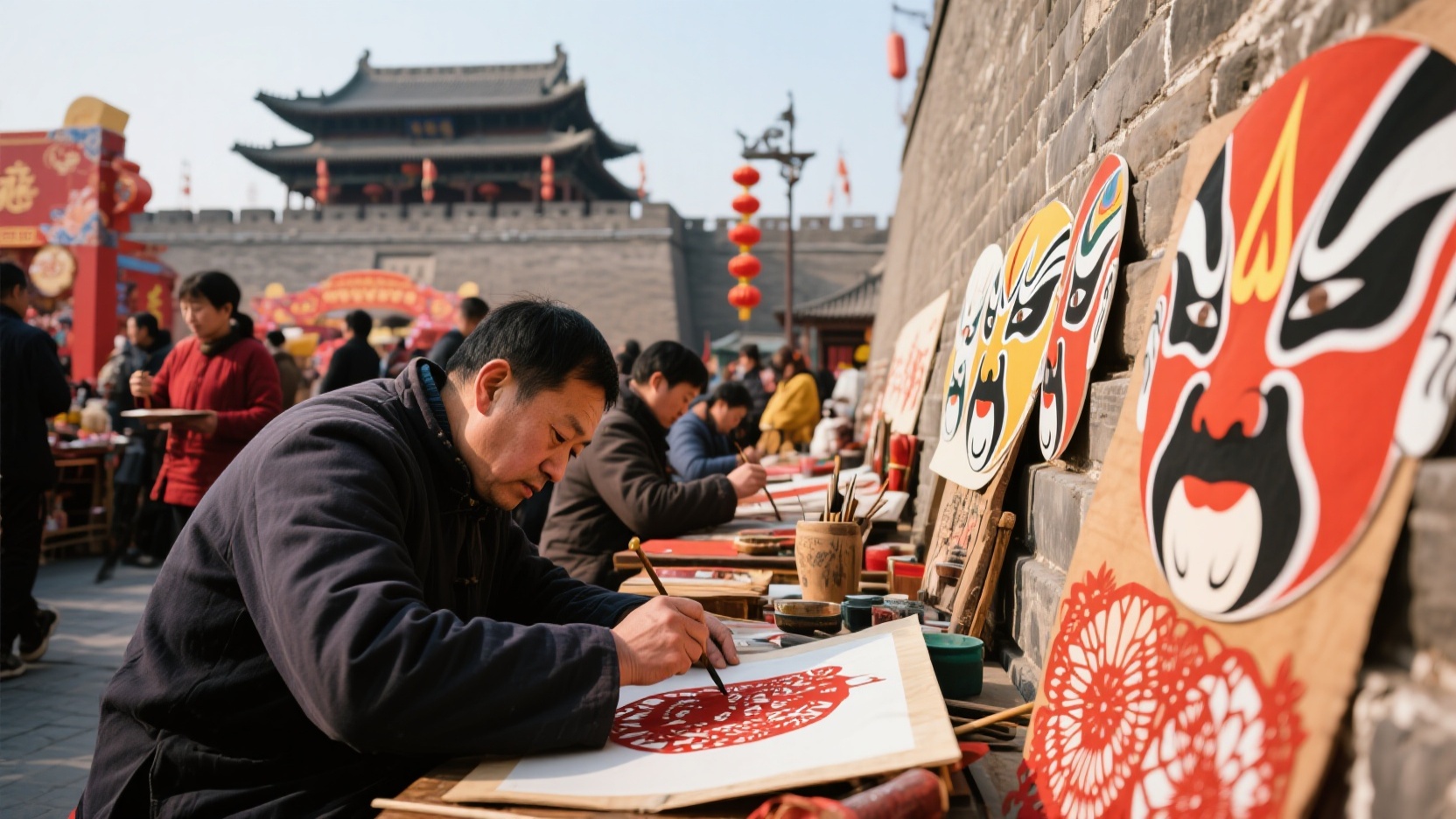
Xi'an's cultural heritage isn't just displayed in museums; it lives on in the City God Temple Fair on the first day of the Lunar New Year, the face-painting workshops of Yisushe, and the window-cutting scissors of Zhouzhi farmers. Avoid the crowds at popular tourist spots, choose a temple fair, sit in an old workshop, and in half a day you can experience the most authentic seasonal fabric of the Guanzhong Plain. The following four types of festival customs and intangible cultural heritage experiences all revolve around "sitting down and getting hands-on," making them ideal for setting aside half a day for your trip.
City God Temple Fair: A grand folk market in Guanzhong from the first to the fifteenth day of the first lunar month.
The Xi'an City God Temple was first built during the Hongwu period of the Ming Dynasty, and the existing buildings are from the Qing Dynasty. The temple fair is concentrated from the first to the fifteenth day of the first lunar month, with a smaller peak on the eighth day of the second lunar month, the birthday of the City God. In the square in front of the temple and along West Street, folk performances, Qinqiang opera, and rod puppet shows are staged in turn, while stalls selling paper cutting, clay sculptures, and painted masks line the streets. The focus of the experience is not "strolling" but "sitting": listen to an original Qinqiang opera performance under the stage, or have an artisan cut a zodiac-themed window decoration on the spot. The temple fair retains the sacrificial tradition of "City God's procession"—in Guanzhong folk culture, the City God is both the guardian deity of the city and a symbol of punishing evil and promoting good. The folk performances in the procession originate from the ancient custom of exorcising evil spirits and praying for blessings, with stilts, stilt walkers, and land boats each corresponding to different meanings of warding off disasters. If you go around the fifth day of the first lunar month, you can also see a small ceremony called "Welcoming the God of Wealth," where merchants and residents set up offerings at their doorsteps to welcome the God of Wealth, creating a lively atmosphere.
The Spring Festival Temple Fair at the West Market of the Tang Dynasty: Live Handicrafts at the Silk Road Intangible Cultural Heritage Market
From the first to the fifteenth day of the first lunar month each year, the Tang West Market hosts a Spring Festival temple fair within a Tang-style architectural complex. The focus isn't on the antique streetscape, but rather on a Silk Road-themed intangible cultural heritage market. Artisans demonstrate their skills in cotton painting, Qin embroidery, tie-dyeing, and shadow puppet carving, with some stalls offering hands-on experiences. A recommended activity is trying shadow puppet coloring: choose a semi-finished shadow puppet, apply mineral pigments according to a pattern, let it dry, and then hold it up to a light; the joints will be translucent, and the patterns will be clearly visible. Shadow puppetry in Shaanxi is divided into two schools: the Eastern School and the Western School. The area around Xi'an mainly features the Eastern School, characterized by exaggerated shapes, intricate lines, and singing styles often in the style of Wanwanqiang or Laoqiang opera. The hands-on process takes less than two hours, yet it allows you to understand the logic of shadow puppetry: "One mouth narrates a thousand years of history, two hands command a million soldiers." The market also regularly features a "Silk Road Caravan" parade and Hu Xuan dance performances, allowing you to compare and contrast similar themes in shadow puppet plays and experience the spatial continuity from the Tang Dynasty's Chang'an West Market to today's temple fair.
Yisushe Cultural Street: Paint a Qinqiang opera mask and listen to half an excerpt from an opera.
Qinqiang opera face painting is one of the most accessible intangible cultural heritage experiences in Xi'an, available year-round in the Yisushe Cultural Street and surrounding workshops, without needing to rush to festivals. The experience usually begins with learning the color schemes: red for loyalty, black for integrity, white for treachery, and yellow for violence, with color symbols passed down through generations. Choose a paper pulp face blank, sketch the eyebrows and eyes with a pencil, and then fill in the colors according to the character's personality. Guan Yu's red face is paired with silkworm eyebrows, Bao Gong's black face with crescent moon patterns, and Zhang Fei's black face with leopard-head eyes; each pattern has its origin in opera. After painting the face, you can stop by the century-old Yisushe Theater to listen to half an excerpt from an opera, experiencing the bold and generous spirit of Qinqiang opera. As the ancestor of Bangzi opera, Qinqiang's singing style is high-pitched and robust, perfectly matching the tone of the Guanzhong dialect; the actors' movements on stage—lifting their robes, flicking their sleeves, and showing off their boot soles—are all stylized body language. If you've painted your face beforehand, it's easier to understand the visual cues of the characters' personalities while watching the performance.
Zhouzhi Paper Cutting: Seasonal Festivals and the Tree of Life in a Single Cut
Zhouzhi and Huxian are the core areas for the inheritance of Guanzhong paper-cutting. In the twelfth lunar month, rural women cut paper-cuts for windows and ceilings; on the fifteenth day of the first lunar month, they cut lantern decorations; and on the second day of the second lunar month, they cut "Dragon Raising Its Head" decorations. Even if you miss the New Year holidays, the Zhouzhi Intangible Cultural Heritage Workshop is open year-round. The experience begins with folding paper: three folds, five folds, and eight folds determine the symmetry of the pattern; then you learn "maojiao"—cutting directly with scissors without tracing the pattern. A common pattern is the "Tree of Life," with roots rooted in the earth, birds perched on branches, and deer beneath, symbolizing the propagation of life and the arrival of good fortune. It's an ancient symbol shared by Guanzhong wedding customs and the Spring Festival. With a piece of red paper and a pair of scissors, you can cut a basic pattern in half an hour, but to achieve smooth, unbroken lines requires repeated practice. In Guanzhong, paper-cutting is not merely decorative; it's deeply intertwined with seasonal sacrifices, weddings, and funerals. Window decorations are pasted on windows to ward off evil and bring good fortune, while decorations around the kang (heated brick bed) protect the whole family—a language for rural women to express their wishes.
To experience life as a "local for half a day" in Xi'an, you don't need to sign up for an expensive tour. Temple fairs, opera houses, and workshops are all part of local life. Sit down, try things out, and chat with the artisans. Festivals and folk customs are no longer just descriptions on display boards, but tangible everyday life in Guanzhong. If time is limited, prioritize an activity that coincides with the current season, wear comfortable shoes, and allow two hours without rushing.