
Shaoxing 4km Citywalk | Blogger personally tested it three times before recommending it | Stroll through the artsy old streets away from the crowds (including 2 side routes)
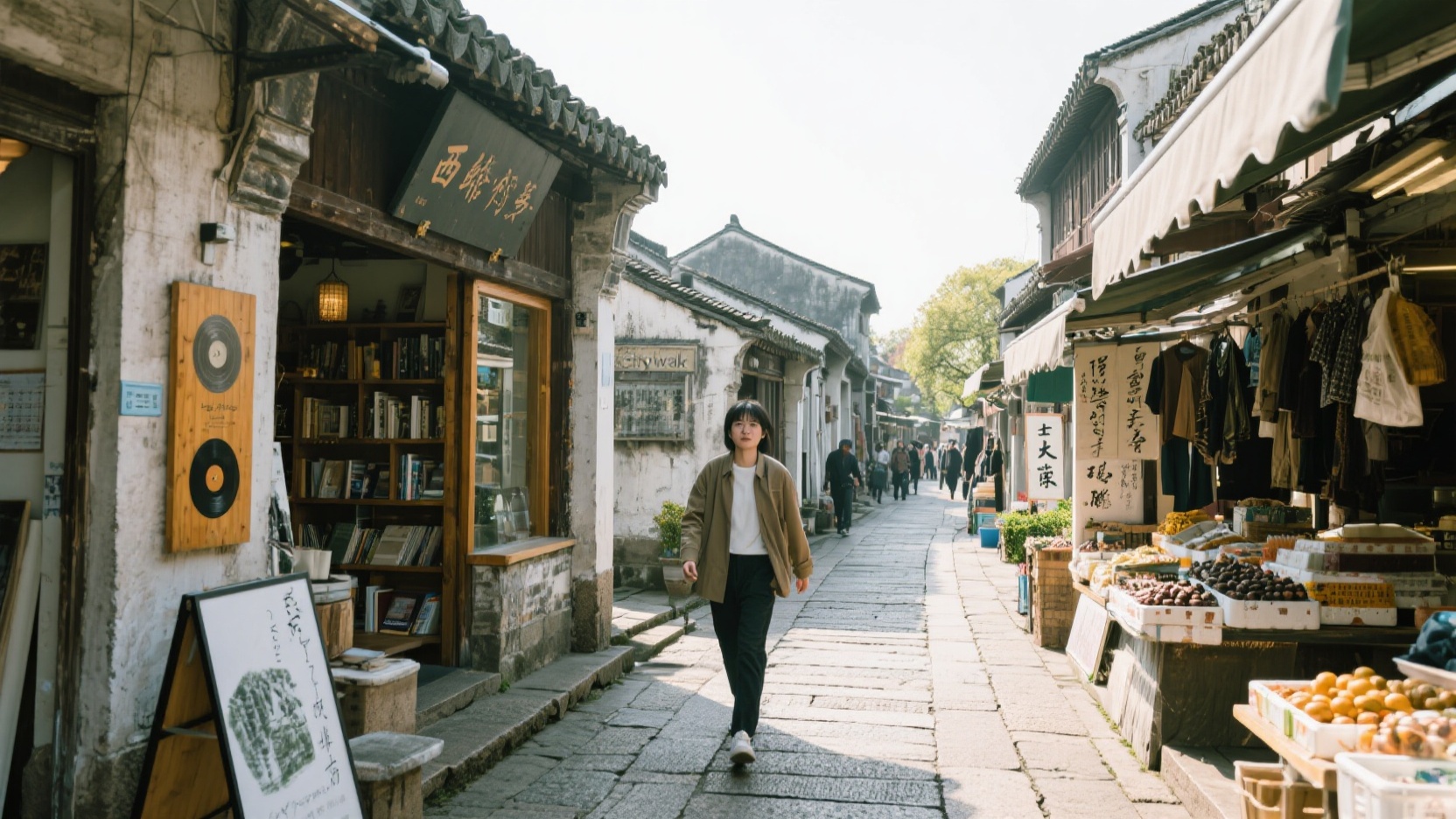
Leave Lu Xun's former residence to tour groups and Cangqiao Straight Street to those checking off tourist spots. This route, just over 4 kilometers long, is the artistic capillary I painstakingly explored in Shaoxing's old town over three afternoons. It bypasses any attractions requiring queues or ticket checks, yet strings together Ming and Qing dynasty gatehouses, Republican-era alleyways, the steamy atmosphere of the market, the sound of vinyl records, and the camphor scent of vintage clothing. If you only have one day and don't want to be swept away by the "touristy" feeling, you can directly follow this route.
Starting point of Xixiaolu: Enjoy the life of the water town and the old traditional houses (approximately 1.1 km / 20 minutes)
Starting at the "South Entrance of Xixiaolu Historical District," walk north along Xixiaolu. This street is narrow, with a river on one side and old Ming and Qing dynasty gatehouses on the other. The blogger's camera position: standing in the center of Xiegong Bridge, using the river's reflection to capture a three-tiered composition of "gatehouse + awning boat + clothes-drying bamboo pole," waiting for someone on an electric scooter to pass by before pressing the shutter. Why stop and watch for 5 minutes: There are no outdoor coffee stalls, only elderly people washing mops at the riverbank, and smoke rising from behind the gable walls of coal stoves—this is the everyday life of Shaoxing's water towns before it's been filtered out.
At the intersection of Xixiaolu Road and Beihai Road, you'll see a row of brick and wood buildings from the Republican era. It's recommended to take photos from the opposite sidewalk using a medium telephoto lens to avoid wide-angle distortion. Further north, you'll pass the "Xixiaohe Pocket Park," with stone tables, benches, and several old camphor trees. Suggested camera position: Sit on a stone bench and take a low-angle shot of people riding electric bikes alongside the church steeple on the opposite bank of the river. Why it's worth stopping for 5 minutes: Although the park is small, it offers a glimpse into three distinct urban landscapes: religious architecture, old traditional courtyard houses, and 1990s residential buildings—like an open slice of Shaoxing city.
Fushan Hengjie Market and long-established bookstore (approximately 0.8 km / 15 minutes)
Turn right at the north entrance of Xixiaolu onto Fushan Hengjie. This street is a vegetable market in the morning, and the wet stone slabs remain after the vendors pack up in the afternoon. Camera position: Crouch down at the intersection of Fushan Hengjie and Huanshan Road, and use a wide-angle lens to capture the overlap of the vegetable stalls' sunshades with the greenery of Fushan Mountain, waiting for elderly people carrying plastic bags to walk out of the frame. Why it's worth stopping for 5 minutes: The vegetable market is the most honest art scene in a city. The halved winter bamboo shoots, the neatly stacked fermented amaranth stalks, and the steaming rice cake stalls are more beautiful than any creative market. Blogger's tips: Don't go after 10 am, as many stalls close early. Also, don't take close-up photos of people's faces; close-ups of the stalls or hands are safer.
Turning from the market onto Huanshan Road, on the south side of the road, there's a long-established bookstore. The storefront is small, mainly selling local chronicles, calligraphy practice books, and old comic books. Camera angle: Standing at the bookstore entrance, using the door frame as a foreground, capture the owner's hands arranging old books and a pedicab passing by. Why it's worth stopping for 5 minutes: They don't sell coffee here, and there aren't any photo spots, but on the bottom shelf, you can find copies of "Shaoxing Historical and Cultural Materials" from the 1980s; the yellowed smell of the paper is another kind of "art" in Shaoxing.
Branch Line A: Duopo Lane, Bifei Lane and Wang Yangming's Former Residence (approx. 0.7 km / 12 minutes)
This side street leads from the bookstore across Shengli West Road, into "Tishanqiao Straight Street," and then turns into "Duopo Lane." The alley is so narrow that two people walking side by side have to turn sideways, and the walls are covered in moss. Camera position: Shoot from below at the alley entrance with a vertical composition, waiting for a cyclist to pass by; ideally, the bicycle basket should have scallions and fried dough sticks. Why it's worth watching for 5 minutes: The alley's name comes from the story of Wang Xizhi writing an inscription on a fan for an old woman, and half of a Qing Dynasty "fire-avoidance stele" is embedded in the wall. This feeling of engraving calligraphy legends into the fabric of the alley is unique to Shaoxing.
Turning out of Duopo Lane leads to "Bifei Lane," an even shorter lane connecting to the back wall of Cai Yuanpei's former residence. A few steps further north is Wang Yangming's former residence; the reconstructed square is spacious, contrasting sharply with the narrowness of the alleyway ahead. Camera angle: Stand by the pond on the west side of Wang Yangming's former residence, capturing the white wall reflected in the water and the air conditioner units of distant residential buildings in the same frame. Why it's worth spending 5 minutes watching: The new and old aren't opposed, but rather layered together, which is more "Shaoxing" than simply photographing a single wall. This section is largely untouched by tourists, perfect for a leisurely stroll.
Branch Line B: From the vinyl record store on Shangda Road to the vintage clothing warehouse on Xiada Road (approx. 0.9 km / 15 minutes)
Turning back from Wang Yangming's hometown, we headed east along Shangda Road. This street, after renovation, preserved the eaves and verandas of shops from the Republican era. In the afternoon, the west-facing sunlight casts geometric lines through the shadows of the pillars and the outdoor coffee stalls. Camera position: crouching down at the intersection of Shangda Road and Beihai Road, using the pillar shadows as leading lines to film pedestrians walking into the light. Why it's worth watching for 5 minutes: The gables and columns of the Republican-era buildings are well-preserved, yet nearby are residents drying their quilts—this mix is more visually appealing than a purely commercial street.
In the middle section of Shangda Road, there's a vinyl record café nestled inside an old traditional courtyard house. The owner places the record player in the courtyard, playing jazz or Yue opera vinyl records when the weather is nice. Camera angle: Standing outside the courtyard threshold, use the silhouette of the door frame to capture the moment the needle touches the record, with the weathered eaves of the traditional "Four Waters Returning to the Hall" roof in the background. Why it's worth stopping for 5 minutes: The background noise of the vinyl record and the resonance of the wooden structure of the courtyard house are very subtle. Sitting on the threshold and listening to half a song like "The Butterfly Lovers" or "Kind of Blue," time suddenly slows down.
I strolled into a vintage clothing and general store on Xia Dalu Road. It was actually a combination of warehouse and workshop, filled with old leather trunks, vintage shirts, and enamel plates from the Shaoxing Winery. Camera angle: From outside, I photographed clothes racks and a calico cat bathed in warm light through the wooden lattice window. Why it's worth spending 5 minutes looking: It doesn't feel like a shop; it's more like a 20th-century Shaoxing preserved by its objects. The camphor and old leather smells are a natural "olfactory exhibition."
The journey ends at Jishan Street Pocket Park and Tishan Bridge (approximately 0.6 km / 10 minutes).
From Xia Dalu, head east back to Jishan Street and reach Tishan Bridge. This bridge is the visual highlight of the entire route; the difference in elevation between the bridge surface and the water is small, and the sound of oars and water can be heard as the covered boats pass through the arches. Camera position: Stand on the stone steps on the east side of Tishan Bridge, wait for an empty boat to pass through the arch, and use a slow shutter speed to capture the water surface like silk. Why it's worth watching for 5 minutes: The stone slabs on the bridge are polished to a shine, and the evening light filters through the gaps in the railings, like outlining the steps. It's much quieter here than Lu Xun's former residence.
Beside the bridge is a small pocket park with a few chinaberry trees and a circle of stone benches. Sit down to rest and watch the lights of the old houses on the opposite bank gradually illuminate. The blogger summarizes: This route, just over 4 kilometers long, has two branches: Branch A is "Calligraphy and Alleyways," Branch B is "Sounds and Old Objects," and the main route is "Daily Life in a Water Town." It doesn't guarantee a perfect nine-grid photo opportunity, but it will allow those who appreciate the texture of a city to truly understand why Shaoxing is called "a museum without walls."
Blogger's Summary and Practical Tips
This route is best explored in half a day, ideally on a weekday afternoon to avoid the weekend crowds. The entire route is approximately 4.5 kilometers, and with stops for photography, it will take about 2.5 to 3 hours. Wear soft, thin-soled shoes, as the cobblestone streets are not foot-friendly. If you want to photograph the local market, try to arrive at Fushan Hengjie before 8:30 AM, when the steam and vendors' calls are strongest. If you're interested in vintage items and vinyl records, the shops on branch line B usually open in the afternoon, so don't go too early. There are no entrance fees or reservations required for the entire route; simply mark "Tishan Bridge," "Xixiaolu," and "Duopo Lane" on your mobile map to navigate. Finally, a reminder: residents live in the old alleys, so please be quiet while photographing and do not stick your camera into their homes.