
Nanjing in the Light: A Half-Day Intangible Cultural Heritage Event Featuring the Qinhuai Lantern Festival, Baiju Opera, and a Red Paper Sheet
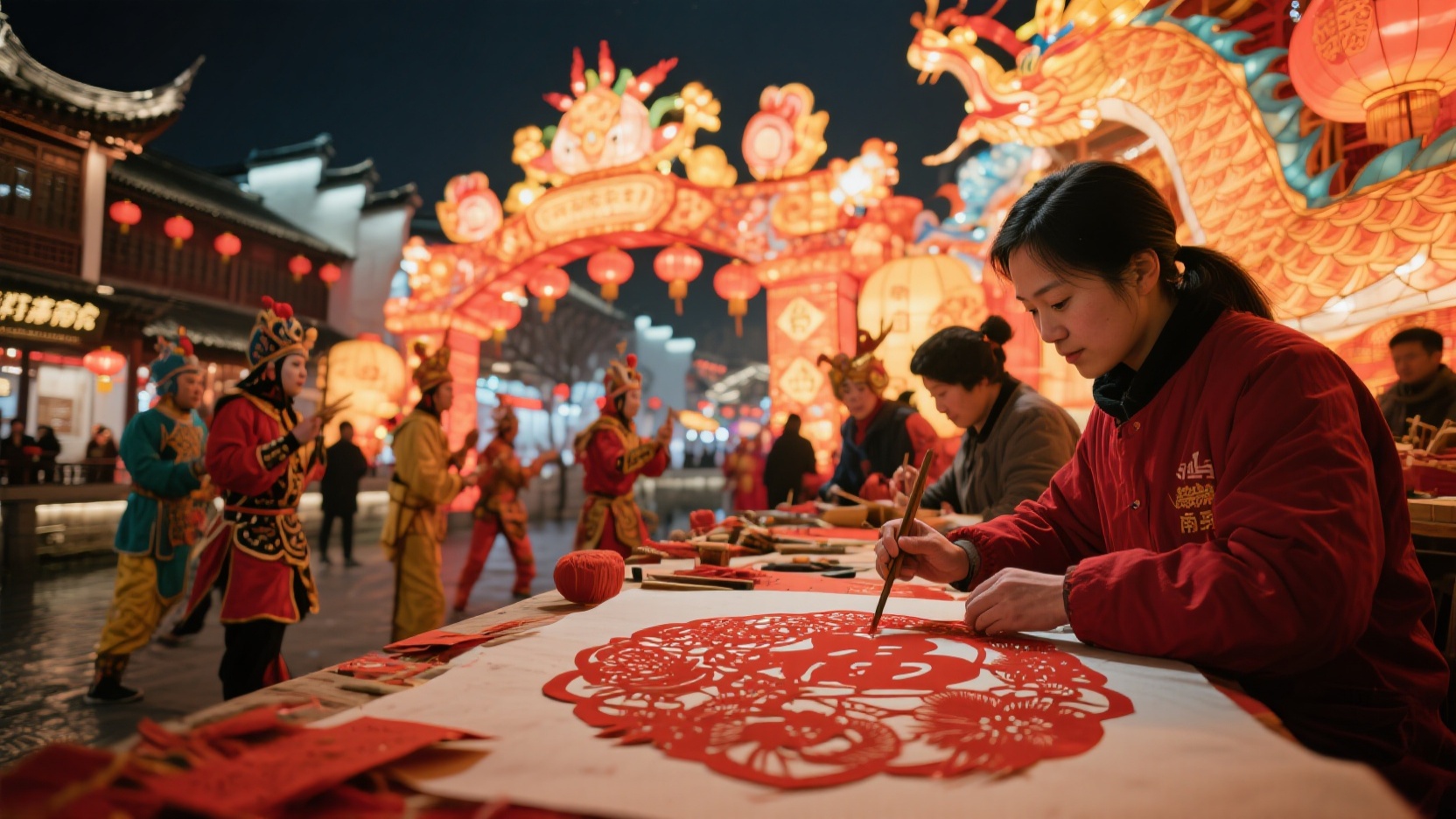
Nanjing's "culture and art" is often simplified to the Sun Yat-sen Mausoleum and museums, but the truly vibrant culture lies hidden in the seasons and crafts. Using winter and spring as a timeline, you can string together Nanjing's intangible cultural heritage experiences into a "half-day local" route: making Qinhuai lanterns and watching Gaochun Nuo dance in the first month of the lunar calendar; cutting red paper at the Ganxi Residence on weekdays and listening to a piece of Jinling Baiju opera in a teahouse. All four activities are accessible to everyone; simply set aside about two hours and let your hands and ears be engaged with local artists.
Qinhuai Lantern Festival and Lanterns: Making a rabbit lantern during the first month of the lunar calendar
The Qinhuai Lantern Festival is concentrated from the first to the eighteenth day of the first lunar month each year, with the core areas in Confucius Temple, Laomendong, and Bailuzhou. However, the best time to experience lantern making is in the afternoon from the fifth to the tenth day of the first lunar month. The lantern festival originated in the Southern Dynasties. In the early Ming Dynasty, Zhu Yuanzhang advocated the display of lanterns during the Lantern Festival in Nanjing, which made the lantern boats on the Qinhuai River famous. Nowadays, many people visit the lantern festival, but few actually sit down to make lanterns. Lantern workshops usually provide split bamboo strips, Xuan paper, paste, and LED lights. The master first teaches how to "bind the frame," using cotton thread to cross and fix the bamboo strips. The rabbit lantern needs to be made with two long ears and a round body. Then, the master teaches how to "paste the paper," where the Xuan paper needs to be lightly stretched and sizinged to avoid wrinkles. Finally, paper-cut eyes and petals are attached. The Qinhuai lantern is particular about "five bends in one bamboo strip," and each petal of the lotus lantern needs to be slightly heated over a fire before being bent into an arc. In the past, Nanjing families would hang lanterns during the New Year, as the word for lantern is a homophone for "ascend," implying "rising step by step." After you finish making your lantern, don't rush to leave. In the evening, walk from Dongshuiguan along the Inner Qinhuai River to Wende Bridge and watch your lantern blend with the lanterns on both banks. This is the quietest part of the lantern festival.
Nanjing paper-cutting: "Flowers within flowers" on red paper
Nanjing paper-cutting can be experienced year-round, but the best time is before the Spring Festival and Dragon Boat Festival. Nanjing paper-cutting was already a tribute item in the Ming Dynasty. Unlike the intricate style of Yangzhou paper-cutting, Nanjing paper-cutting emphasizes "flowers within flowers, themes within themes"—a peony might conceal a pomegranate, a bat, or a ruyi (a traditional Chinese ornament symbolizing good fortune). Experience points are often located near the Ganxi Residence or in intangible cultural heritage workshops. The instructor usually gives you a sheet of red paper and a pair of pointed scissors, and you can start cutting directly without a draft. Beginners start with the character "喜" (happiness) and plum blossoms, learning two cutting techniques: "open cut" for the outer outline and "closed cut" by inserting the scissors into the back of the paper to create an internal cutout. When cutting plum blossoms, you must cut five petals at once without breaking the lines. There's an old Nanjing saying, "The scissors are so exquisite, you can't praise them enough!" From the 23rd day of the twelfth lunar month to New Year's Eve, Nanjing people paste "hanging paper" on their door lintels, cutting out characters like "福" (fortune) and "春" (spring) from red paper, with the bottom cut into tassel shapes. During the Dragon Boat Festival, people cut out images of the "Five Poisons" and paste them on the back of their doors, symbolizing fighting poison with poison. The experience takes about an hour and a half, and the finished pieces can be taken home with a blank sheet of paper, which is more personal than buying printed souvenirs.
Jinling Baiju: Listening to the sound of a loom in a teahouse
Baiju is Nanjing's only ancient local opera genre, sung in the Nanjing dialect, and originated in the Ming and Qing dynasties. At that time, brocade weavers would hum tunes while working long hours in their looms, gradually developing into a form of self-entertainment called "Baiju" (literally "singing a round of songs for free"). Because it didn't sell tickets or charge money, it was named "Baiju." Today, Baiju performances are often held in small theaters or teahouses, mostly in the afternoon or evening. The experience is divided into two parts: listening and learning. First, listen to a section of "Qinhuai Mei" or "Shu Qiao" (Counting the Bridges), the lyrics of which count Nanjing's bridges from one to ten, interspersed with bridge names, place names, and street vendor cries. Then learn the line "Guai guai long di dong, jiu cai chao da cong" (Good heavens, long, scallions and chives), which seems colloquial but actually requires singing the entering tone and drawn-out syllables in Nanjing dialect. The performers will break down the rhythm of the clappers and teach everyone to lightly tap teacups with chopsticks to simulate the sound of a "wooden shuttle in a loom." Baiju opera was listed as a national intangible cultural heritage in 2008. The scripts preserve a lot of Nanjing slang, folk taboos, and old street names from the Ming and Qing dynasties. Don't rush to leave after listening. The sweet taro seedlings and braised dried tofu mentioned in the lyrics can be found in the nearby streets and alleys. You can try them according to the lyrics.
Gaochun Five Gods Dance: A Rural Ritual Under the Nuo Mask
The "Jumping Five Gods" dance in Gaochun is a Nuo dance preserved in rural temple fairs, mainly held during the first month of the lunar calendar, with the most complete performances in the Yaxi and Qiqiao areas. The Five Gods are the five deities of the five directions, and the ritual originates from the ancient "Xiangren Nuo," aimed at warding off plague and bringing good fortune. Performers wear five-colored Nuo masks (blue, red, white, black, and yellow) and warrior costumes, walking the "Yu Step" to the accompaniment of gongs, drums, and cymbals, their movements vigorous and powerful, with flags fluttering as they turn. The entire ceremony is divided into "Starting the Gods," "Jumping the Gods," and "Closing the Gods," sometimes lasting all day. Tourists can watch from the field ridges or outside the ancestral hall; villagers will invite you to join the procession for a while, but you should not touch the Nuo masks or take photos directly in front of the altar. The most captivating aspect of the Jumping Gods is the transformation of identity behind the masks: villagers who normally farm or run small shops become "god" substitutes after donning the masks, their movements meticulous. Afterwards, you can chat with the elderly villagers about the correspondence between the colors of the facial makeup and the five directions and five elements, which is much more engaging than the explanatory plaques in the exhibition hall. Gaochun is about an hour's drive from downtown Nanjing, and you can combine a day trip with a leisurely visit to Gaochun Old Street and Gucheng Lake.
There's a common logic to experiencing intangible cultural heritage in Nanjing: first, understand the seasonal context, then try your hand at it or listen to the performance. In the first month of the lunar calendar, go to the Qinhuai Lantern Festival to learn how to make lanterns, or to Gaochun to watch the "Five Witches Dance"; on weekdays, visit the Ganxi Residence to cut a piece of red paper or listen to a performance of Baiju opera. Spending half a day on a pair of scissors, a lantern, or a snippet of Nanjing dialect is a much deeper way to understand the city's essence than simply checking off tourist attractions.