
Yunnan Cultural Heritage: A Guide to In-Depth, Slow-Paced Cultural and Artistic Travel in Kunming
Kunming, a city known as the "Spring City," possesses charm far beyond its year-round spring-like climate and picturesque scenery. Deep within it lies the rich cultural heritage of Yunnan, spanning thousands of years; the resounding echoes of its modern history; and the vibrant tapestry of diverse ethnic arts. This article will guide you on an in-depth cultural and artistic journey, leading you beyond superficial observation to immerse you in Kunming's historical context and cultural essence.
Tracing the Origins of Dianchi Lake: Yunnan Provincial Museum
The Yunnan Provincial Museum serves as a starting point for understanding the culture and art of Kunming and Yunnan as a whole. Its rich collection, particularly the "Dian Kingdom Bronze Ware," vividly portrays the mysterious and glorious history of the ancient Dian Kingdom. From the imposing ox and tiger bronze table to the exquisite cowrie shell container, each artifact carries the social structure, sacrificial beliefs, and artistic aesthetics of a thousand years ago. Furthermore, the museum systematically organizes the cultural features, customs, and artistic achievements of various ethnic groups in Yunnan, providing an excellent window into understanding this diverse land. Here, you will experience the enduring vitality and creativity of Dian culture from the Stone Age to modern times.
Cultural Heritage Preservation: The Former Site of the Southwest Associated University and Cuihu Park
From the glory of ancient Dian to the turbulent modern era, the former site of the Southwest Associated University stands as a spiritual high ground in the cultural history of Kunming and even China. Amidst the flames of the War of Resistance against Japan, Tsinghua University, Peking University, and Nankai University relocated to Kunming, persisting in their educational endeavors for eight years, cultivating countless outstanding talents—a miracle in the history of Chinese education. Strolling through the former site, one can almost hear the sounds of students reciting their lessons and the clash of ideas amidst the ruins. This is not merely a physical remnant, but a symbol of national spirit and academic independence. Adjacent to the former site is Cuihu Park, which embodies the leisurely philosophy of life and historical imprint of Kunming residents. Once part of Dianchi Lake, it later became a gathering place for scholars and intellectuals due to its proximity to institutions such as the Yunnan Military Academy and Yunnan University. On the shores of Cuihu Lake, one can feel the interplay between the weight of academic tradition and the tranquility of nature, experiencing the unique urban character of Kunming.
Ancient Charm, New Sound: Guandu Ancient Town
Leaving behind the solemnity of the academy, we turned to the vibrant, bustling Guandu Ancient Town. As a historically significant village on the northeastern shore of Dianchi Lake, Guandu Ancient Town is an important part of Kunming's historical and cultural city. It preserves numerous ancient buildings from the Ming and Qing dynasties, such as Miaozhan Temple and the Vajra Pagoda, showcasing the architectural characteristics of central Yunnan with exquisite wood carvings, stone carvings, and paintings. Stroll along the cobblestone streets, visit handicraft workshops, and sample intangible cultural heritage delicacies like Guandu Baba, experiencing the living transmission of traditional culture. Every brick, tile, and alleyway in the ancient town tells a story spanning a thousand years, making it an ideal place to experience authentic Kunming folk customs and traditional handicrafts.
Urban Imprints: Jinma Biji Archway and East and West Pagodas
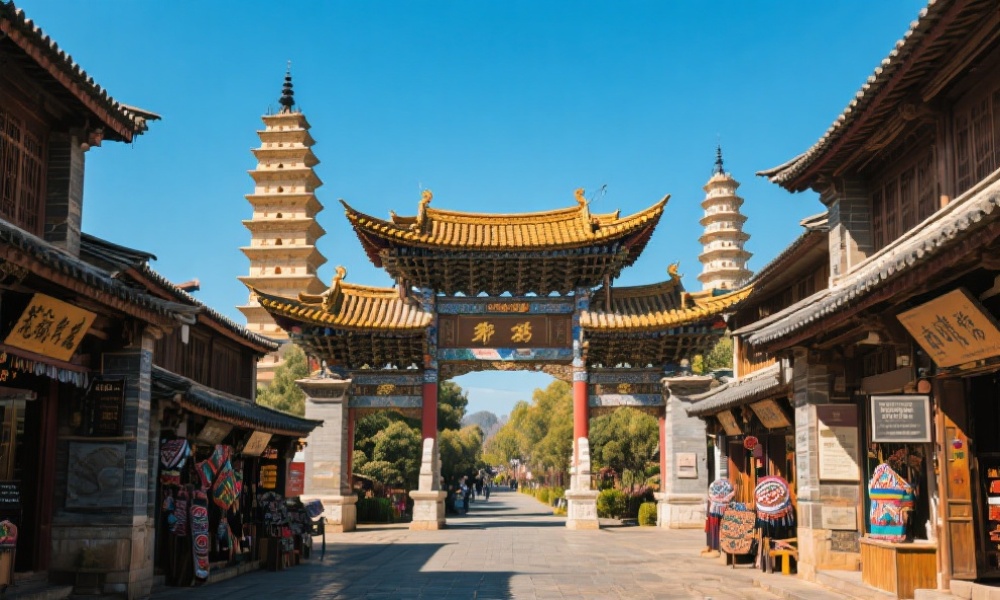
As iconic landmarks of Kunming, the Jinma Biji Archway is not only a city center landmark but also a window into Kunming's commercial culture and urban evolution. Originally built in the Ming Dynasty, the two archways' unique "golden and jade-like radiance" (the scene of the setting sun's rays piercing through the archways on certain days) embodies the wisdom and reverence for nature of the ancients. The surrounding area was once Kunming's most bustling commercial district, and it remains vibrant today, offering an excellent vantage point for observing modern Kunming life. Not far away, the East and West Pagodas, though weathered by time, still stand with their ancient forms, witnessing the rise and fall of Kunming's Buddhist culture and the city's transformation. They are silent narrators of Kunming's history, worthy of our attention and contemplation.