
Between the light and shadow and blue and white: From Dragon Boat Festival to Watermelon Lanterns, four hands-on events showcasing Jiaxing's intangible cultural heritage.
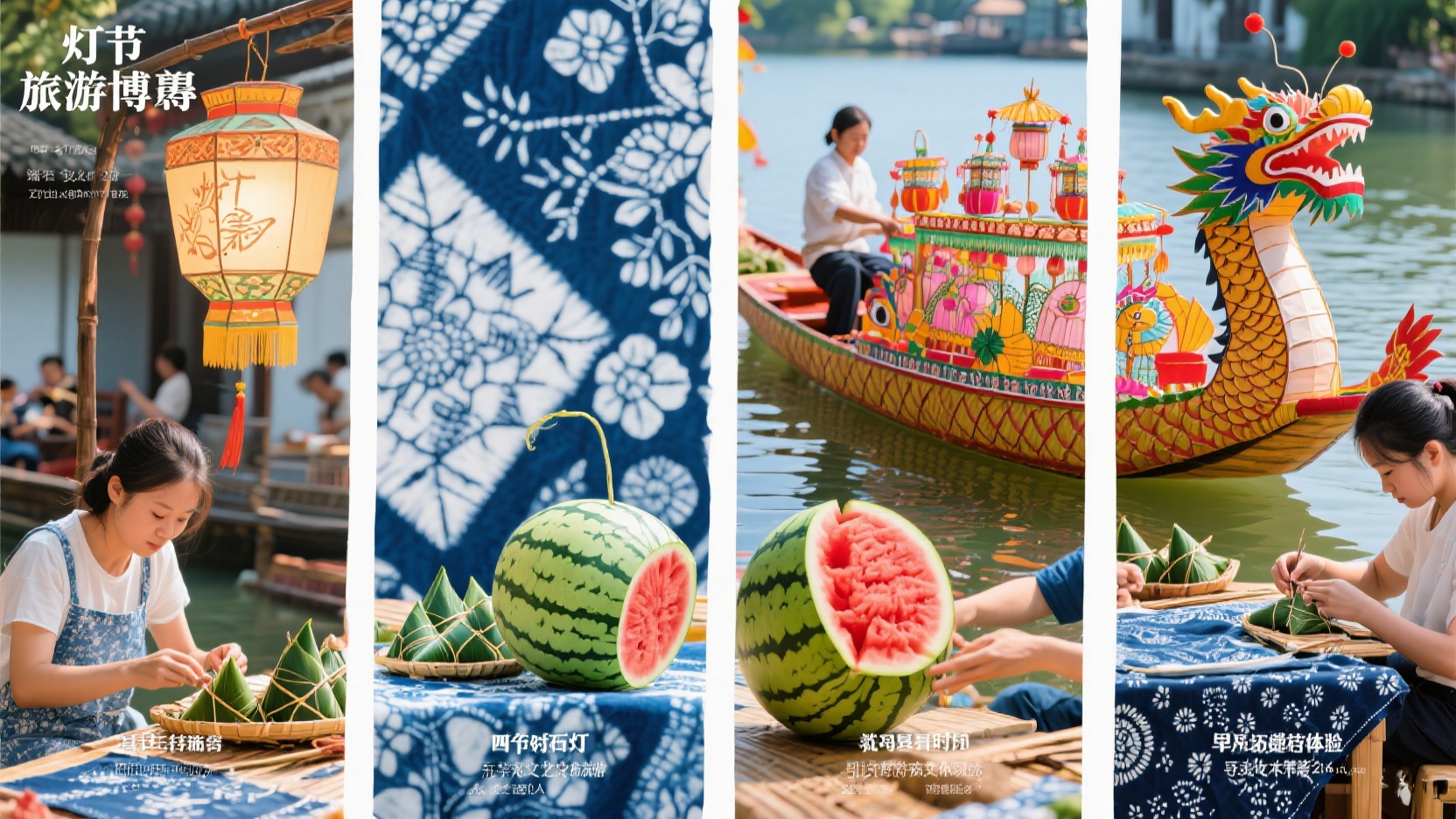
Most of Jiaxing's intangible cultural heritage activities are tied to the four seasons, including lantern viewing, zongzi wrapping, cloth dyeing, and melon carving—each perfect for setting aside half a day to sit down and participate. The following four experiences are distributed seasonally and can be inserted into individual itineraries or strung together as a cultural and artistic thread throughout the year. Their common characteristic is that while the materials are ordinary, the processes are truly exquisite.
Xiashi Lanterns: During the first month of the lunar calendar, visit Xiashi to create a "translucent painting".
Haining Xiashi Lanterns are a national intangible cultural heritage representative work, with core techniques combining needlework, piercing, carving, and painting. Every year around the Lantern Festival (January 1st of the lunar calendar), lantern festivals are held along the river and old streets of Xiashi, filling the streets with lantern light after dark. To gain a deeper understanding of its wonders, it's advisable to check local cultural venues for hands-on experiences. The experience typically begins with a piece of Xuan paper or silk. First, tiny holes are pierced into the paper with a needle, then the outline is carved according to a design, and finally, the paper is dyed and pasted. The smaller and denser the holes, the softer the light. Xiashi lanterns have a tradition of being "tribute lanterns" since the Southern Song Dynasty, and the pavilions and figures on the lantern pieces are often composed of hundreds of thousands of needle holes. Sitting down to pierce for an hour or two is far more memorable than simply taking photos in front of the lantern. The entire process requires no artistic skill; the key is a steady hand and a calm mind.
Dragon Boat Festival in Jiaxing: Wu Zixu's Memories of Wrapping Zongzi and Scented Sachets
The Jiaxing Dragon Boat Festival is concentrated around the fifth day of the fifth lunar month, with the areas around Nanhu Lake, Yuehe River, and the city moat being the most lively. Besides dragon boat races, the activities truly suitable for tourists to participate in include wrapping zongzi (sticky rice dumplings) and making sachets. The drumbeats of the dragon boats on Nanhu Lake are intense, and long queues often form in front of the zongzi-wrapping stalls along the shore, where experienced craftsmen's fingers move almost non-stop. Jiaxing zongzi are famous for their fresh meat fillings, and locals emphasize "folding the bamboo leaves so they don't fall apart and binding them with just the right tightness." An elderly woman sitting at the alley entrance can easily wrap a perfect four-cornered zongzi. To experience it, you can start by folding the bamboo leaves, filling them with seasoned glutinous rice and pork belly, and then tying them with cotton thread. In Jiaxing, the Dragon Boat Festival is not only about commemorating Qu Yuan; in the old Wu region, Wu Zixu was also highly revered, and the dragon boats and sacrificial rites on Nanhu Lake preserve this memory. Making sachets is equally simple: mugwort, calamus, angelica, and other medicinal herbs are filled into cloth bags and sewn together stitch by stitch, carrying away a touch of the pure fragrance of the Southern Dragon Boat Festival.
Tongxiang Blue Calico: Understanding the Logic of Blue and White by the Dyeing Vat
The Tongxiang blue-and-white printed fabric dyeing technique is closely related to the water town life of Wuzhen and Shimen, a remnant of the "every household dyeing cloth" practiced during the agricultural era of Jiangnan. Experiencing this technique is possible year-round, but spring and autumn are the most comfortable, as the fabric needs to be naturally dried after being sized. The traditional process involves several steps: carving the printing plate, applying the resist paste, dyeing, and scraping off the white residue. First, soybean powder and lime are mixed to form a resist paste, which is then scraped onto the white fabric using a paper stencil. After drying, the fabric is immersed in an indigo dye vat. The fabric initially appears greenish, gradually turning blue through oxidation. Finally, the resist paste is scraped off, revealing the white pattern underneath. The ancient logic of indigo processing and lime resist dyeing becomes clear in this scraping and dyeing process. The smell of indigo mixed with rice paste often lingers near the dye vat, a direct indicator of whether the workshop is operating normally. Many workshops can make handkerchiefs or small bags, which parents and children can easily participate in, but the complete process takes at least two to three hours.
Pinghu Watermelon Lanterns: A "Food Carving" Lesson on a Midsummer Night
Pinghu watermelon lanterns are a provincial-level intangible cultural heritage of Zhejiang Province, with peak experiences typically occurring in June and July when watermelons ripen. Pinghu is located on the Hangzhou-Jiaxing-Huzhou Plain, where watermelons have thin, well-shaped rinds, making them ideal for carving. The principle of making watermelon lanterns is "cut through the rind, but don't damage the flesh." First, the watermelon surface is cleaned, and then a carving knife is used to carve openwork patterns onto the green rind according to the design. Flowers, birds, waterscapes, and auspicious sayings are all acceptable themes. Then, the flesh inside is carefully hollowed out and a small lamp or candle is inserted, completing the watermelon lantern. In the past, Pinghu people carved watermelon lanterns to cool off on summer nights, which later developed into a local festival. For tourists, this is a seasonal hands-on activity. There are people on-site to guide the carving techniques, but completing a decent lantern still requires patience, especially when the light source is lit, the patterns on the rind seem to come alive again. Before cutting, one must learn to judge the thickness of the rind to avoid carving through the flesh.
The four experiences correspond to different seasons: viewing the lanterns of Xiashi in the first month of the lunar calendar, wrapping zongzi (sticky rice dumplings) at Nanhu before the Dragon Boat Festival, visiting the dyeing workshops of Tongxiang in spring and autumn, and carving watermelon lanterns in Pinghu in the height of summer. Each experience uses the most common materials—paper, cotton thread, indigo, and watermelon rind—to clearly illustrate the creativity of Jiaxing people and the seasons. It is recommended to allocate large blocks of time in the itinerary and avoid compressing it between attractions; many steps in the intangible cultural heritage handicrafts require waiting—waiting for oxidation, waiting for drying, waiting for the watermelon rind to let the light through—which is precisely its value. Confirm with local cultural venues in advance whether the experience is open for the season, and then treat yourself as a half-day apprentice; this will give you a deeper understanding of Jiaxing than a superficial visit. If you only choose one to begin with, the indigo calico making process is clear and the time is controllable, making it suitable as your first stop.