
How can I plan a three-day trip to Guilin without feeling rushed or tired? I'll break it down by the hour for you.
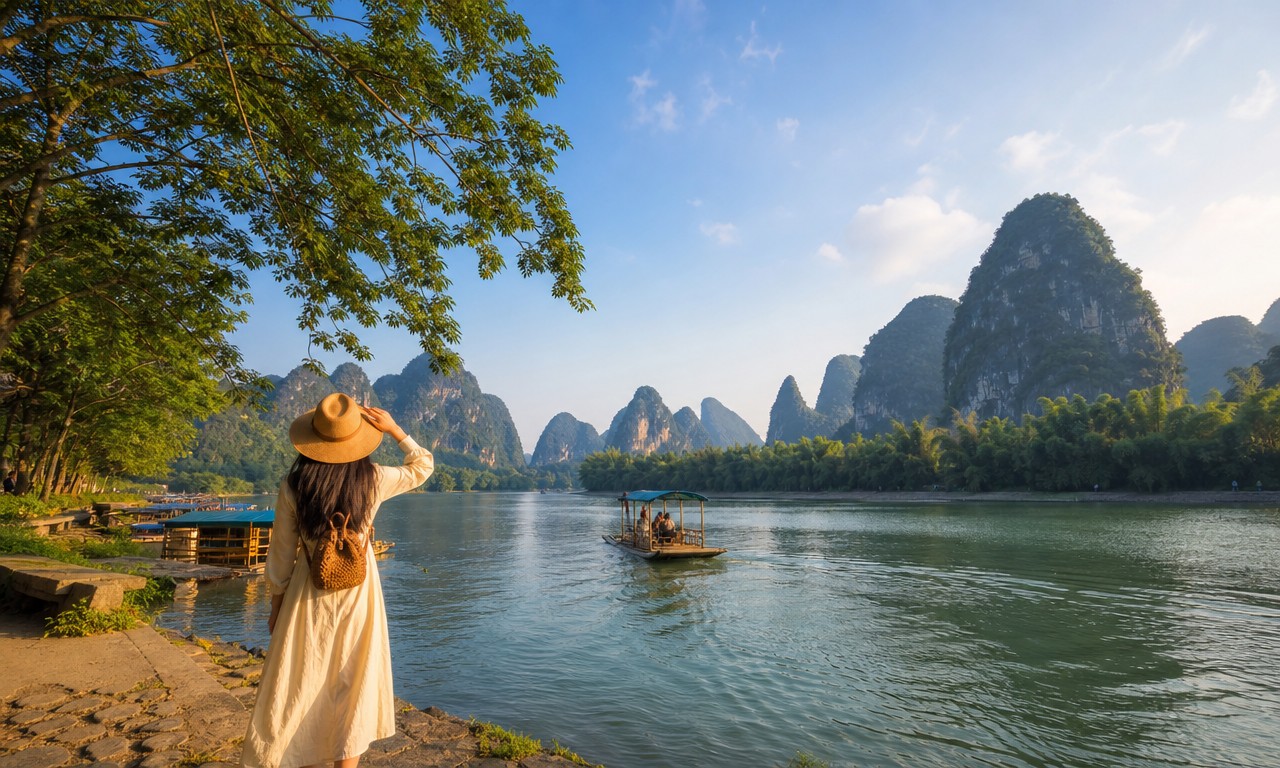
This is the most frequently asked question, and it deserves the most serious answer: Guilin's attractions are scattered, and there's a considerable drive between the city center and Yangshuo. If you follow a list of attractions commonly found online, you'll easily get tired and your time will be fragmented. This article won't list "must-see" attractions; instead, it will outline a three-day itinerary that has been tested many times, explaining what to do at each time slot and why.
Arrive at 2 PM on the day of arrival | Check into the city center, don't rush to leave the city.
Whether you arrive by plane or high-speed train, I recommend checking into Guilin city center on the first afternoon and not rushing to Yangshuo. The reason is practical: it takes an hour or two to get to Yangshuo from the airport or train station, and by the time you arrive it's dark, you won't see anything, and you'll be exhausted. Staying in the city center gives you ample time in the afternoon to explore on foot. For accommodation, a mid-range hotel near the Two Rivers and Four Lakes or the Shizijie area is sufficient. It's convenient for going out at night, and you don't need a river-view room, as the scenery of the Two Rivers and Four Lakes is more vividly experienced from the shore than from your room.
After dropping off your luggage, spend a little over an hour strolling along Lake Sugi, don't rush to take a boat. The Sun and Moon Twin Towers are even more beautiful in the evening light than at night, and the lakeside path is quiet. This time is for your body to adjust to the local pace, not for rushing to see all the sights.
Arrival time 18:00 | First meal of Guilin rice noodles, at a shop where locals line up.
For dinner, I won't go to the pedestrian street or a fancy chain restaurant. I'll find a rice noodle shop with a lot of electric scooters parked outside and people constantly calling out numbers at the takeout counter. I'll order braised rice noodles with a pot of scallion, and eat the dry-mixed noodles first, then add broth halfway through. Going at this time coincides with the first round of locals after get off work, so the noodles are at their best, and the pot of scallion isn't too soggy yet. To judge whether a shop is good, look at two things: do they sell "braised rice noodles" instead of just "Guilin rice noodles," and is the braised broth added by yourself at the counter or by the kitchen? The former shows the difference in quality.
Don't rush back to the hotel after your meal. Walk along Zhengyang Pedestrian Street towards Jiefang Bridge, and you'll pass through the most authentic part of Guilin's old town: stalls selling pickled vegetables, fruit baskets before closing up shop, and elderly people playing chess. This hour isn't a tourist attraction, but it will give you a better understanding of the scale of Guilin's city: it's a city perfect for walking.
Day 2, 8:00 AM | Boat trip on the Li River to Yangshuo; taking the early boat is more important than anything else.
The Li River cruise to Yangshuo requires taking the early morning departure. This isn't for watching the sunrise, but to reach the river before the large tour groups arrive and the harsh midday sun sets. Buy your tickets a day in advance, departing from the city center around 7:30 AM for Mopanshan Wharf, and boarding around 8:00 AM. For the first hour of the journey, the water and mountains are still cool, with a thin mist on the river, making the mountains appear farther away than in the afternoon. Once the sun is fully up, the river reflects light strongly, and photos don't do as well as what you see with your own eyes.
The entire journey takes about four hours, arriving in Yangshuo around noon. Many people ask if it's worth taking the whole trip, and my opinion is yes: the section from Guilin to Yangshuo is the most complete scenic stretch of the Li River, and taking the whole trip offers a more continuous experience than seeing only a section from Xingping. If you get seasick, the first half is smoother than the second half, so choose a window seat at the bow.
Day 2, 2:00 PM | After arriving in Yangshuo, rest first; don't go directly to West Street.
You'll usually arrive in Yangshuo around 2 PM, which is the hottest and sunniest time of day. Avoid cycling or going to West Street during this time; settle in and rest first. Choose accommodation near Fuqian Lane or Xianqian Street, which are not far from West Street but quiet at night. Take a short nap (about half an hour) or shower and change clothes, and then go out again after 3:30 PM.
The pace of life in Yangshuo is different from that in the city center; it's more suitable for activities starting in the late afternoon. The sunlight softens around 3 or 4 pm, and riding an electric scooter slowly along the Ten-Mile Gallery is pleasant with a gentle breeze. You can rent scooters near your hotel; no need to book in advance. Just pick one when you arrive, as they're all in similar condition. Try them out before deciding.
Day 2, 18:00 | Go to West Street an hour before it gets busiest, then leave.
West Street is Yangshuo's nighttime symbol, but it's not a street suitable for strolling from one end to the other. The best approach is to go around 6 PM, before it gets completely dark, when it's less crowded, and the cobblestone streets haven't warmed up from being walked on. You can then appreciate the details of the old houses and take a quiet walk before the bars and restaurants start soliciting customers. Afterward, head out to Osmanthus Lane or Riverside Road, adjacent to West Street, for dinner. There are many local restaurants there, and the prices are more reasonable.
Don't plan too much for Yangshuo in the evening. After a day on the boat, your fatigue will surface after dinner. Getting back to your accommodation before 9 pm, taking a hot shower, and going to bed is more worthwhile than spending another two hours strolling around West Street. It's also crucial that you don't need to get up too early the next day.
Day 3, 9:00 AM | Yulong River Bamboo Rafting: Choose the route from Jinlong Bridge to Jiuxian.
The Yulong River is an underrated section of Yangshuo. While the Li River is for "seeing," the Yulong River is for "sitting"—sitting on a bamboo raft, the water is so close you can put your hand in. Arrive at the Jinlong Bridge pier at 9 am; by then, one tour group has already left, so the queue won't be too long. The section from Jinlong Bridge to Jiuxian has a good drop and dense scenery, taking about an hour and a half—not too long, not too short. If you are traveling with elderly people or children, check the water level beforehand, as this section is closed during the rainy season when the water level is high.
After disembarking, you'll find old houses and several large banyan trees in Jiuxian County, which you can stroll around for about twenty minutes – it's just as charming as the Ten-Mile Gallery. Return to Yangshuo Town for lunch. Don't rush to check out; come back after lunch to pack your luggage before continuing your journey.
Day 3, 15:00 | Return to Guilin, allowing ample time for flexibility rather than rushing to more tourist attractions.
Returning from Yangshuo to Guilin city center is convenient by minibus and high-speed train, but avoid departing right on time. Departing at 3 PM and arriving in Guilin around 4 PM allows time to enjoy a bowl of rice noodles or buy some osmanthus cakes as souvenirs in the city, and also provides leeway for rescheduling if you miss your train. If your last stop is the airport, you can go directly from Yangshuo, but you must leave before 1 PM, otherwise you'll easily be rushed. My advice is not to treat the afternoon of the third day as another day for sightseeing, but rather as a reserved stretch of travel time, allowing for a more relaxed first two and a half days.
Three days is enough to cover the main routes in Guilin city and Yangshuo without rushing. If you only have two days, skip the city and go directly to Yangshuo; if you have four days, you can add Longji, but that will be a different pace. Following this order allows you to spend every hour on worthwhile activities, rather than wasting time on the road.