
Do locals actually eat the Guilin snacks recommended online?
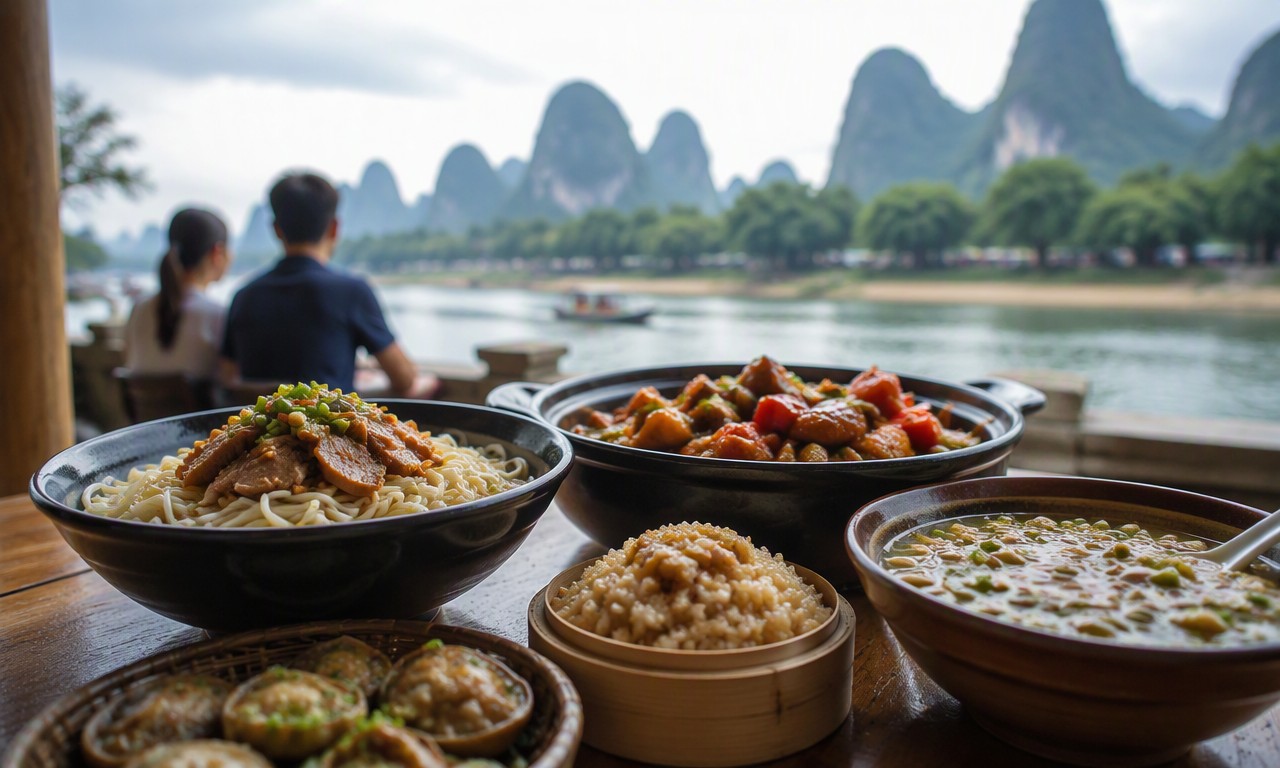
The internet is flooded with recommendations for Guilin's food, but how much of it reflects what locals actually eat on a daily basis? This is a question worth answering seriously, as it directly determines whether what you experience during your two or three days of travel is a tourist attraction or authentic local cuisine. Below are six comparisons, pitting the most widely circulated claims against local realities; choose the side that suits you best.
Guilin Rice Noodles: Travel guides recommend "Chongshan" and "Minggui," but locals often go to the one downstairs in their apartment complex.
Most travel guides will tell you to go to established chain restaurants like Chongshan Rice Noodles or Minggui Rice Noodles for Guilin rice noodles, claiming they're clean, consistently delicious, and easy for tourists to find. However, locals rarely make the trip to chain restaurants specifically for rice noodles. They're more likely to find a small, unassuming neighborhood shop that's been open for over ten years, serving only breakfast and lunch, with homemade braising sauce and generous portions of roasted pork and beef. Chain restaurants aren't necessarily bad, especially if you're short on time and worried about making a bad choice; they are indeed more reliable. But if you want the authentic, traditional taste of Guilin rice noodles, I suggest using a map to find moderately rated shops near residential areas with many local accents in the reviews—these are closer to the real experience than the guide lists.
Beer Fish: Are the "Master Chef" and "Sister Xie" on West Street in Yangshuo really any good?
Most travel guides will tell you that you must try beer fish in Yangshuo. Several large restaurants on West Street are well-known and have a lively atmosphere. Ordering swordfish or hairy fish will cost around 100 yuan per person for an authentic experience. However, locals rarely eat beer fish on the main West Street because rent is high, and a large portion of the price goes towards seating. Locals prefer to go to farmhouses near the county town or the Yulong River, where the fish is caught fresh from the pond, prepared in a more home-style way, and at more reasonable prices. If you want convenience and want to eat and then stroll along West Street, you can choose a large restaurant, but remember to ask about the weight and check the freshness of the fish. If you're willing to walk an extra ten minutes or so to find a farmhouse restaurant with local license plates parked outside, the beer fish there will often have a richer, more authentic flavor.
Oil Tea: The guidebook says "Gongcheng oil tea is the most authentic," but does the one I had in the city center count?
Most travel guides will tell you that to experience Guilin's oil tea, you must go to Gongcheng, as that's its birthplace, and it's best to make a special trip to Gongcheng to have a bowl of oil tea served with fried rice, peanuts, and glutinous rice cakes. While Gongcheng oil tea does have its unique preparation method, there are many oil tea shops in Guilin city and surrounding counties where locals drink it daily. These shops have a slightly bitter taste with a strong aftertaste, and the toppings differ slightly from Gongcheng's, such as more commonly including boat-shaped cakes and mugwort cakes. If you only have two or three days, you don't need to make a special trip to Gongcheng for the "authentic" experience. Just find an oil tea shop in the city that's full of middle-aged and elderly people at lunchtime, order a bowl of oil tea with some cakes, and you'll get a genuine local meal. Only if you're particularly interested in oil tea culture should you allocate half a day to Gongcheng to see the production process.
Water chestnut cake, steamed rice cake, osmanthus cake: Are the stalls at the scenic area entrance offering "tourist prices" or "local flavors"?
Most travel guides will tell you that water chestnut cake, steamed sponge cake, and osmanthus cake, which are ubiquitous in Guilin, are traditional snacks, and you should buy them whenever you see them and eat them while strolling around. In reality, locals usually buy these pastries from fixed stalls in farmers' markets or older neighborhoods, not at the entrances to tourist attractions. To maximize sales, stalls near tourist attractions often use premixed powder and artificial flavorings, resulting in a drier, sweeter taste at inflated prices. You can treat the entrances to tourist attractions as a place for "tasting," but there's no need to buy much. If you really want to buy some souvenirs or eat them yourself, go to places like Lequn Market or Wayao Market and find stalls that make and steam them fresh. The water chestnut cake will have water chestnut pieces, the steamed sponge cake will be soft and slightly sour, and the osmanthus cake will have a genuine osmanthus fragrance.
Luosifen (river snail rice noodles): Do people in Guilin eat it? Why does it keep appearing in travel guides?
Most travel guides will tell you that Guilin and Liuzhou are close, and that Luosifen (river snail rice noodles) is worth trying; some even list it as a must-eat in Guilin. In reality, locals in Guilin rarely eat Luosifen regularly; it's a staple food in Liuzhou. There are Luosifen shops in Guilin, but the taste isn't as good as in Liuzhou, and locals prefer Guilin rice noodles, boiled noodles, or sliced noodles. If you're a Luosifen lover, you can certainly satisfy your craving in Guilin, but don't consider it a Guilin specialty. Save your stomach for Guilin rice noodles, glutinous rice, and oil tea. You can basically skip the "Guilin Luosifen" recommendations in the guides.
Eighteen Delicacies: The guide says "go to Pingle to eat the most complete selection," are there any reliable options in the city?
Most travel guides will tell you to go to Pingle County for the "Eighteen Stuffed Dishes of Guilin," as it boasts the most diverse selection, including stuffed bitter melon, stuffed chili peppers, and stuffed tofu. They recommend dedicating a day there. While Pingle's eighteen stuffed dishes are indeed famous, many local restaurants in Guilin city also offer excellent stuffed dishes, especially some that have been open for over a decade. These restaurants often feature four or five different stuffed dishes on their menus year-round, and the taste is quite good, saving you the travel time. If you have ample time and are particularly fond of stuffed dishes, Pingle is worth a visit; however, if you just want to try something new, ordering two or three stuffed dishes in the city along with other Guilin dishes is sufficient. Locals also frequently make them at home; it's a common practice and shouldn't be overemphasized.
Sticky rice: Not mentioned much in travel guides, but it's the soul of local breakfast.
Most travel guides will tell you that breakfast in Guilin is rice noodles, maybe with a little oil tea, rarely mentioning glutinous rice. In reality, a very high percentage of Guilin residents eat glutinous rice for breakfast, especially working professionals and students. A glutinous rice ball, filled with pickled cowpeas, sausage, crispy fried dough, and chili sauce, costs only a few yuan and is quite filling. Good glutinous rice stalls are often located near elementary schools and old residential areas, setting up around 7 or 8 am and closing as soon as they sell out. If you're staying in the city center, skip the hotel buffet the next morning and go find a glutinous rice stall with a queue; you'll understand that this is more authentically Guilin than any travel guide.
Online guides and local experiences aren't about right or wrong, but rather the difference between a "tourist version" and an "everyday version." If you're short on time and want to avoid hassle, follow the guides to large restaurants and chains; you won't go wrong. If you want to eat like a local, head to the wet markets, residential areas, and school gates, and follow the queues of locals. Both approaches work; it just depends on which kind of Guilin you want.