
Avoid These Popular Tourist Spots in Chongqing | A Local's Guide to Avoiding Pitfalls: Don't Be Fooled by 3-Day, 2-Night Itineraries
Having lived in Chongqing for six years, I dread when friends send me a "classic 3-day, 2-night itinerary" for confirmation—nine times out of ten, I'll waste my vacation queuing and getting stuck in traffic.
Those travel guides string together Hongyadong, Ciqikou, and the Yangtze River Cableway into a single line, which seems reasonable, but they completely lack understanding of local transportation and real-world experiences. Today, I'll break it down for you point by point and provide a local-optimized version.
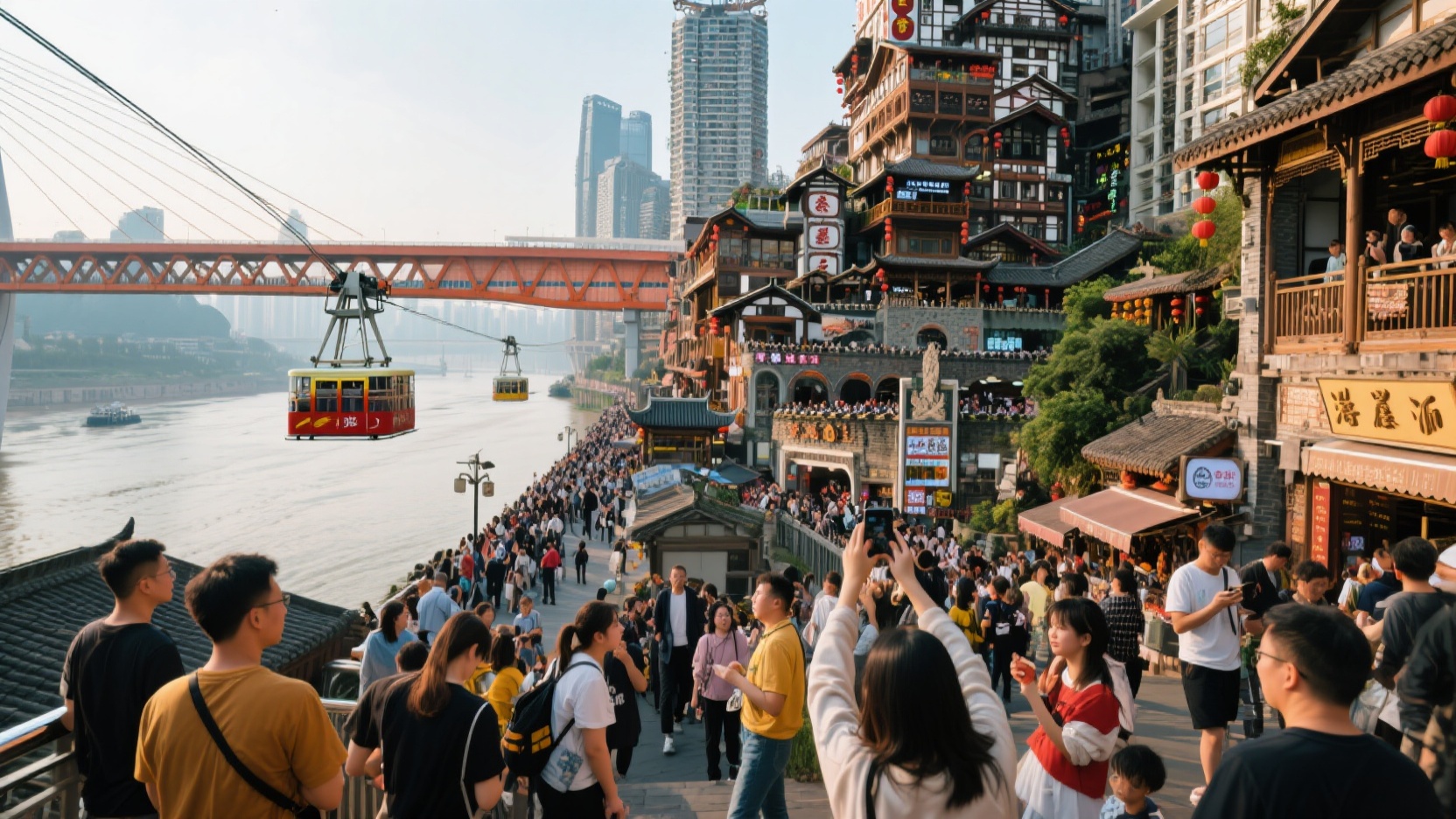
Hongyadong: Don't go in, just go to the other side of the river and see it lit up.
Online guides suggest "strolling through Hongyadong at night," but in reality, it's filled with identical souvenirs from all over the country and cramped staircases where you have to wander around for ages. Photographers mostly focus on the Qianmen Bridge or the Jiangbeizui riverfront, while locals just use Hongyadong as a backdrop.
Correct approach: Get off at the Grand Theatre station as it's getting dark, walk to the riverbank, and watch the entire Hongyadong illuminated across the river without having to squeeze inside. Alternatively, walk halfway across the Qianmen Bridge, take photos, and leave; don't eat inside.
Ciqikou: The main street is full of tourists; 30 minutes is enough. It's more worthwhile to go to Xiahaoli instead.
The main street of Ciqikou, from the entrance to the pier, is lined with shops selling fried dough twists, hot and sour noodles, and silver jewelry—just like any other commercial street in an ancient town. During peak season, it's packed with people, making it difficult to move. Locals only visit with relatives from out of town, and even then, they only explore the back streets or go near Baolun Temple, leaving within half an hour.
Better alternatives: Go to Xiahaoli or Longmenhao Old Street nearby. They're less crowded, have river views, offer a glimpse into old Chongqing, and you can even walk to Nanbin Road for some fresh air. If you absolutely must go to Ciqikou, don't buy from the first Chen Mahua shop at the entrance; any shop further in is about the same, no need to queue.
The Liziba light rail passes through a building: Take a quick photo and leave, don't spend half a day there.
The so-called "light rail passing through the building" observation deck is right by the roadside, with trains running every few minutes. You can leave in five minutes after taking your video. Many travel guides suggest spending the whole morning here, but you end up standing in the sun waiting for the train, surrounded by tourists holding up their phones.
Locals suggest taking Line 2 from Fotuguan to Liziba; this section offers a better view of the buildings and the Jialing River, and the angle is better than shooting from below. After taking the photos, take the light rail to Eling No. 2 Factory or Zhongshan Fourth Road; there's no need to waste time at the observation deck.
The Yangtze River Cableway: queuing for two hours for a three-minute ride is less appealing than taking the rail or walking across the bridge.
The Yangtze River Cableway used to be a local commute across the river, but now it's a tourist-only line. On holidays, the queue stretches from Xinhua Road all the way downstairs. It's a three-minute ride to the other side, and the carriages are so crowded you can barely turn around. A one-way ticket isn't cheap either, so locals almost never ride it.
If you want to take photos of the cable car, head to the pedestrian walkway on Dongshuimen Bridge; you can capture the cable car and the Yuzhong Peninsula in the same frame. For a riverside experience, take Metro Line 6 or the Loop Line; it's faster, more comfortable, and offers river views. If you absolutely must take the cable car, it might be less crowded before 8 AM or after 9 PM.
The Bayi Food Street and popular hot pot restaurants: It's really not worth queuing for two hours. Go to Guanyinqiao or a neighborhood store instead.
The hot and sour noodles, Chongqing noodles, and skewers at the Jiefangbei Bayi Food Street are mostly chain stalls, whose flavors have been conditioned by tourists, and are also expensive. The trendy hot pot restaurants are even more outrageous; you get a number at 4 pm and don't get to eat until 10 pm, and the broth gets saltier and saltier, so locals don't bother queuing up there.
Locals go to the small, unassuming restaurants downstairs in residential areas, such as Qixinggang, Lianglukou, and the old Nanping neighborhood, for hot pot. The average cost is between tens and hundreds of yuan per person. The tripe and duck intestines are fresh, and the broth is fragrant but not bitter. For snacks, go to Guanyinqiao Food Street or Daping Shiyou Road, where there are more choices and the prices are more affordable.
Nanshan One Tree and Crown Escalator: No need to make a special trip, local alternatives are more comfortable.
The entrance fee to Nanshan Yikeshu (One Tree) is quite high, and there's only one viewing platform at the top. During the day, the view is hazy, and at night, traffic jams make the journey up and down the mountain much worse. Locals prefer to go to Yihuali Night View Park or Changjiahui on Nanbin Road for the night view; these are free, offer more expansive river views, and provide opportunities for strolling.
The Crown Escalator is just a longer escalator; it used to be a mode of transportation between Lianglukou and Caiyuanba, but now it costs extra. If you're not a transportation enthusiast, there's absolutely no need to make a special trip there. Places like the Mountain City Trail and Baixiangju, which are free and have a more authentic mountain city feel, are much more worthwhile.
Indigenous Optimized Version: 3 Days 2 Nights + 1 Day Flexible Alternative
The most comfortable season in Chongqing is from October to April of the following year. Summers are scorching hot and winters are damp and cold, but less crowded. Day 1: In the morning, skip the trendy noodle shops and go to Zhongshan Fourth Road or the area around the Great Hall of the People for a bowl of local noodles. Then take Line 2 to Fotuguan Station to Liziba to see the buildings that seem to pass through the city. In the afternoon, go to Eling Second Factory or the Mountain City Trail. In the evening, go to Changjiahui on Nanbin Road to see the night view, which is ten times more comfortable than inside Hongyadong.
Day 2: In the morning, go to Xiaohaoli or Longmenhao, avoiding Ciqikou Main Street. Have a community hot pot lunch in Nan'an. In the afternoon, take the subway across the river to Baixiangju or Luohan Temple area. In the evening, take photos of Hongyadong from the Qianmen Bridge riverbank, but don't go inside.
Day 3: In the morning, visit Huangjueping Traffic Tea House or Graffiti Street, just for half an hour along the way; then go to Shiyou Road or Guanyinqiao for snacks. In the afternoon, you can flexibly go to Jiangbeizui or Beicang Cultural and Creative Park. Optional activities for Day 4: Take the kids to Chongqing Zoo or Natural History Museum; if you like taking photos, go to Jinhaiwan Park or Banshan Cliffside; for leisure, go to Nanshan Old Street or Nanwenquan.
In conclusion: Don't ask the locals for 5 tips I didn't tell you. Each tip has two pitfalls, so there are a total of ten things you shouldn't do.
First, don't make Hongyadong your destination, and don't buy Chen Mahua (a type of fried dough twist) at the entrance of Ciqikou.
Second, do not queue for the Yangtze River Cableway, and do not wear high heels or new shoes to climb the slope.
Third, avoid eating at so-called "time-honored" restaurants on Bayi Food Street, and don't queue for two hours just to try out popular hot pot restaurants.
Fourth, don't believe navigation saying "it's a short walk". Allow an extra half hour, and avoid going to places exposed to the scorching sun at midday in summer.
Fifth, don't just believe in popular photo spots, and don't take a taxi specifically for the Crown Escalator. Locals find their joy in the alleys and along the river.