
Forget about crowding into Tai Kwun M+ | Local expert's advice: This 5km local artsy walking route is the real Hong Kong.
The dumbest cultural experience I ever had was accompanying a friend to Tai Kwun on a weekend afternoon. We ended up queuing for 25 minutes in front of the prison wall, and all the photos I took had selfie sticks and other people's backs in the background. At that moment, I thought, who in real Hong Kong would view an exhibition like that?
Many travel guides describe Hong Kong's culture and arts scene as a linear route: "M+—Tai Kwun—PMQ". But as a local resident who has been traversing Hong Kong Island and Kowloon for over five years, I rarely go into these places on my own initiative. It's not that they're bad, but when something becomes a routine check-in, it loses its connection to everyday art.
First, avoid these three popular Instagrammable spots: even locals passing by won't go in.
The first one is Tai Kwun. The building itself is beautiful, and the stone walls and stairs are indeed photogenic, but it was so crowded on a weekend afternoon that it was difficult to move. The exhibition content was inconsistent, and many people just took pictures of the exterior walls and left. Friends who work nearby would rather detour to Hollywood Road than go in and become background figures.
The second is the M+ rooftop lawn in the West Kowloon Cultural District. The lawn by the sea is indeed spacious, but in the afternoon, backlighting makes Victoria Harbour appear hazy, and entering the exhibition hall involves long queues like airport security. On weekends, strollers and selfie sticks fill the passageways. For a better sea view, locals tend to go to the Sai Wan area, which is much quieter.
The third is Tai Nan Street in Sham Shui Po, known as the "hipster street." In recent years, it's been touted as Hong Kong's Brooklyn, but in reality, half of it consists of pop-up upscale cafes and designer boutiques. Locals can't even get through the food carts, and when taking photos, the air conditioning is often dripping wet in the background. The truly vibrant old shops are located on the neighboring Pei Ho Street and Apliu Street.
II. A 5-kilometer local artsy walking route: from Sham Shui Po to Yau Ma Tei
I take this route every week, starting from Exit C2 of Sham Shui Po Station, passing Pei Ho Street Market, Apliu Street, Shek Kip Mei Park, JCCAC, then down Tai Po Road to Mong Kok, past the Preface Bookstore, and finally to Yau Ma Tei Theatre and Broadway Cinematheque. The whole route is about 5 kilometers long, and it takes about three hours to stop and eat along the way. It connects wet markets, old streets, community parks, creative parks in old factories, upstairs bookstores, and small theaters, and just avoids all the must-see landmarks.
I recommend starting your walk around 4 PM in autumn or early winter, when the light is softer and the Sham Shui Po market hasn't completely closed yet. By the time you reach Yau Ma Tei, the red brick houses and neon lights will be just coming on. Don't push yourself in the summer; walking five kilometers in the humid heat will feel like being in a sauna.
III. Beihe Street Market + Yaliao Street Entrance: The colors of the market are more substantial than most of the exhibitions.
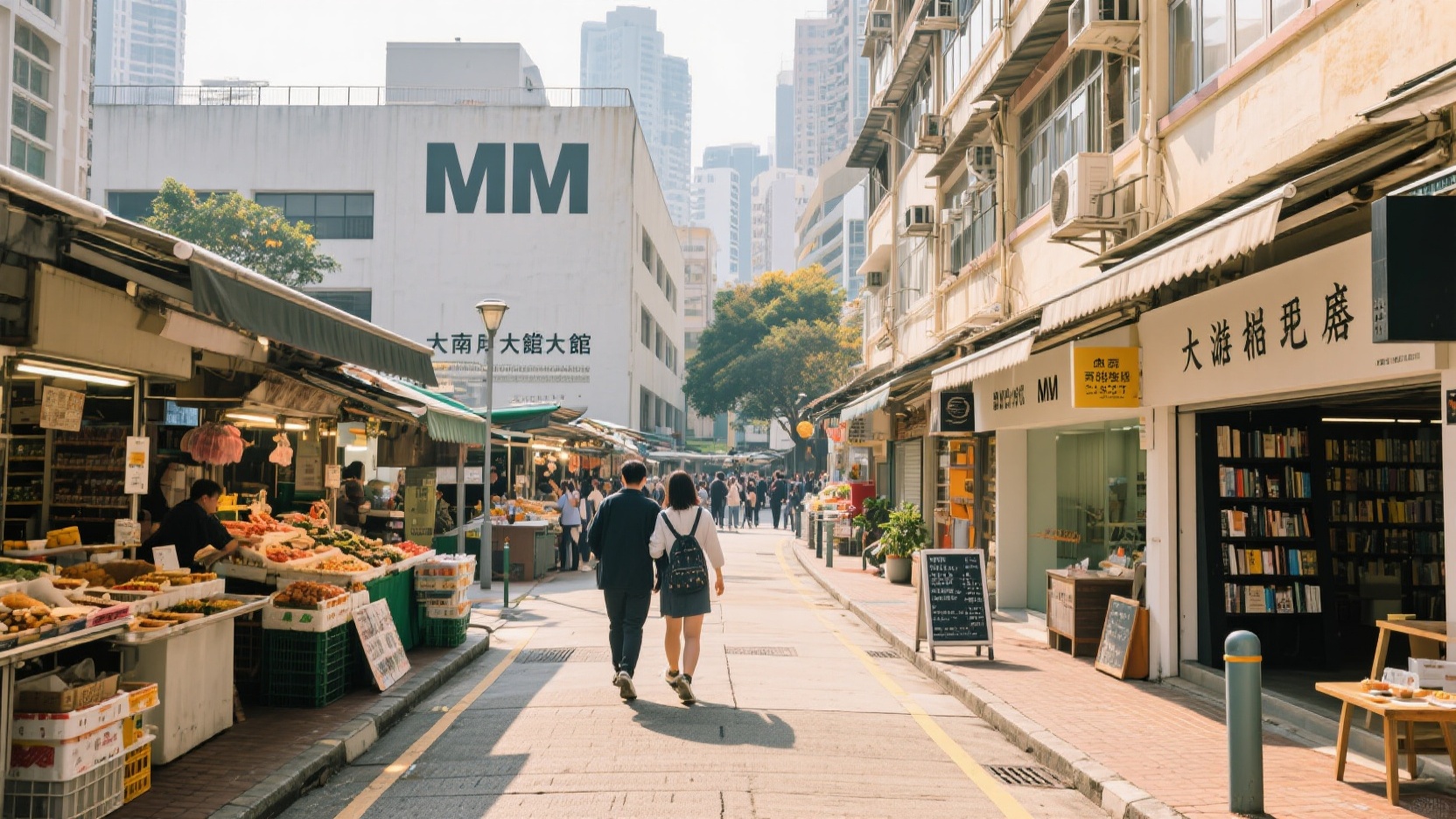
Beihe Street Market is worth stopping for ten minutes, not because it's pretty, but because every stall's signboard, plastic box, and red, white, and blue cloth are a vibrant display of color. The best spot is at the entrance under the footbridge in the middle of the market; use a telephoto lens to avoid the crowds and capture the dynamic action of the vendors chopping roasted meats—it's more natural than a posed photo. Nearby, try He Yi Tai Rice Noodle Rolls or Gong He Bean Products; they cost a few dozen yuan per person. Eat there before continuing your journey.
The old alleyway at the intersection of Apliu Street and Kwai Lam Street is a true "gallery" of secondhand goods in Sham Shui Po. Old radios, used watches, and mountains of charging cables create a chaotic yet orderly scene. The camera spot is on the corner of Kwai Lam Street looking towards Apliu Street; after 6 pm, the old signs light up, telling a story more than the wall at Tai Kwun. Nearby, try the affordable and comforting egg and beef sandwich from Sun Heung Yuen.
IV. Shek Kip Mei Park + JCCAC Old Factory Creative Park: Community daily life and artist studios are separated by only one staircase.
Walking north from Apliu Street for about ten minutes, you enter Shek Kip Mei Park. There are no internet celebrities here, only an old man playing chess, a housewife practicing qigong, and a few students jogging. The best vantage point is a pavilion high up in the park, looking down at the sports field and the old public housing estate in the background—a very Hong Kong composition. Taking a ten-minute break is a good way to refresh both your feet and eyes.
Next to the park is the JCCAC Jockey Club Creative Arts Centre, converted from the Shek Kip Mei Factory Building. Unlike shopping mall-style creative parks, each floor has artist studios with exhibition posters at the entrance, and you might occasionally see apprentices carrying clay. The best photo spot is on the seventh-floor corridor, where the old factory's iron gates and window frames are very photogenic. Nearby, there's a dai pai dong (open-air food stall) on the Nam Shan Estate platform, where you can find food for a few dozen dollars per person; I recommend the fried pork rind noodles or the iced milk tea.
Some studios at JCCAC are only open on weekends, but even on weekdays, the old industrial feel of the elevators and stairwells is quite appealing.
V. Preface Bookstore + Yau Ma Tei Theatre/Broadway Cinematheque: The bookstore upstairs and street performances are the evening shows.
Walking back to Mong Kok from Shek Kip Mei is about two kilometers. Preface Bookstore is located upstairs in an old building. Unlike large shopping malls, it doesn't have bestseller lists; the shelves are mostly filled with philosophy, social sciences, Hong Kong literature, and independent publishing. It's worth stopping for ten minutes. The window seats offer a view of the old buildings of Mong Kok. Your photo spot is right by the window, so please don't disturb those reading. Nearby is Kam Wah Cafe, known for its pineapple buns and milk tea—affordable but always crowded.
Continue walking for about ten minutes to Yau Ma Tei. The Yau Ma Tei Theatre is a red-brick building; you can see small performance posters at the entrance, and sometimes local theater troupes rehearse, their dialogue audible outside. The Broadway Cinematheque is in the alley across the street; Kubrick Bookstore and the cinema entrance are next to each other, with soft lighting at night. The best spot is across the street from the main entrance of the Yau Ma Tei Theatre, capturing the red-brick wall and street signs in the same frame.
If you don't want to pay to see a play, just standing in the alleyway outside and listening for five minutes is already a free mini-theater in the city.
VI. In conclusion: Don't ask the locals if I didn't tell you.
First, autumn to early winter is the best time to travel this route. Depart after 4 pm to see both the daytime streets and the illuminated Yau Ma Tei.
Second, don't wear white shoes. The streets of Beihe Street Market and Apliu Street are always slippery, and the air conditioning in the old buildings can spray water at any time.
Third, you can go to Tai Kwun and M+, but try to go on weekday mornings and avoid going on weekend afternoons to be just a background figure.
Fourth, this route is suitable for solo travelers or those with a good friend, but not for couples who want to take photos the whole way, as it will disrupt their rhythm.
Fifth, there are many exits between Sham Shui Po and Yau Ma Tei. Whenever you get tired, you can return to the MTR station by turning left or right for one or two blocks or so, without having to push yourself.