
Avoid these 3 fake artsy spots | Local testimonial: This 5km walking route in Chongqing's old neighborhoods is the real artsy spot.
During the ten or so minutes that Hongyadong was lit up, locals were taking shortcuts home without even looking up. It wasn't that we were indifferent; it's just that the spot that was touted as a "Spirited Away" location in travel guides always turned out blurry when filmed from across the river. Once inside, all you see are bars trying to lure customers in and the same old Yiwu souvenirs.
The true culture and art of Chongqing aren't found on rooftops where you have to queue for two hours, but rather in the folds of old neighborhoods, farmers' markets, and old factories. This article won't give you a top 10 list, but will simply lay out a 5-kilometer route frequently taken by local art enthusiasts, and incidentally, point out three pitfalls.
1. A “Trendy Illusion” That Even Locals Wouldn’t Enter
The first one is Hongyadong. During the day it looks like an antique-style commercial building, and at night it looks like a large-scale light show, but the internal layout is extremely bad. Going up and down the stairs is all about squeezing in, and the best photo spots are either on the opposite bank of the river or under maintenance, so the only way to get a good photo is with a filter. Locals only go in with relatives from other places; otherwise, they just want to leave as quickly as possible when passing by.
The second one is Eling No. 2 Factory. The concept of turning an old factory into a cultural and creative park is correct, but now it is full of photo shoots and coffee trucks. The rooftop photo spots have a queue of at least half an hour. Some of the "art spaces" sell postcards and aromatherapy products. The content is no different from the cultural and creative streets in the previous city.
The third is Jiaotong Tea House. Originally a place where old tea drinkers in Huangjueping played cards, now there are more cameras than teacups. Tourists are snapping photos of you with their long lenses, and even the elderly seem to be forced to perform when drinking tea. If you want to experience the old tea houses of Chongqing, you should go to the tea shops in the backstreets and communities. The owners will even ask you, "Young man, would you like jasmine tea or tuocha?"
2. Take an alternate route: the 5-kilometer old community route from Yeshuigou to Beibin Road
The route starts from the Yeshuigou vegetable market behind Guanyinqiao, passes through Taping Community, Beicang Old Factory, Liyuchi Cooperative Village, and finally goes down to Xiangguosi Wharf on Beibin Road. The whole route is about 5 kilometers long. There are no tourist attraction signs, but there are almost no tourists.
It's perfect for a walk in the spring, from morning to afternoon, with shaded trees, terraced steps, the sounds of market vendors, and a gentle river breeze. If you get tired, just pop into a small noodle stall or a local café near a residential building; prices are reasonable, no need to queue, and no fear of being overcharged. It's not a "photogenic" route, but every step reveals the authentic everyday life of Chongqing's local artsy scene.
III. Yeshuigou Old Street Market: Take a 10-minute break and see how this city awakens.
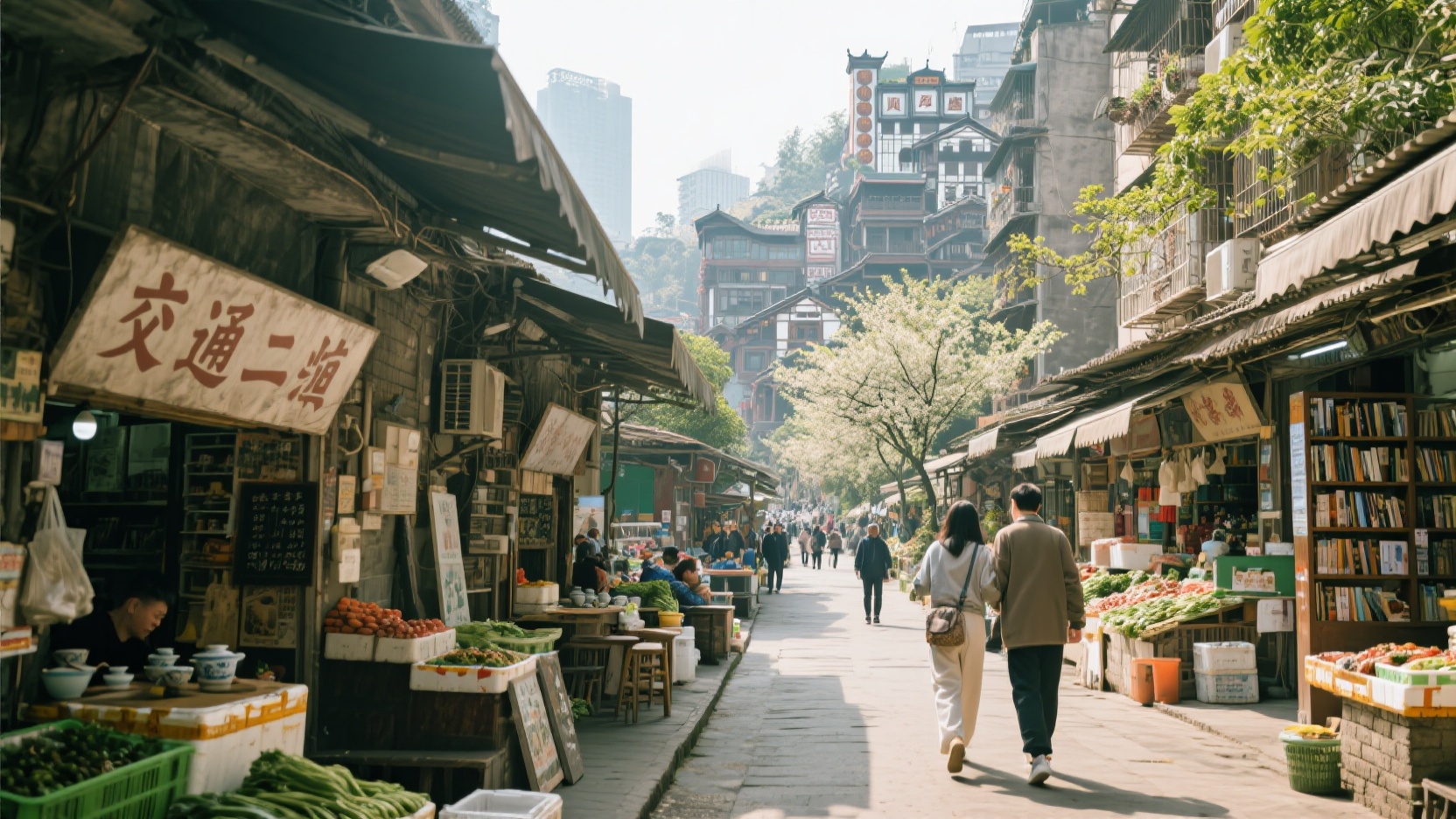
Our first stop was Yeshuigou, which art students and photographers affectionately call "the wild studio." This is an old community behind the Guanyinqiao commercial district, where vegetable stalls, butcher shops, and roast meat stalls are crammed into narrow alleys. Before nine o'clock in the morning, the sunlight slants into the awnings, and the blue and white striped sunshade cloths and red peppers piled together create a more vibrant color scheme than any installation exhibition.
A spot worth stopping for 10 minutes is at the first corner after going uphill from the entrance. Stand next to the stalls selling water spinach and Sichuan peppercorns, and take a vertical photo of the alley's depth with your phone. Nearby places to eat: there's an unsigned glutinous rice ball and oil tea stall by the steps, costing just a few yuan per person; further up is a community tofu rice stall where you can sit down and have a bowl of tofu pudding with braised pork belly for lunch.
IV. Taping Community Park: The aunties' square dancing is more entertaining than a small theater.
Don't underestimate community parks. In the morning, uncles practice Tai Chi at Taping Park; in the afternoon, aunties play cards; and in the evening, there are rehearsals for square dancing. Its "performances" don't have a stage, but if you sit for ten minutes at a stone table under a banyan tree, you can hear the most authentic Chongqing dialect—whose son is working overtime, whose cat has run away—more substantial than many stand-up comedy routines.
The best vantage point is under the old banyan tree in the southeast corner of the park. Using the tree roots and the stone table as a foreground, you can capture the Guanyinqiao high-rise buildings and the rooftops of the old residential buildings in the same frame. Nearby, you can eat barbecued sweet potato noodles and ice jelly/cold shrimp. Some stalls only stay open until dinner time, so it's a good time to replenish your energy before heading to the next stop.
V. Beicang Cultural and Creative District and Liyuchi Cooperation Village: True Art in Old Factory Buildings is "People Are Still Working"
Beicang is a creative park converted from an old factory, but it's much quieter than Eling No. 2 Factory. The staircases here still retain their old terrazzo and rusty handrails, and some studios are genuinely engaged in design, ceramics, and independent publishing. The most worthwhile place to stop is a small bookstore further inside, which focuses on local history and art books and doesn't sell photo props.
Crossing a community road from Beicang leads to Liyuchi Cooperative Village, where several shared art studios and drama workshops are located downstairs. Occasionally, improvisational comedy training sessions are open to the public on weekends; there are no formal posters, only a small blackboard at the entrance displaying the times. The best vantage point is at the corner of the old freight staircase in the middle of Beicang, offering views of the factory courtyard and the residential buildings behind it.
What to eat nearby: There are noodle stalls and a pushcart selling traditional iron-shaped cakes at the entrance of Beicang, and they are friendly and equal; near Liyuchi, there is pig's trotter soup under an old residential building, which costs a few dozen yuan per person and has a rich but not greasy soup.
6. Jiujie Street Theater and Xiangguo Temple Wharf: Before nightfall, head to the riverside to wrap things up.
Continue walking towards Jiujie Street, but avoid the shopping mall and main bar street. Instead, turn into one or two back alleys. Occasionally, you'll see young people setting up microphones to sing dialect rap, or performing impromptu skits in front of old gates. These aren't regular performances, but they're more likely to happen on weekend evenings. Just join in when you see a crowd gathered in a semi-circle, and enjoy the show.
Finally, we went down to Xiangguo Temple Wharf on Beibin Road. At sunset, the river surface turned grayish-blue, and Qianximen Bridge and Hongyadong became small bright spots in the distance. There were no tourists crowding the area, only people fishing and flying kites. The best spot for my camera was on the stone steps next to the old pontoon at the wharf. I sat low and took pictures of the river and the bridge, and the lighting was just right.
What to eat nearby: There are stalls selling roasted corn and braised tofu under the Beibin Road Bridge in the evening. You can also walk back to Guanyinqiao for a late-night snack. Hot and sour noodles, cold noodles, and hot pot can cost anywhere from tens to hundreds of yuan per person.
In conclusion
First, don't ask locals if Hongyadong is worth visiting. If you do, they'll just say, "You'll come back and blame me if you go."
Second, this 5-kilometer route is best taken in the morning during spring. It gets too hot in the afternoon during summer, and the steep steps will teach you a lesson.
Third, do not take close-up photos of aunties and stall owners in farmers' markets and community parks. If you want to take photos, buy some vegetables or say hello first.
Fourth, you can skip the trendy restaurants that "locals are lining up for"; real neighborhood restaurants usually only have the names of the dishes on the outside, not "must-visit".
Fifth, the small theater on Jiujie Street doesn't have a fixed program. If you miss it, you can just sit on the roadside and eat a bowl of cold noodles. That's part of Chongqing's nightlife.