
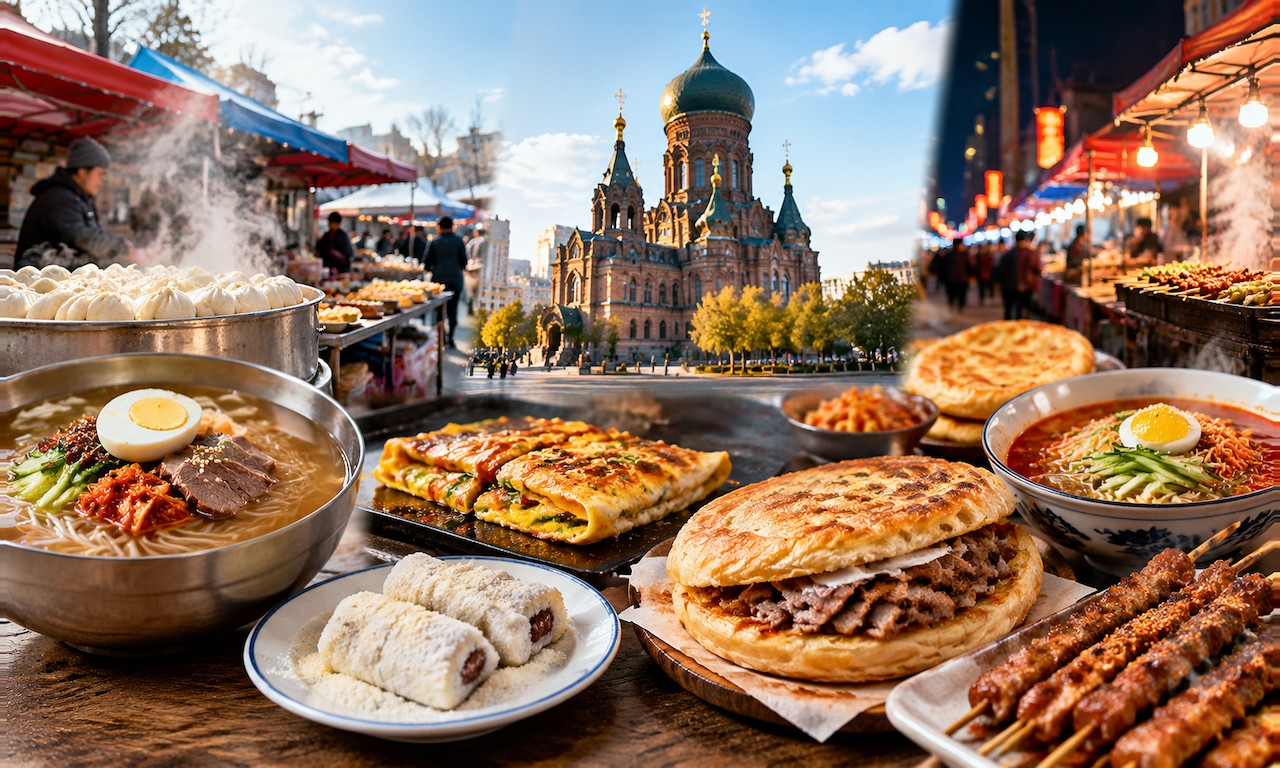
What exactly do people in Changchun eat in a day? We found out from the first pot of soup at the morning market to the late-night roadside stalls.
6:00 AM First pot of rice at the morning market
In Changchun, the morning market isn't a tourist attraction; it's the prelude to local life. The best thing to eat at this time isn't steamed buns or soy milk, but rather the freshly baked cornbread and sticky rice cakes. Why this time? Because most stalls open at 5:30 AM, and the first batch comes out around 6:00 AM, the bottom of the pancake still has a slightly charred edge from the iron pan, and when you break it open, it's still steaming hot. Pair it with a bowl of pickled mustard greens from the vendor, and enjoy the natural sweetness and saltiness of the grains without any other sauce.
If you want something a bit more substantial, look for the carts at the morning market that make fresh "chicken broth tofu skewers." You can get this at other times, but the broth is clearest and has the least beany taste in the morning because the vendors have just changed the broth. The dried tofu skewers are cooked in the chicken broth until slightly puffed up, then brushed with minced garlic and chili, and eaten with flatbread—a much lighter and more refreshing option than the lunchtime version. The morning market usually closes around 8 AM; if you go too late, you'll only find the styrofoam boxes left from packing up.
8:00 Local breakfast
Eight o'clock is proper breakfast time. Changchun locals won't queue for trendy restaurants; instead, they'll head to a "tofu pudding and fried dough stick shop" that's been around for over a decade on a street corner. Changchun's tofu pudding is different from that in the south; the broth is savory and contains shredded wood ear mushrooms, daylily buds, and sometimes a sprinkle of crushed peanuts. The key is to pair it with freshly fried "da guozi," which is essentially fried dough sticks. Changchun's fried dough sticks are thicker and shorter, crispy on the outside and fluffy on the inside. Tear them apart and soak them in the tofu pudding broth, letting them absorb the flavorful liquid before eating—it's a more complex experience than eating fried dough sticks alone.
If you don't want fried dough sticks, try "beef flatbread" with millet porridge. Many breakfast shops in Changchun make their beef flatbread fresh; it's small, filled with beef and onions, and has a little juice when you bite into it, but it's not too hot to eat. Why go around 8 am? Because before 7:30 am, the shops are mainly for early birds, tables turn over quickly, and the atmosphere is noisy; after 8 am, the first wave of customers leaves, and the second batch of flatbread is just coming out of the oven, so you can sit and eat more leisurely. After 9 am, many small shops sell out and close down.
11:00 Lunch Service
Eleven o'clock is the time when the lunch market opens. In Changchun, the most authentic local lunch isn't at stir-fry restaurants, but rather "smoked meat pancakes" paired with "pickled cabbage and pork hot pot." The smoked meat pancakes should be made the old-fashioned way: the meat is smoked pork belly, thinly sliced, with a good balance of fat and lean; the pancake is freshly rolled and baked, and served with parchment paper. To eat it, stuff the meat into the pancake, add scallions and a little sweet bean sauce. Why come at eleven? Because the smoked meat is smoked in the early morning, so by noon it's perfectly flavorful and not dry, and the pancake hasn't dried out yet. After noon, there are many office workers queuing, and the pancake is hastily baked, resulting in a slightly less desirable texture.
The sauerkraut and pork belly hot pot is best enjoyed by two or more people; it's not cost-effective for a small group. If you're traveling alone, I recommend ordering the "Pork Ribs Stew with Green Beans" with rice. In Changchun, this dish uses local green beans, stewed until tender but not falling apart, and the meat on the ribs is so tender it falls off the bone. The advantage of going at 11:00 AM is that the restaurant has just started stewing the large pot, and the green beans haven't turned black yet, resulting in perfect color and texture. If you come after 12:30 PM, the green beans may have been simmering in the pot for two hours, becoming too salty and too soft.
3:00 PM Afternoon tea or sweet soup
Unlike the south, Changchun doesn't have dedicated dessert shops for afternoon tea. The perfect afternoon tea option is a bowl of "Korean-style cold noodles" or a serving of "tteok" (rice cakes). Don't think of cold noodles as a main meal; Changchun's cold noodle shops are open from noon until evening. Around 3 PM is the quietest time—no one rushes you, and the broth is at its coldest. Buckwheat noodles are soaked in icy beef broth, accompanied by a slice of beef, half a boiled egg, cucumber strips, and kimchi. The sweet and sour flavor with a hint of spiciness is surprisingly refreshing.
If it's too cold to eat cold noodles, you can look for a Korean rice cake stall. Around 3 PM, the vendor will cut freshly made rice cakes into pieces and roll them in soybean powder and sugar. If you buy them at this time, the rice cakes are still soft; they'll harden if left out too long. Pair them with a bottle of local rice wine or regular hot tea, and enjoy them slowly on the street – it's more in line with the local atmosphere of Changchun than sitting in a cafe. Note that rice cake stalls are usually mobile, located near markets or residential areas; buy them when you see them, and don't expect them to be open at night.
18:00 Night market or evening market
After 6 PM, the night markets in Changchun gradually come on. The most representative items aren't the grilled skewers, but rather "grilled cold noodles" and "chicken soup tofu skewers." Changchun's grilled cold noodles are made fresh on a griddle. The noodles are fried until slightly browned, an egg is cracked on top, spread with garlic chili sauce, sprinkled with onions and cilantro, rolled up, and cut into sections. Going around 6 PM means you'll be there when the first batch of noodles has just been unpacked, resulting in the softest and most chewy texture. Later, when it gets crowded, the vendors flip the noodles quickly, making them too dry.
The biggest difference between the chicken soup and dried tofu skewers at the night market and the morning market version is the soup. The soup at night has been simmering all day, resulting in a richer flavor that's perfect for those who like strong flavors. The sauce brushed on the skewers is also saltier and spicier, and it pairs perfectly with a bottle of local soda. If you prefer something a bit more substantial, you can order a "sizzling egg on a hot plate," a Changchun specialty. The eggs are seasoned with alkaline water and then fried on a hot plate, resulting in a more bouncy texture than regular fried eggs, a rarity elsewhere. Between 6 and 7 pm, there aren't long queues at any of the stalls, making it the most comfortable time to stroll through the night market.
22:00 Late-night snack
At 10 PM, late-night snacks in Changchun fall into two categories: one is going to "Shaguoju" in the old city, and the other is looking for "roadside roasted corn" near the university. Shaguoju is suitable for those who want to sit down and eat slowly, ordering a "white meat and blood sausage casserole" or a "tofu skin casserole." The soup keeps simmering, getting richer and richer as it cooks. After 10 PM, the shop is quiet, the owner doesn't rush you, and the heat of the casserole is turned down so the soup doesn't boil dry. Eating a casserole here is less about eating food and more about enjoying a slowly cooling evening.
If you just want a quick bite, the grilled corn stalls near universities are the best choice. In Changchun, the corn is grilled raw; it's placed directly over charcoal and slowly turned until the outer skin blisters and is slightly charred. Around 10 AM is when the last batch of corn is at its most tender; any later and only hardened corn remains. Next to the grilled corn stalls, there are often carts selling "candied hawthorn skewers"—large hawthorn berries from Northeast China, coated in a crispy sugar shell. The sweet and savory contrast with the grilled corn perfectly concludes the day's culinary memories.