
Between temple fairs and kiln fires | Spending half a day as a local artisan in Zhengzhou
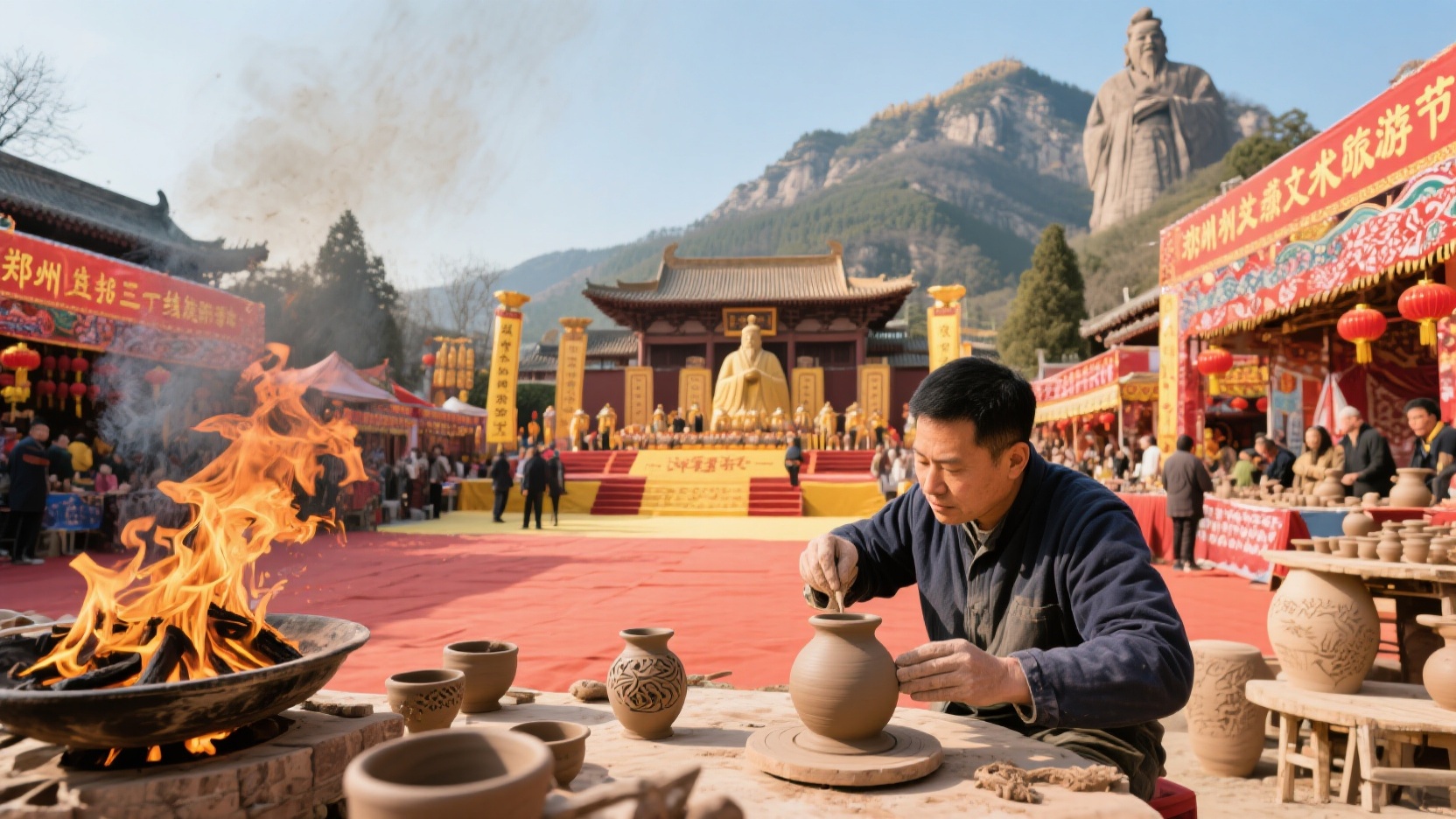
Traditional cultural experiences in Zhengzhou aren't concentrated in a single exhibition hall, but rather distributed throughout temple fairs, sacrificial ceremonies, and handicraft workshops during specific seasons. On the third day of the third lunar month, participate in the Yellow Emperor's Hometown Ancestor Worship Ceremony in Xinzheng; in spring and autumn, attend the Zhongyue Temple Fair in Dengfeng; in the first lunar month, the Zhengzhou City God Temple Fair is perfect for opera performances and paper cutting; and at other times, you can touch clay at the Dengfeng Kiln Workshop. The following four scenarios are all worth setting aside half a day for—don't just be a spectator, but truly engage with the experience firsthand.
I. The Ancestor Worship Ceremony at the Birthplace of the Yellow Emperor: The Ceremony on the Third Day of the Third Lunar Month
The ceremony is held annually on the third day of the third lunar month at the Yellow Emperor's Hometown Park in Xinzheng. The core rituals, such as hand-washing and incense offering, presenting flower baskets, reciting the eulogy, and music and dance performances, follow a fixed procedure. However, ordinary tourists can enter early and complete their worship in designated areas following the chief officiant's instructions. It is recommended to arrive early and walk along the park's central axis, visiting the Ancestral Hall, the Ancestral Worship Altar, and the Xuanyuan Hall to understand the historical context of the "Yellow Emperor's Hometown" before entering the ceremony. On-site etiquette requires wearing plain clothing, maintaining silence, and refraining from taking photos. The event reflects the Central Plains tradition of "Worshiping Xuanyuan on the Third Day of the Third Lunar Month," a fusion of the ancient Shangsi Festival and Yellow Emperor worship, and has been listed as a national intangible cultural heritage. When participating, consider bowing along with local worshippers; this will help you better understand the meaning of "shared roots and ancestors" than simply taking photos from the outside.
II. Zhongyue Temple Fair: Incense and Craftsmanship During the Ten-Day Fair
The Zhongyue Temple Fair is held twice a year, around the tenth day of the third and tenth lunar months, lasting about ten days, at the Zhongyue Temple in Dengfeng. Before rushing to browse the stalls, you can follow local custom and "touch the iron figures": the several Song Dynasty iron figures in the Zhongyue Temple have long been regarded as symbols of peace, and touching them for blessings is a fixed activity at the fair. Taoist music and sacrificial activities are held concurrently inside the temple, while the market outside offers handicrafts such as tiger-head shoes, sachets, clay sculptures, and pyrography. If you want to try your hand at it, sit down at the sachet stall and sew a simple mugwort sachet with the vendor; or squat in front of the clay sculpture stall and watch how a lump of clay is sculpted into a zodiac animal in minutes. If you happen to visit during the tenth lunar month fair, you can also see mountain produce and medicinal herbs harvested after the autumn harvest. The Zhongyue Temple Fair, continuing from the Tang and Song dynasties, is related to the Zhongyue sacrificial tradition and is the most stable folk custom site west of Zhengzhou. It is recommended to arrive in the morning, when the pilgrims have not yet left and the stall owners have just set up their stalls, making it the most vibrant and lively place.
III. Zhengzhou City God Temple Fair: Henan Opera and Paper-cutting Stalls during the Spring Festival
The City God Temple Fair runs from the first to the sixteenth day of the first lunar month, taking place in the area around the City God Temple and Confucian Temple in Zhengzhou's old city. During the Spring Festival, the most worthwhile experience here isn't the snacks, but rather the opera stage and craft stalls. The stage usually features performances of Henan opera and Quju opera. You can sit among the elderly audience and listen to a section of "Henan Bangzi" (a type of Henan opera) with its drawn-out melodies. You don't need to understand every word; the gongs, drums, and cheers themselves create the atmosphere. After the opera, set aside an hour at the paper-cutting stalls: choose a piece of traditional red paper and, under the guidance of an artist, fold the paper, draw a pattern, and cut out a "福" (Fu, meaning good fortune) character or the zodiac animal of the year. Paper-cutting has a deep-rooted folk tradition in Zhengzhou, and the City God Temple Fair was once the most important public gathering in old Zhengzhou during the Spring Festival. Many locals still maintain the custom of "visiting the City God Temple during the New Year." Arrive before 10:00 AM; the side corridors on either side of the stage are quieter, and it's easier to strike up a conversation with the craftspeople.
IV. Dengfeng Kiln Ceramic Workshop: Throwing a clay piece next to the Tang and Song Dynasty kiln site
The experience of working at Dengfeng Kiln is not limited by season, with spring and autumn being the most comfortable times. Dengfeng Kiln was an important folk kiln in the Central Plains during the Tang and Song dynasties, renowned for its white glaze, slip, and "pearl-ground incised decoration" technique, producing simple yet beautiful pieces. The experience usually begins with kneading clay: first watching the master strike the clay and find its center, then trying your hand at throwing it on a potter's wheel. The most difficult part of throwing for the first time is not applying force, but stabilizing the clay on the turntable; it often takes twenty minutes to make the cup stand upright. If you are more interested in hand-painting, you can choose to carve patterns on the unglazed piece, imitating the pearl-ground incised decoration, using a bamboo stick to carve intertwined floral patterns on the clay. Culturally, this type of porcelain served the daily life of the Central Plains, emphasizing durability and the traces of handcrafting rather than exquisite detail. The pieces need to wait for firing, so it's advisable to stay in Zhengzhou for a day or two. Sitting down and chatting with the master about glazes and firing temperatures will be more rewarding than simply playing with the clay.
These four scenes are arranged according to the lunar calendar, forming a parallel thread of Zhengzhou's folk culture with the regular tourist attractions: worshipping the Yellow Emperor in spring, attending the Zhongyue Temple Fair in spring and autumn, visiting the City God Temple Fair in the first month of the lunar calendar, and touching the Dengfeng Kiln pottery throughout the year. Their common characteristic is that they all require "sitting still." Choose a point that overlaps with your itinerary, set aside half a day, and instead of just standing on the periphery, sit down next to the vendors, under the stage, or in front of the pottery wheel. Only then will Zhengzhou's cultural heritage become concrete through the seasons, the clay, and the songs.