
Deep within the market lies Chang'an: Authentic local products often bought by locals in the Xicang and Jianguomen Old Markets.
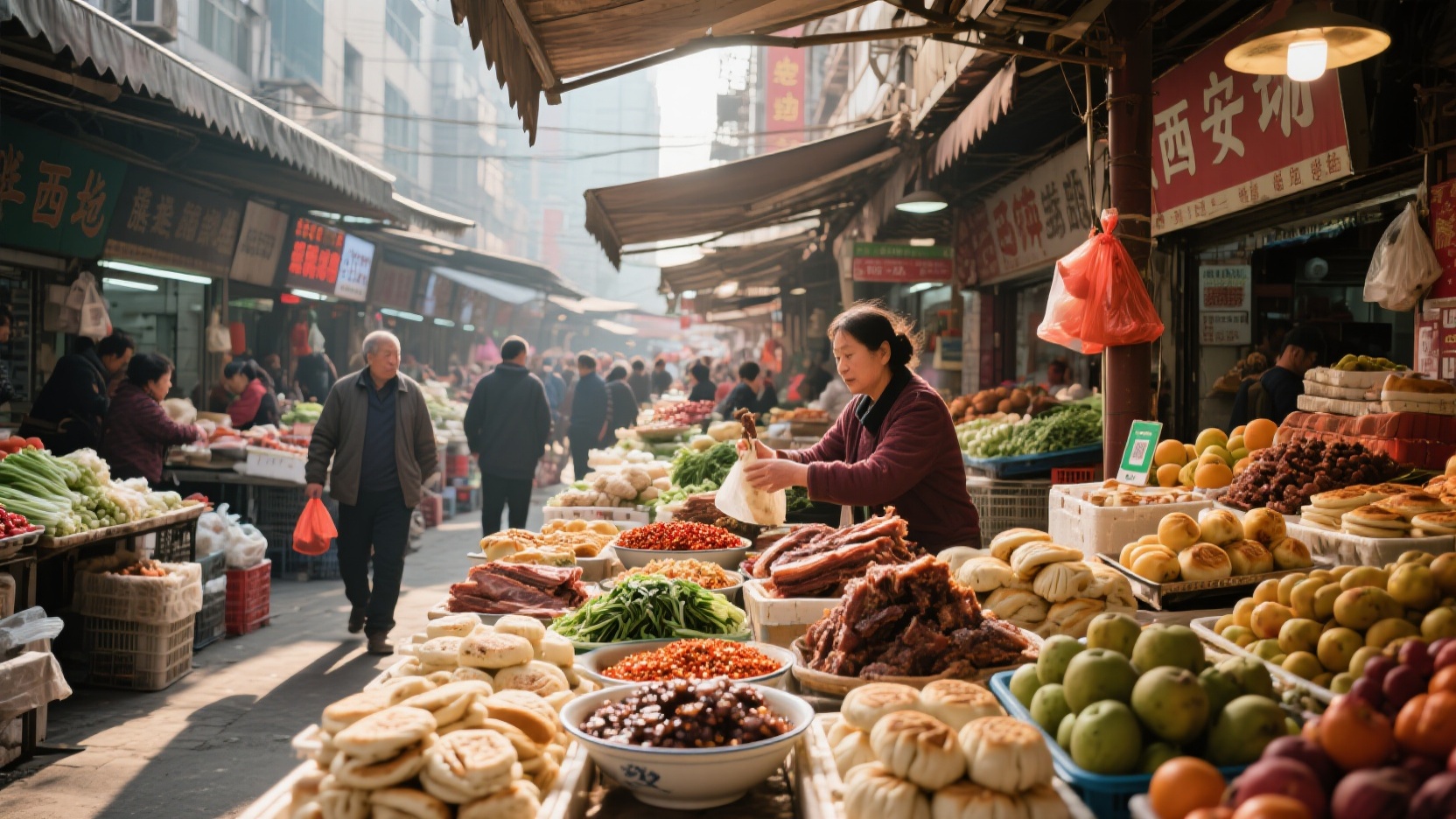
Observing daily food in Xi'an, Xicang Market and Jianguomen Comprehensive Market are more effective than the food streets near tourist attractions. Xicang Market is open every Thursday and Sunday, mainly offering ingredients, cooked food, and pickles from the Hui neighborhood; Jianguomen Comprehensive Market, converted from an old factory, supplies the surrounding community year-round, with numerous stalls selling noodles, pickles, and fruits. Below is a list of cooked food, pickles, snacks, and fruits worth taking away or eating on the spot.
Delicatessen: The Combination Logic of Cured Beef and Tuotuo Steamed Buns
Most of the cooked food stalls at Xicang Market start selling on the morning of market opening. Cured beef and mutton are categorized by cut: shank, ribs, and sandwich. Shank meat has firm fibers and is suitable for sandwiches after slicing; ribs are slightly fattier and best eaten plain with garlic. When selecting meat, check for a dry surface and excessive slime on the cut surface. Be wary of meat that is too bright red or dark. Refrigerate for at least four hours after purchase for optimal taste.
Tuotuo bread and cured beef are a classic combination. The bread comes in two types: "white bread" and "fried dough." The white bread is made with a semi-leavened dough, has a low moisture content, and after baking, the outer skin has tiger-stripe-like charred marks. The inside is soft and chewy, preventing the meat from becoming soggy from the broth. When choosing, gently squeeze it; a quick spring back and soft, non-brittle edges are better. If you plan to eat it on the go, ask the vendor to slice the cured beef thinly and stuff it into a freshly baked white bread, along with a separate small bag of meat broth jelly.
Sauces and pickles: freshly made chili sauce, chili paste, and pickled vegetables.
Chili oil stalls in Xi'an's vegetable markets usually grind and sell chili oil fresh. Qin chili peppers, with their coarse slices, have a medium spiciness and a prominent aroma. They are best used by heating rapeseed oil until it smokes, then turning off the heat and letting it cool slightly before pouring the oil over the chilies. When buying, ask the vendor to pour the oil over the chilies, and ask them to fill the bottom portion with extra chili oil, as that part will have the most concentrated aroma after soaking in the oil. When using it at home to mix with cold noodles, dip dumplings, or season cold dishes, use about one-third less than bottled chili oil.
Chili sauce and fermented vegetables belong to two different categories of fermentation or pickling. Chili sauce is made by stir-frying chili flakes with fermented broad bean paste and a small amount of sugar. It is salty and slightly sweet, and goes well with steamed buns and sandwiches. It needs to be refrigerated after opening. Fermented vegetables are mostly made by naturally fermenting celery or cabbage with noodle soup. The soup is slightly white and has a mild sour taste. When choosing, look for vegetables that are not sticky and the soup should not have any off-odors. After buying them, you can ask the vendor to give you an extra bag of fermentation starter for later use. Simple ways to eat them are to cut them into sections and stir-fry them with shredded potatoes, or boil them with noodles. They should not be cooked for too long.
Handmade desserts: Steamed glutinous rice cake, stone-baked buns, and honey-glazed rice cake
Zenggao (steamed glutinous rice cake) is a must-buy item at the market, requiring you to get there early. A good zenggao (steamed glutinous rice cake) has distinct layers from top to bottom: jujube paste, glutinous rice, and red kidney beans. When buying, check if the glutinous rice grains are separate, and if the jujube paste is a deep brownish-red color and can be pulled into threads with a wooden spatula. If the jujube paste is black or the glutinous rice has clumped together, it means it has been heated for too long. It's best to buy and eat it immediately. After cooling, resteam for five minutes; do not reheat in a microwave for extended periods.
Stone-baked bread is suitable as travel rations. It's made by baking it on heated pebbles, creating irregular pits on the surface. When choosing, first check if the color is even, then break it open and smell for any rancid smell. Thinner, crispier ones are suitable as snacks, while thicker ones are better soaked in mutton soup or served with tea. Honey-glazed rice cake is common in Xicang; it's made with glutinous rice filled with red bean paste, topped with rose jam and honey. It should be eaten on the same day it's bought; when choosing, make sure the red bean paste doesn't taste sour and the glutinous rice layer isn't dry or hard.
Seasonal fruits: Fire Crystal Persimmon, Hutai No. 8, and Zhouzhi Kiwi.
Huojing persimmons are a signature fruit of Xi'an's autumn markets, known for their thin skin and juiciness. When selecting them, choose those with orange-red skin, still-green stems, and slightly soft but not collapsed flesh. They are not suitable for stacking; it's best to carry them in a sturdy box laid flat. Hutai No. 8 grapes are commonly found in local markets. Intact bloom, green rachis, and intact berries are signs of freshness, making them ideal for immediate consumption. For Zhouzhi kiwifruit, distinguish between firm and unfirm: firm kiwifruit can be left at room temperature for two to three days, then refrigerated after softening. Do not buy kiwifruit that has developed a wine-like smell or is oozing juice from both ends.
In these markets, many stalls don't offer samples or cater to tourists; they still sell according to the habits of their regular customers: by the piece, by the bunch, by the bag. It is precisely this unsimplified logic of trade and production that makes Xi'an's culinary geography visible. To understand a city, you don't just need to follow lists and queue up. Carry a cloth bag into the market and watch how locals choose persimmons and wait for a pot of steamed rice cakes to come out of the steamer. Those unpackaged flavors will then enter your journey.