
Xiamen Amidst the Sound of Drums and Gongs | From Mid-Autumn Mooncake Gambling to Sending Off the Wangchuan (King's Boat), Spending Half a Day as a Local
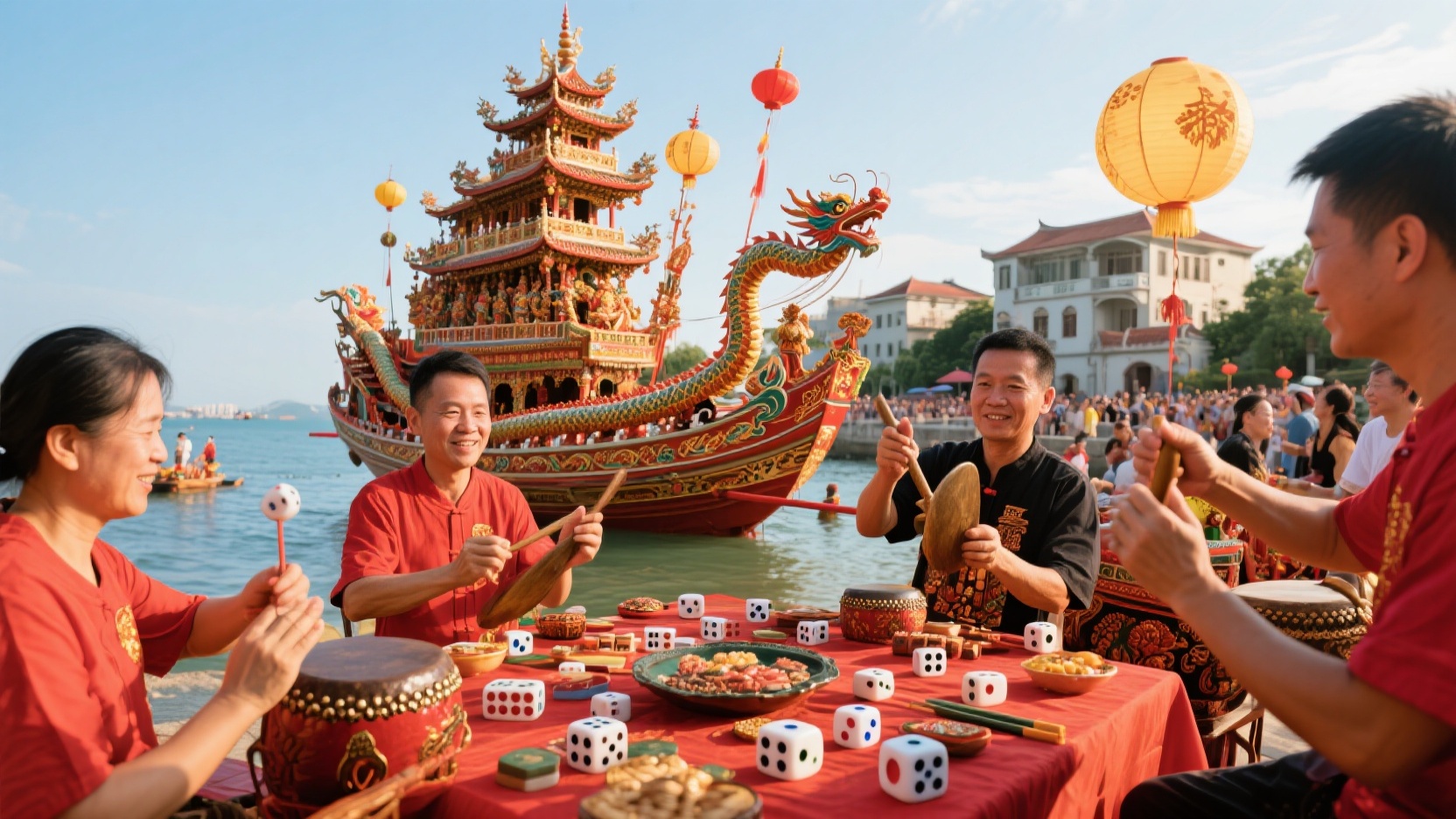
Another travel timeline in Xiamen isn't based on sightseeing, but rather on Minnan festivals and temple fairs. Mid-Autumn Festival dice games, the autumn king-sending ceremony, the New Year's procession, and learning lacquer thread carving on ordinary days offer a more authentic "local" experience than simply strolling through the streets. The following four experience routes select the most representative festivals, folk customs, and intangible cultural heritage handicrafts of Xiamen, providing a visible, participatory, and portable "semi-local" solution.
Mid-Autumn Mooncake Gambling: A Nationwide Game Amidst the Sound of Dice Rolls
The event takes place in the eighth month of the lunar calendar, about a month before and after the Mid-Autumn Festival. The setting isn't in fixed scenic areas, but rather in Xiamen's communities, arcade buildings, shops, hotel lobbies, and even folding tables set up on the roadside. The experience is straightforward: approach a group playing the dice game, explain your purpose, and most Xiamen locals will let you "roll a ball." The rules are simple: six dice are thrown into a large porcelain bowl, with the red four-point combinations corresponding to academic achievements, ranging from "Yi Xiu" to "Zhuang Yuan" (top scholar in the imperial examinations). Prizes vary from toothpaste and tissues to mooncakes and other traditional treats. The sounds of the dice game are highly distinctive—the crisp sound of the dice hitting the bowl, mixed with the announcements in Hokkien, is the most authentic background noise of Mid-Autumn Festival in Xiamen.
Cultural Origin: Legend has it that when Zheng Chenggong stationed his troops in Xiamen, he designed a dice game to soothe the homesickness of his soldiers, incorporating the imperial examination system into the game. This later evolved into a Mid-Autumn Festival custom in southern Fujian. Tourists don't need to aim for winning; simply learn to listen to commands like "Top Scholar" and "Matchmaker," and then feel the rhythm of the six dice bouncing in the large bowl – that's how you immerse yourself. If you wish to participate, when checking into a hotel or guesthouse during the eighth lunar month, you can inquire about dice games. Most public places set up large bowls in the evenings for guests to experience.
Sending off the King's Boat: A ritual to ward off disasters on the coastline in late autumn.
The event typically takes place between October and November of the lunar calendar, with specific dates chosen by coastal temples. Shapowei is the core observation area. The experience is divided into two parts: "making" and "sending off." Beforehand, visitors can see the making of the Wangchuan (royal boat) at a marine culture exhibition space near Shapowei—the boat's hull is made of wood and decorated with paper and colorful paintings, featuring extremely intricate details. On the main day, there are processions, lion dances, drum performances, and a Wangchuan parade. Finally, the boat is burned on the coast to send off the plague. The entire process is highly ritualistic; it's not a performance, but a continuing community faith.
Participants should note: The parade route often winds through the old town streets and alleys. You can walk alongside the procession, but do not enter the main procession or get too close during the burning ceremony. Understanding its core—the divine inspection and prayer for peace and protection—is more important than taking a picture of the fire illuminating the boat. The Sending Off the King Boat is listed as a Representative Work of the Intangible Cultural Heritage of Humanity and serves as a window into the maritime beliefs of Southern Fujian. The ceremony may be adjusted in case of rain or strong winds; please confirm the actual route with local residents before joining the procession.
Haicang Centipede Pavilion: A mobile "pavilion array" during the first month of the lunar calendar.
The event takes place during the first month of the lunar calendar, coinciding with the procession of the Shebaosheng Emperor from villages like Dongyu in Haicang. The Centipede Pavilion, composed of dozens of interconnected sections resembling a centipede, has a child dressed as a historical or theatrical character seated on each section. The procession, carried by able-bodied men, lasts for several hours. From afar, the long procession winds along village lanes and the coastline, its vibrant colors creating a striking and memorable scene at any Minnan temple fair.
Experience Tips: When visiting Haicang during the first month of the lunar calendar, inquire about the day of the procession from your guesthouse or locals beforehand. Avoid crowding at the starting and ending points; instead, choose a section of streets and alleys to follow. The Centipede Pavilion originates from the belief in Baosheng Dadi (the God of Medicine). The centipede symbolizes warding off evil spirits, and children sitting on the pavilion are also seen as praying for blessings. When taking photos, avoid using flash directly on children and do not touch the pavilion's structure. If you are traveling with children, explain beforehand that "the children sitting up are praying for blessings, not performing," which will encourage them to watch more quietly.
Lacquer thread carving: Incorporating Minnan patterns into a small item
If you can't wait for the seasonal festival, lacquer thread carving is an intangible cultural heritage craft that can be done year-round. Originally a technique for decorating Buddhist statues, Xiamen lacquer thread carving uses fine lacquer threads to create patterns such as dragons, phoenixes, clouds, and intertwined branches on the clay body, then gilds or paints them, giving the lines a relief-like effect. Introductory classes typically begin with twisting the lacquer thread, progressing to creating simple patterns on teacup coasters, small ornaments, or clay blanks, taking about two to three hours. The difficulty lies not in strength, but in patience: the thread must be even and coiled tightly against the clay surface for the pattern to stand up.
When choosing a pattern, it's recommended to avoid complex dragon heads and start with cloud patterns, scrolls, or surnames for a higher success rate. The finished piece can be taken home, a truly handmade piece of Minnan (Southern Fujian) memory. Many museums and intangible cultural heritage workshops on Xiamen Island offer related experiences; reservations can be made one day in advance. For extended experiences, consider bead embroidery and shadow carving, but lacquer thread carving's three-dimensional lines are most suitable for beginners.
What these experiences have in common is that they all require travelers to slow down: a game of the Mooncake Gambling game only lasts a few minutes, but it's best to sit down and listen to the whole thing; the Sending Off the King's Boat Cruise lasts for several hours, and it's worth following the whole process; the Centipede Pavilion is fleeting, but you should arrive early; and lacquer thread carving freezes time directly between your fingers. Xiamen is not just about seascapes and old villas; its cultural density is hidden in the sound of dice, the drumbeats, and the individual lacquer threads.