
A 4km walk in Liuzhou | Blogger's firsthand experience with Citywalk: traversing arcades, back alleys of the market, and vinyl record shops in one go (A list of places to avoid)
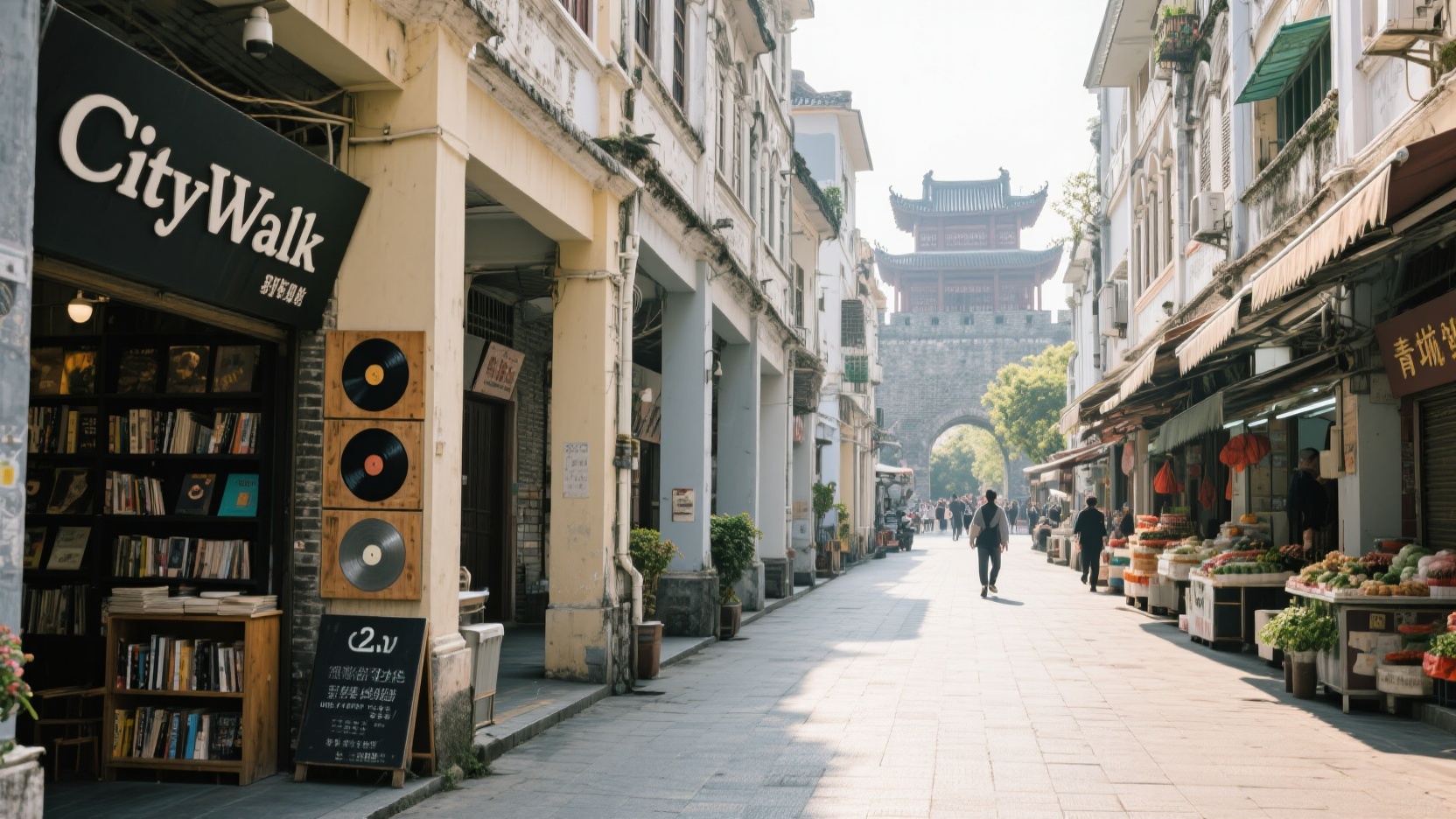
On my third trip to Liuzhou, I didn't visit any of the popular snail rice noodle shops. At 9:00 AM, I set off with my camera from under the arcades on Shuguang West Road, walking a semi-circular route of about 4.2 kilometers along the old city, connecting the Ming and Qing dynasty city gates, the Republican-era arcades, the back alleys of the vegetable market, vintage vinyl records, and two pocket parks. The route has a gentle slope, suitable for walking in spring, autumn, or early winter. The main route takes about 1 hour and 40 minutes on foot, so I recommend allowing a morning for stops.
I. The Arcade Buildings on Shuguang West Road: A Look at Liuzhou's Version of the Old Dream of Nanyang
This stop starts at the intersection of Shuguang West Road and Zhongshan West Road, and is about 0.8 kilometers from the next stop, a 15-minute walk. The camera is positioned behind the arcade columns, crouching low, using a wide-angle lens to capture the continuous arcade, the wooden windows on the second floor, and the old signs spanning the street in the same frame.
Why stop and look for 5 minutes? The arcade buildings of Liuzhou aren't just sealed-off exhibits; people still repair watches, sell clay pot rice, and hang clothes to dry under the eaves. Before 10 a.m., slanting sunlight streams into the colonnades, and electric bikes passing by create a gust of wind—it feels more authentic than any Republican-era film set. Looking up at the gray plaster on the column capitals and the drainage pipes, traces of the shops from the 1930s remain.
II. Back alley of Qingyun Vegetable Market: Avoiding the queues to hear the original sounds of the community.
Turning from Shuguang West Road into a back alley on the south side of Qingyun Road, the distance from the end of the alley to the next stop is about 0.7 kilometers, a 12-minute walk. This area is still within the Qingyun Vegetable Market, but it's not the route tourists take to buy snacks. The camera is positioned on the stone steps opposite the incense and candle shop at the alley entrance, using a medium-telephoto lens to compress the depth of the vegetable stalls, roast meat stalls, and old arcade walls on both sides.
A five-minute stop reveals the morning market system of Liuzhou's old community: an elderly woman sits on a low stool selecting vegetables, a fishmonger changes the water in a wooden basin, and a loudspeaker broadcasts from a half-open wooden window upstairs. Avoid taking photos of people's faces; focus on their hands, the scales, and the flowing water and stone-paved streets for a more authentic feel. The alleys are narrow, so it's advisable to carry your backpack in front to allow residents to pass.
This stop wasn't for food, but to understand the local character and atmosphere of Liuzhou as a river and land port. In summer, turning into the ground floor of an arcade building brings a sudden coolness—that's the natural ventilation of the old buildings, not air conditioning.
III. First Sub-plot: Turning into the arcade mezzanine of Xiaonan Road, you'll find vinyl records and vintage clothing.
Turn right after returning to Xiaonan Road from Qingyun Back Alley. Turn right after seeing a light gray terrazzo arcade building. The round trip is about 500 meters, taking about 8 minutes one way. On the second floor is a vinyl record store without a prominent sign, and a vintage clothing store is at the corner of the stairs.
The camera was positioned near the iron railings at the entrance of the second-floor vinyl record store, with the arcade street as a backdrop, capturing the overlapping shadows of the warm yellow lights in the listening area and the old signs outside the window. Why is it worth watching for 5 minutes? The owner will casually play an old local Guangxi record; the background noise from the old speakers blends with the sounds of electric bikes downstairs, creating a unique auditory memory of Liuzhou. The vintage clothing store's shelves aren't large; even if you don't buy anything, you can browse the labels on the cuffs to see the old Liuzhou factory names.
IV. From the East Gate Tower to the North Bank of Wenhui Bridge: View the Ming and Qing Dynasty river defenses and the bend of the Liujiang River.
Returning to the main route, continue east along Xiaonan Road, crossing Shuguang Middle Road to reach the East Gate Tower. This section is approximately 1.1 kilometers long and takes about 20 minutes on foot. The East Gate Tower is a well-preserved Ming Dynasty brick and stone city gate in Liuzhou, located next to residential buildings, making it easy to pass. Position the camera inside the gate opening and shoot outwards, framing the riverside trees and Wenhui Bridge, creating a natural contrast of light and shadow.
It's worth stopping for 5 minutes because this is the only angle on the route that offers a simultaneous view of the Ming and Qing dynasty city walls, the Liujiang River, and the modern bridge. There's no entrance fee to the city gate; in the morning, you can see elderly people playing chess on the stone steps of the gate. After exiting the city gate, walk south along the riverside path. Don't go onto the bridge; stay close to the north bank for photos of the wide expanse of the Liujiang River's bend.
V. Second side story: Pocket corner in Liuhou Park and old bookstore café
Turning from the north bank of Wenhui Bridge towards the west side of Liuhou Park, the second branch line diverges from here, a round trip of about 700 meters, taking 10 minutes one way. Instead of entering the main park gate, walk along the old community outside the park's west wall. There's a used bookstore and café located downstairs in a dormitory building, next to a pocket park enclosed by several large camphor trees.
The camera was positioned by the window in a café, shooting through the sheer curtains at the old walls and new leaves of the park; or at a stone table in a pocket park, taking low-angle shots of elderly people playing chess and the feet of strolling citizens. The five-minute pause was to slow the pace; this area lacks tourist attractions, yet it is the most tranquil corner of Liuzhou's cultural atmosphere.
VI. The final stop: Jiahe Xiaotaoyuan and the outer wall of the Confucian Temple: captured in the blues of dusk.
Returning to the riverbank from the branch road near Liuhou Park, walk towards Jiahe Xiaotaoyuan (Jiahe Little Peach Blossom Spring). The destination is approximately 1.4 kilometers away, a 25-minute walk. Reach the Jiahe Road area before evening, where the Confucian Temple's outer wall, Panlong Mountain, and the Liujiang River form the final scene. Position the camera at the corner of the Confucian Temple's outer wall using a vertical composition, superimposing the red courtyard wall, the mountain outline, and the bridge's reflection on the river.
Why is it worth watching for 5 minutes? The half hour before sunset is the blues hour; the walls of the Confucian Temple darken in color, and the silhouettes of fishermen appear on the riverside pebble beach. Walking this route, you'll discover that Liuzhou's art and culture aren't confined to exhibition halls, but rather found on the pillars of arcade buildings, in the back alleys of the market, in the background noise of vinyl records, and on the riverside stone steps.
The blogger summarizes: This main route is about 4.2 kilometers long, covering the city's fabric beyond just food stalls. The two side routes are not mandatory; if you're short on time, you can just take the main route. If you want to take photos, it's recommended to start at 9 am, when the light is perfect for the morning market.
Practical Tips: 1. Wear non-slip shoes, as the back alleys of Qingyun and the riverside pebble beach can be slippery after rain; 2. There is no shade under the East Gate Tower, and it is scorching hot in the summer afternoons, so it is best to walk in the early morning or evening in spring and autumn; 3. Vintage shops and vinyl record stores generally open in the afternoon, so don't go too early and miss them; 4. It is not recommended to drive into the old town, electric bikes and walking are the most convenient; 5. Nod to the residents before taking photos, and avoid using flash photography in the market.