
A Chronicle of Jinhua's Intangible Cultural Heritage Through the Seasons: In-Depth Experiences of Bullfighting, Fire Refining, Wuzhou Kiln, and Pujiang Paper Cutting
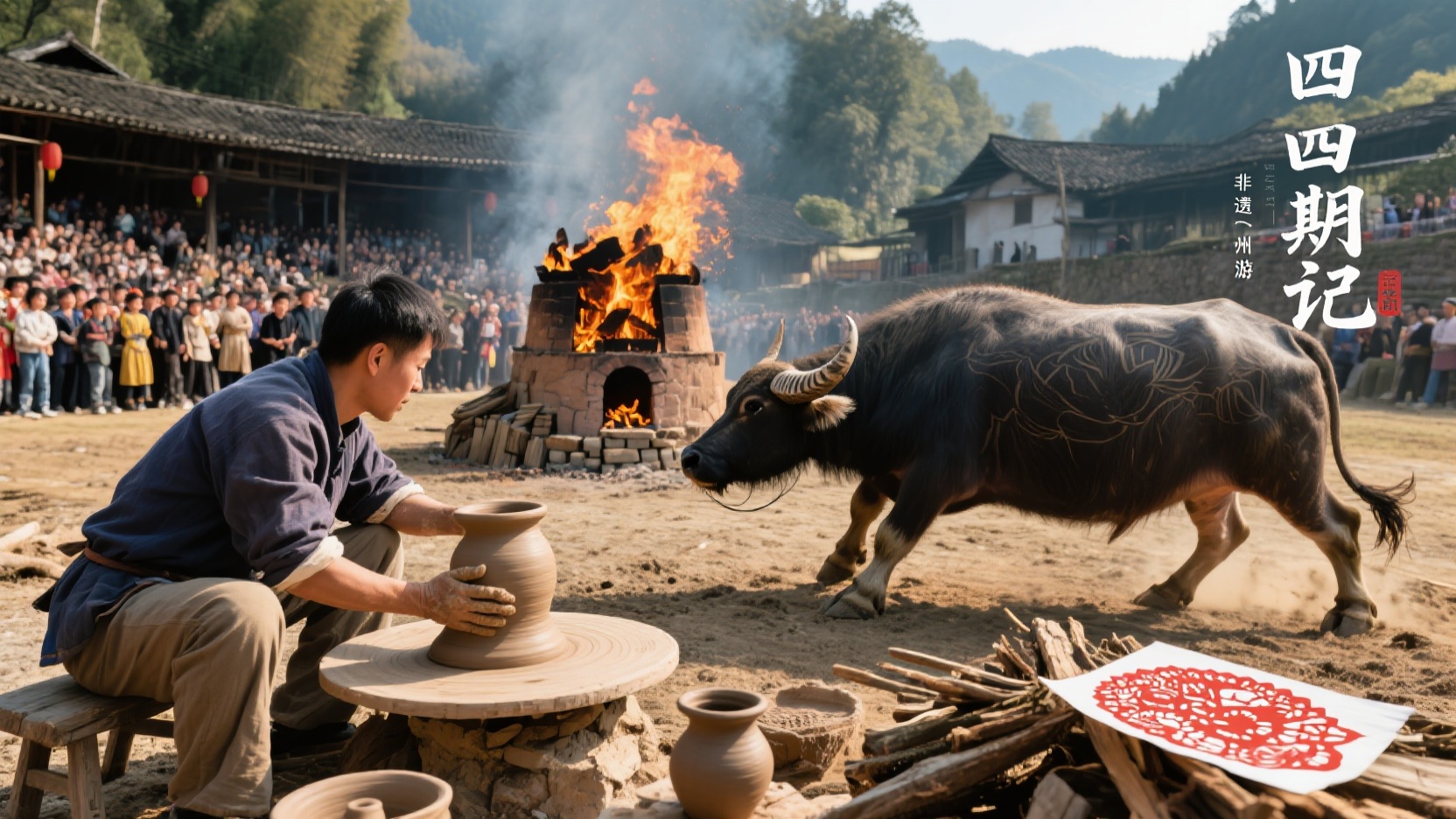
Jinhua's intangible cultural heritage experiences are not concentrated in a single park, but rather scattered throughout kilns, villages, bullfighting arenas, and mountain village fire pits according to the lunar calendar and solar terms. Following a list of attractions can easily lead to seeing only static displays and missing the authentic feel, the firelight, and the rhythm. The following four points can be broken down into a half-day itinerary; the key is to sit down, reach out, and join in the chants, rather than simply taking photos outside the barriers.
The four nodes cover different ways of participation: Wuzhou kiln is handmade, Pujiang paper-cutting is a visualization of opera, Jinhua bullfighting is an agricultural competition, and Pan'an fire-making is a belief in mountain fire. They are scattered throughout the four seasons, which can be strung together to form a unique folk custom path.
Wuzhou Kiln: Half-Day Pottery Workers – From Kneading Clay to Loading the Kiln
Basic experiences like throwing and carving are available year-round, but witnessing the complete process of "loading the kiln, sealing the kiln, and opening the kiln" is most concentrated in spring and autumn. These sessions are mostly held in kiln workshops in Wucheng District and Langya Town, many still using dragon kilns or wood-fired kilns. The experience begins with selecting the clay: Wuzhou kiln clay has a high iron content, requiring repeated kneading to remove air bubbles. The master will demonstrate the "centering" technique before allowing you to set the center. Half a day is sufficient to complete a small bowl or teacup.
Next comes the "half-knife carving," where a slanted knife is used to carve lotus petals or intertwined floral patterns onto the clay body, with the depth of the cut being only millimeters. Practice often involves repeating this dozens of times on scrap clay. Finally, a wood ash glaze is applied, resulting in a yellowish-green or milky, moon-white color after firing. Wuzhou kilns originated in the Eastern Han Dynasty, and during the Tang and Song Dynasties, they were known for their milky glaze and sculpted designs. Lu Yu ranked Wuzhou celadon third in his *The Classic of Tea*. The focus is not on creating a "perfect souvenir," but on understanding how different kiln positions affect glaze color—a skill passed down orally among local potters. If you only participate for an hour, you can skip throwing and practice carving directly on semi-dry clay, which will still allow you to grasp the linear logic of Wuzhou kiln pottery.
Pujiang paper-cutting: Understand a passage from a play before cutting.
The peak season for Pujiang paper-cutting is around the "Pujiang Welcoming Festival" in the first month of the lunar calendar. On a daily basis, it's mostly taught by village workshops or experienced artisans. The experience begins with observing a "smoked pattern": the artisan pastes the cut pattern onto white paper, smokes it with oil lamp smoke to create an ink draft, and then cuts it out according to the draft. Local handmade paper or thin Xuan paper is commonly used; before cutting, it's sprayed with moisture and flattened to prevent fuzzing. Beginners first practice three basic cutting techniques: serrated, crescent, and wavy lines, and then move on to cutting out human figures.
The unique feature of Pujiang paper-cutting lies in its themes, which are largely derived from Wuju opera and folk operas. To cut out figures, one must first understand "who is doing what": the White Snake Lady needs a broken bridge and flowing sleeves, while military generals need a banner and plumes. Veteran artists will explain the opera while cutting, clarifying why window decorations depicting "loyalty, filial piety, chastity, and righteousness" can only be pasted in the main hall. A single-color opera figure can be completed in half a day; if it coincides with a festival, the paper-cut can be pasted on a lamp and paraded with the procession at night. This process transforms "watching the opera" into "cutting the opera," offering a deeper understanding than simply buying a finished product, and is more suitable for children to complete.
Jinhua Bullfighting: Learning to Judge and Invite Bulls Before the Competition
Bullfighting in Jinhua is concentrated in the first month of the lunar calendar, during the Dragon Boat Festival, Mid-Autumn Festival, and some temple fair days. The arenas are usually muddy bullrings near villages. Unlike Spanish bullfighting, this is a contest between water buffaloes; the bulls do not attack people, and the winner is the one who retreats first. The most engaging time is two hours before the fight: the bull trainers lead the bulls around the arena to "warm up," and visitors can help cool the bulls by splashing water on their backs with bamboo tubes, but they cannot stand directly behind the bulls or suddenly raise their hands. The Dragon Boat Festival events are often combined with dragon boat races and temple fairs; visitors can watch the dragon boats in the morning and then go to the bullfighting arena in the afternoon.
The older generation teaches how to "judge a bull," observing the curvature of its horns and the height of its shoulder to assess its explosive power and endurance. They also demonstrate a short, deep "bullfighting call," using brief, low shouts to guide the bull into the arena. This custom originates from the tradition of respecting cattle in rice farming, and bullfighting is recorded in local chronicles from the Ming Dynasty. The winning bull is draped in red silk and adorned with silver horns, while the defeated bull is not killed but returned to the fields for farming. If bullfighting is viewed merely as a few minutes of confrontation, one overlooks the preceding order of interaction between humans and bulls, which is the part that the locals truly value.
Pan'an Fire Refining: From Stacking Firewood in the Afternoon to Cleaning Up the Fire at Night
The practice of burning pine logs in Pan'an typically occurs during the Double Ninth Festival, the Spring Festival, and village festivals, with the highest concentration in the southern mountain villages of Pan'an. The peak time is after nightfall, but actual participation begins in the afternoon: villagers carry pine logs up the mountain, stacking the split logs into circular fire pits according to their orientation, leaving ventilation channels in the center. Older pine trees with high oil content are preferred, as they produce less smoke and more solid charcoal. After lighting the fire in the evening, the pine logs must burn until their surface turns white and the charcoal collapses into a bright red pile. This process usually lasts for several hours, during which the charcoal must be constantly gathered and collected with long poles.
Before the ceremony begins, there is a brief ritual of inviting the gods and purifying the area. The person in charge demarcates the boundary between the viewing area and the ceremony, and participants must remain quiet outside the area and not cross the center line of the fire altar. The fire-maker walks barefoot quickly across the embers, performing movements such as "stepping on the volcano" and "rolling over the volcano," while uttering short commands. The custom retains ancient fire worship and the awareness of warding off plagues and epidemics, but at its core is the village's recognition of "purity" and "courage." Although tourists cannot step on the fire, half a day of stacking firewood, watching the fire, and guarding the fire constitutes a complete on-site learning experience of the folk custom. When watching, it is recommended to wear cotton trousers and closed-toe shoes, and avoid wearing synthetic clothing, as there may be sporadic sparks around the perimeter of the area.
The four key events can be arranged seasonally as follows: watch the opening of the Wuzhou Kiln in spring, watch bullfighting during the Dragon Boat Festival, go into the mountains to watch the firing process during the Double Ninth Festival, and cut paper-cuts to welcome the New Year in winter or January. Allocate half a day for each location, and make the itinerary go from "having been there" to "having done it," only then can you truly experience the intangible cultural heritage of Jinhua.