
How should I spend a day exploring Guilin's cultural and artistic scene? I've planned out the best spots for each time period.
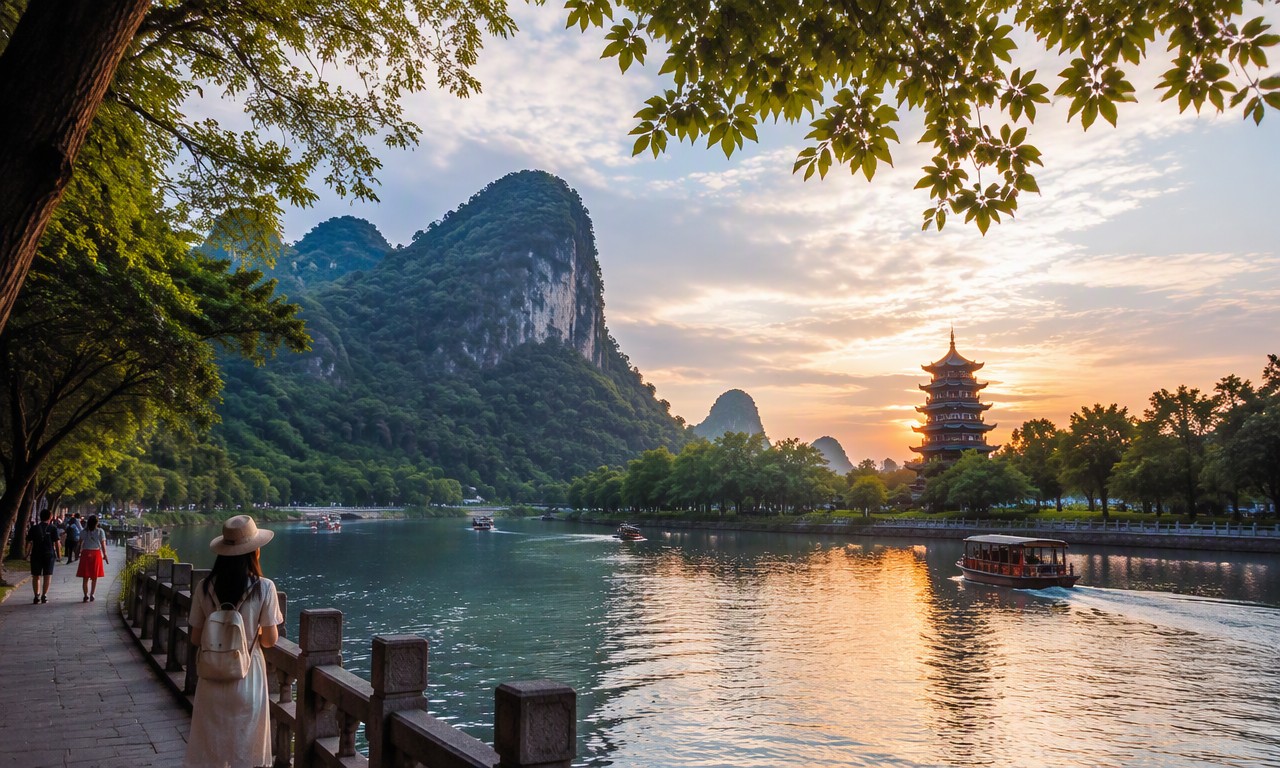
Many readers have asked how to plan a cultural and artistic tour of Guilin to avoid wasting precious sunlight and being rushed by tour groups. This question deserves a serious answer because Guilin's cultural sites are scattered, with varying opening and closing times and optimal viewing times. If the itinerary is incorrect, you'll end up either spending your day seeing inscriptions under the scorching sun or being turned away at closed venues. The timeline below is a compilation based on my years of on-site visits, observing changes in light, visitor flow patterns, and opening hours. You can use it as a guide.
6:30 | Qixing Park Guihai Stele Forest – Only the morning light can penetrate the cliff face.
The most worthwhile part of the Guihai Stele Forest isn't the indoor exhibition halls, but rather the cliff carvings in Longyin Cave and Longyin Rock. The cliff faces east, and between 6:30 and 8:30 AM, the slanting sunlight shines perfectly on the carvings, making the characters' depth and detail crystal clear. After 10:00 AM, the sunlight becomes direct, and the details on the cliff face become harder to see. The park opens very early, and it's the quietest time of day, with many locals doing morning exercises before tour groups arrive. Once inside, don't rush into the deeper parts of the park. First, visit Longyin Rock to see the core area of the "Guihai Stele Forest," then follow the path to Longyin Cave. The round trip takes about an hour and a half. Note that the cave entrance is damp, and there may be dew on the stone steps in the early morning; wear non-slip shoes.
9:00 AM | Jingjiang Prince's Mansion and Duxiu Peak – Be among the first to enter after the gates open; the city walls and stone steps are yours to enjoy.
The Jingjiang Prince's Palace opens at 8:30 AM, so arriving before 9:00 AM allows you to be among the first to enter. This place bears the dual marks of Ming Dynasty princely history and modern teacher training. The Chengyun Hall, Crescent Moon Pool, and the Duxiu Peak hiking trail along the central axis are best appreciated when there are fewer people. Duxiu Peak, in particular, has extremely narrow stone steps, making it very difficult to navigate when tour groups flood in. From the summit, the air clarity around 9:00 AM is usually better than in the afternoon, with the distant mountain formations clearly defined. After descending, spend twenty minutes admiring the stone carvings and architectural details within the palace, then leave before 11:00 AM to avoid the peak tourist season.
11:30 | Guilin Museum – Avoid the midday sun and the crowds.
The Guilin Museum is located in Lingui District, a bit far from the old town, but it's the perfect place to transition between visiting the Prince's Palace in the morning and other city attractions in the afternoon. The museum's collection focuses on Guilin's history, folk customs, and calligraphy and paintings. The lighting inside is stable and unaffected by strong outdoor sunlight. The permanent Guilin History Exhibition Hall on the first floor tells the story of the Jingjiang Prince's City and the Anti-Japanese War Cultural City, with a high information density, well worth a full hour and a half. The museum is well-air-conditioned, making it especially suitable for a midday rest in the summer. Note that the museum is closed on Mondays; if your itinerary coincides with a Monday, skip this stop and proceed directly to your next destination.
14:00 | Cliffside Carvings in Xishan Park – The afternoon light is soft due to the shade on the west side.
Between 2 and 4 pm, while the sun is blazing in most parts of the city, the cliff carvings in Xishan Park are mostly located on the western cliff face, where they are shaded in the afternoon. There aren't many Tang Dynasty statues and inscriptions here, but the tranquil environment and minimal tourist attractions are a major advantage. Compared to the cliff carvings at Qixingyan, the Xishan carvings lean more towards Buddhist themes, with several niches hidden in the shadows of the trees, requiring a leisurely pace to find them. After viewing the carvings, you can walk to Yinshan Mountain, where Huagai Temple is located at the foot of the mountain. Although the more than one hundred Arhat statues in the temple were recast in the Qing Dynasty, their dense arrangement truly makes it a "unique feature of Yinshan." There's no need to rush at this point; an hour and a half is sufficient.
16:30 | Guilin Art Museum and Zizhou Beach – After viewing the exhibition, the sunset is just outside the door.
The Guilin Art Museum is located at the head of Wenchang Bridge, right next to the Taohua River. It usually closes at 5 PM, and you can enter at 4:30 PM to see an exhibition – the time is just right, but not too much. The museum itself is small, with exhibits mainly consisting of local Guangxi calligraphy and paintings, as well as periodic thematic exhibitions; it's a small but stable type of museum. After leaving, don't immediately leave by car. Walk along Zizhou Island for a while; this is the perfect time to see Elephant Trunk Hill and Chuanshan Mountain clearly outlined in the sunset. There are walkways and several small platforms along the shore, allowing you to see the complete reflection of Elephant Trunk Hill in the water without going ashore. Walking here connects with the Guilin Art Museum, making it the most natural transition of the day.
19:30 | Walking along the Two Rivers and Four Lakes – As the night lights come on, walking is more authentic than taking a boat.
Many travel guides recommend taking the cruise on the Two Rivers and Four Lakes, but my assessment is that the cultural and artistic portion of the journey should be experienced on foot. The lighting along the Guihu and Ronghu walking paths is restrained at night; once the Ancient South Gate, Tang Jingsong's Former Residence, and the Sun and Moon Twin Towers are illuminated, the rhythm and cultural layers of the lakeside feel far more authentic than what you see through the cruise ship windows. Walking from near the Ronghu Hotel to the island in the middle of the lake, then through the Ancient South Gate to Ronghu North Road, takes about forty minutes – a leisurely pace without backtracking. If you're interested in the tower reflections, the Sun and Moon Twin Towers are best viewed from the southeast side of Shanhu Lake, where the warm light illuminating the wooden towers creates a natural contrast with the modern glass facades. While a night cruise isn't cheap, this walking experience along the shore is almost free, offering a more authentic local stroll.
21:00 | Bookstores and secondhand book stalls at the foot of the city wall of Wangcheng – ending with buying secondhand books
Around 9 PM, along the city wall surrounding Jingjiang Prince's City, there are several secondhand bookstores and a small independent bookstore specializing in local Guangxi documents and books on Guilin culture. After a day of sightseeing, this is the perfect time to sit down and browse the stories behind the place names you've visited. The secondhand books are inexpensive; some old local chronicles are even available for just a few or ten yuan. Whether you buy something is up to you, but no one will rush you. The stalls close around 10 PM, so you can easily walk back to your accommodation afterward. Although the total walking distance isn't short, the lighting, the flow of people, and the pace are all perfectly timed, ensuring no wasted steps.