
Experience half a day as a Bai ethnic minority: A live guide to the Dali Torch Festival, Jiama (a type of traditional Chinese garment), and tie-dyeing.
The cultural experience in Dali isn't necessarily found on the main street of the ancient city. The truly relaxing places to sit down are often hidden in village festivals, beside dye vats, and in the ink stains of a piece of paper. The following four experiences, ordered chronologically and by hands-on depth, are perfect for dedicating half a day or even a full day to local festivals.
March Street: Herbs, Horse Racing, and Antiphonal Singing in a Thousand-Year-Old Market
From the 15th to the 21st of the third lunar month, a street market several kilometers long naturally forms outside the west gate of Dali Ancient City, at the foot of Zhonghe Peak in Cangshan Mountain. The core of the March Street Market is not the antique-style stalls, but the ongoing trading activity: the medicinal herb area is piled high with dried Yunnan Paris polyphylla, Bletilla striata, and Cangshan Fritillaria cirrhosa, and the stall owners can clearly explain the harvesting month for each herb; the mule and horse trading area retains the old custom of judging prices by their teeth and negotiating prices in their sleeves, and even if you don't buy, it's interesting to stand aside and listen to the bargaining in Bai language. Every afternoon, horse teams from surrounding villages compete at the racetrack, and the Bai ethnic group's Dabenqu and Raosanling dances continue until evening. It is recommended to allow three hours, first walking along the medicinal herb area to the racetrack, then turning back to listen to a Dabenqu performance, and finally enjoying a bowl of cold chicken rice noodles at the end of the street. The March Street Market originated from a temple fair where Guanyin preached in the Tang Dynasty, and later evolved into a gathering for the exchange of goods and song and dance in western Yunnan, serving as an entry point to understanding Dali's "trade route as stage." If it's your first time visiting the March Fair, don't rush to shop. First, listen to a traditional opera and watch a horse race to experience its unique rhythm, which is different from ordinary markets.
Bai Torch Festival: Village Ceremony of Erecting Torches and Sprinkling Pine Resin
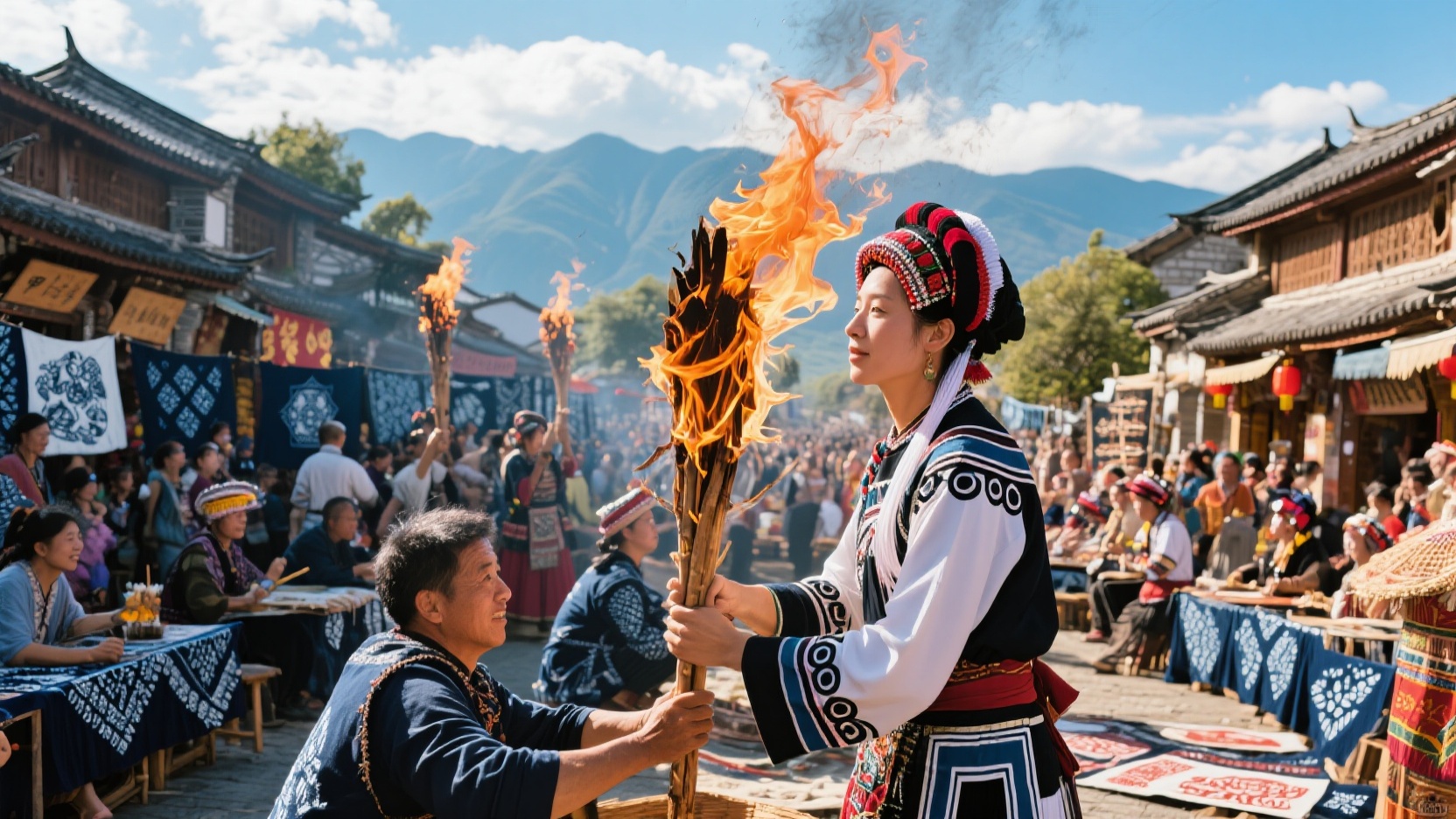
The 25th day of the sixth lunar month is the Bai ethnic group's Torch Festival, which shares the same origin as the Yi ethnic group's Torch Festival but differs in its rituals. In the villages of Xizhou, Zhoucheng, and Shuanglang, torches are erected at dusk. The main torch is funded and constructed by families with a newborn boy or newlyweds, decorated with pine wood, bamboo strips, and colored paper, and topped with a "shengdou" (a type of measuring vessel) and paper figures. After dark, it is lit, and elders recite prayers for blessings while young people sprinkle rosin powder around the torch. Each sprinkle causes the flame to leap higher, symbolizing the removal of disease, pests, and bad luck. Participants should avoid wearing synthetic clothing, stand facing the wind, and follow the person sprinkling the rosin. Outsiders can also receive a small bag of rosin powder and try it at the edge of the fire. The torches in Zhoucheng are more elaborately decorated, while those in Xizhou emphasize worshipping the local deity, and in Shuanglang, the torches are planted on the shores of Erhai Lake. Behind this festival lies the Bai people's prayer for a bountiful rice harvest; the higher the torch, the heavier the rice ears in the fields. If you wish to take photos, it is recommended to stay at least five meters away from the main torch. Sparks will fly when the rosin is released, but they will not linger for long.
Jiama woodblock prints: Printing a Bai ethnic group's "paper talisman".
"Jia Ma" is not actually a horse, but rather a type of folk woodblock print by the Bai ethnic group, depicting deities such as the local deity, mountain god, kitchen god, and bridge god. The experience typically takes place in old courtyards around Xizhou or the ancient city. Workshops provide pear wood printing blocks, ink, and cotton paper. The process is quicker than expected: ink is evenly applied to the block with a palm brush, paper is laid on top, and then pressed again with a clean roller; lifting it up yields a print. However, understanding the images is key—the kitchen god riding a rooster, the bridge god wielding an axe, and the water god treading on a fish—each depicting a corresponding sacrificial scene. The Bai people paste "Jia Ma" on door lintels, stoves, or bridgeheads as a "passport" between humans and deities. Some prints also depict horses carrying command flags, hence the name "Jia Ma": horses are messengers conveying prayers. Sitting down and printing three to five different prints helps you remember the symbols better than buying a set of printed materials. The old craftsmen say that carving one block often takes half a month; pear wood absorbs ink evenly, and cotton paper has long fibers that are not easily damaged.
Bai ethnic tie-dyeing: The timeline from tying the flowers to removing the threads (using the indigo root)
The dye houses in Zhoucheng and Xizhou mostly use plant dyes such as indigo and mugwort, and the blue and white patterns are the most direct expression of Bai ethnic aesthetics. The experience usually begins with a square scarf: first, a design is drawn, then the pattern is tied with needle and thread, or folded and clipped with bamboo clips. The tightness of the knot determines the final dye boundary; too tight, and the white areas will be harsh; too loose, and it will be a patch of blue, requiring repeated adjustments. Afterward, it is immersed in an indigo dye vat, repeatedly oxidized and rinsed, and then the threads are untied and unfolded. A common problem for first-timers is loose threads and blurred pattern boundaries, but this unevenness is precisely the mark of handcrafting. Bai tie-dye patterns include butterflies, camellias, coins, and checks. Elders say butterflies symbolize many children, and camellias represent the Cangshan Mountains. If time is limited, a small square scarf or shawl can be chosen; after untying the threads, the scarf can be dried in the sun for half an hour, and the color will change from green to blue. Most dye houses offer on-site experiences; avoid the afternoon tour rush and visit in the morning for a quieter experience. The dye vat needs to be "maintained" daily by experienced craftsmen. The degree of indigo fermentation determines the depth of color, which is why the same piece of cloth will look slightly different in different seasons.
It's not necessary to complete all four items. The March Street Festival and Torch Festival are subject to date restrictions, while Jiama (a type of traditional Chinese craft) and tie-dyeing can be arranged at any time. If it's your first time in Dali, it's recommended to do a handicraft first, and then attend a festival; the festival provides sounds and smells, while the handicraft provides touch and failures. Combining the two gives you a complete feel for being a "half-day local."