
Fire Dragon Pottery Depicts the Mountain City: Handmade Moments in Tongliang Dragon Dance, Rongchang Pottery, and Liangping Woodblock New Year Paintings
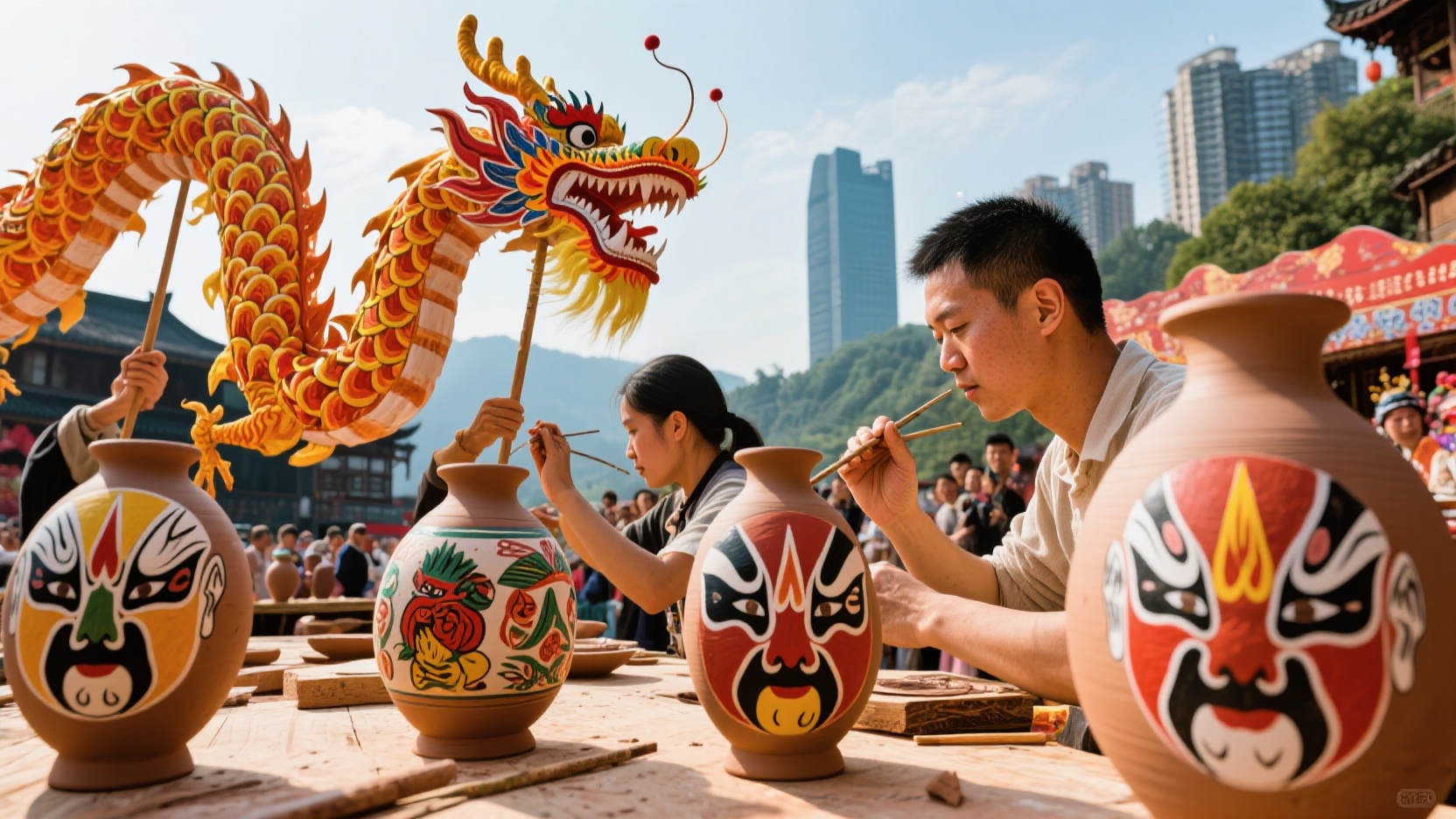
The true cultural and artistic experience of Chongqing isn't found in the glass display cases of art museums, but rather in the molten iron and sparks of Tongliang, the spinning clay of Rongchang, the ink and woodblock printing of Liangping, and the face paint of Sichuan opera. The following four scenes of festival customs and intangible cultural heritage handicrafts are perfect for tourists to "sit down and feel like a local for half a day," understanding the intricacies before trying anything themselves.
Tongliang Fire Dragon: A Frenzied Dance of Flames During the Spring Festival
The performances take place from the first to the fifteenth day of the first lunar month each year, with multiple squares and scenic spots in Tongliang District hosting shows. Arriving at the performance venue in the evening, visitors first watch shirtless dragon dancers toss molten iron into the air, showering the audience with golden sparks as the dragon tumbles amidst the smoke and fire. Before the show, visitors can participate in a simple dragon dance rehearsal, learning basic techniques such as gripping the handle, changing positions, and running in circles. After the performance, according to local custom, visitors can touch the dragon's whiskers for blessings. Cultural Background: Tongliang dragon dance originated in the Ming Dynasty. Locals used bamboo to make dragons and fire to ward off evil spirits. The fire dragon performance combines traditional metallurgy with dance and has been included in the first batch of national intangible cultural heritage lists. The dragon used in the performance is tens of meters long, with each section of the dragon handle fitted with a homemade firework tube. Sparks fly as the dragon dances, demanding extremely high arm strength and coordination from the dancers.
Rongchang Pottery: Making Your Own Teacup in Antao Town
Available year-round, with spring and autumn offering the best experience. Many pottery workshops in Antao Town, Rongchang District, offer pre-booked pottery-throwing experiences. Take a piece of local red clay, center it on the potter's wheel, make an opening, and lift it, feeling the clay stretch into the cup's wall under your fingertips; then use a bamboo knife to carve intertwined branches or simple characters, let it dry, and the workshop will fire and ship it. Cultural background: Rongchang pottery, along with Yixing purple clay, Jianshui purple pottery, and Qinzhou Nixing, is known as one of China's four famous potteries. The local clay has a high iron content, resulting in a warm, ochre-red color after firing. During the Ming and Qing dynasties, it was sold as "Antao" along the Yangtze River to Southwest China and Southeast Asia. Rongchang pottery glazes are mainly vermilion red, western green, and yellowish-brown. Vermilion red requires firing in an oxidizing flame, demanding precise kiln temperature control. Beginners are encouraged to ask a master for advice on kiln temperature control.
Liangping woodblock New Year paintings: Print a door god and bring it home.
The best time to experience it is from the twelfth lunar month to the first lunar month. In Pingjin Town, Liangping District, some workshops still preserve the traditional hand-printed woodblock printing technique. The experience begins with applying ink evenly to the woodblock using a palm brush, then covering it with local bamboo paper. A line drawing is then created using a rubbing tool, and finally, the door gods or ladies are hand-colored according to the traditional "face-opening" sequence. Cultural background: Liangping New Year paintings, along with those from Yangliuqing in Tianjin, Taohuawu in Suzhou, and Weifang in Shandong, are known as the four major New Year painting production areas in China. They are characterized by their rich colors and robust figures. In the past, families in eastern Sichuan would always paste "Liangping door gods" during the New Year to ward off evil and bring good fortune. The woodblocks for Liangping New Year paintings are mostly made of pear wood, with bold and powerful lines. The coloring emphasizes "red against yellow, bright and radiant," and the high saturation contrast is the most direct expression of the folk aesthetics of the Bashu region.
Sichuan Opera Face Painting: Understanding the Intricacies of Face Changing in the Opera House
Participation is available year-round, with several traditional teahouses and Sichuan Opera theaters in Chongqing offering hands-on experience sessions. The experience begins with watching a short excerpt from a traditional opera and a face-changing performance. A master then explains the symbolism of the facial makeup colors – red for loyalty, black for righteousness, white for treachery, and golden for immortality. Participants then paint a half-face or full-face mask themselves and learn two basic body movements. Finally, a group photo is taken. Cultural Background: Sichuan Opera face-changing originates from ancient Nuo opera and the shamanistic culture of the Ba-Yu region. It is used to externalize the character's inner transformations. Actors use facial makeup, costumes, and body movements to tell the story, rather than simply showcasing skills. During the experience, pay attention to the gestures of different roles: painted-face characters use "tiger claws," while female characters use "orchids." These subtle differences are key to understanding Sichuan Opera.
Doing these four things will give you a deeper understanding of Chongqing than visiting ten tourist attractions—because you'll have touched its pottery, printed its New Year pictures, danced its dragons, and painted its opera masks. The roughness and warmth in your hands reveal the city's cultural essence, which it doesn't easily show to the public. Next time you come to Chongqing, don't just think about hot pot and Chongqing noodles; set aside half a day for these intangible cultural heritage sites that require you to sit down and savor the experience. The rewards will be far more profound than any photograph.