
Temple Fair, Kiln Fire, and Ballad Singing: Spending Half a Day as a Local Craftsman in Changsha, Experiencing Four Hunan Festivals
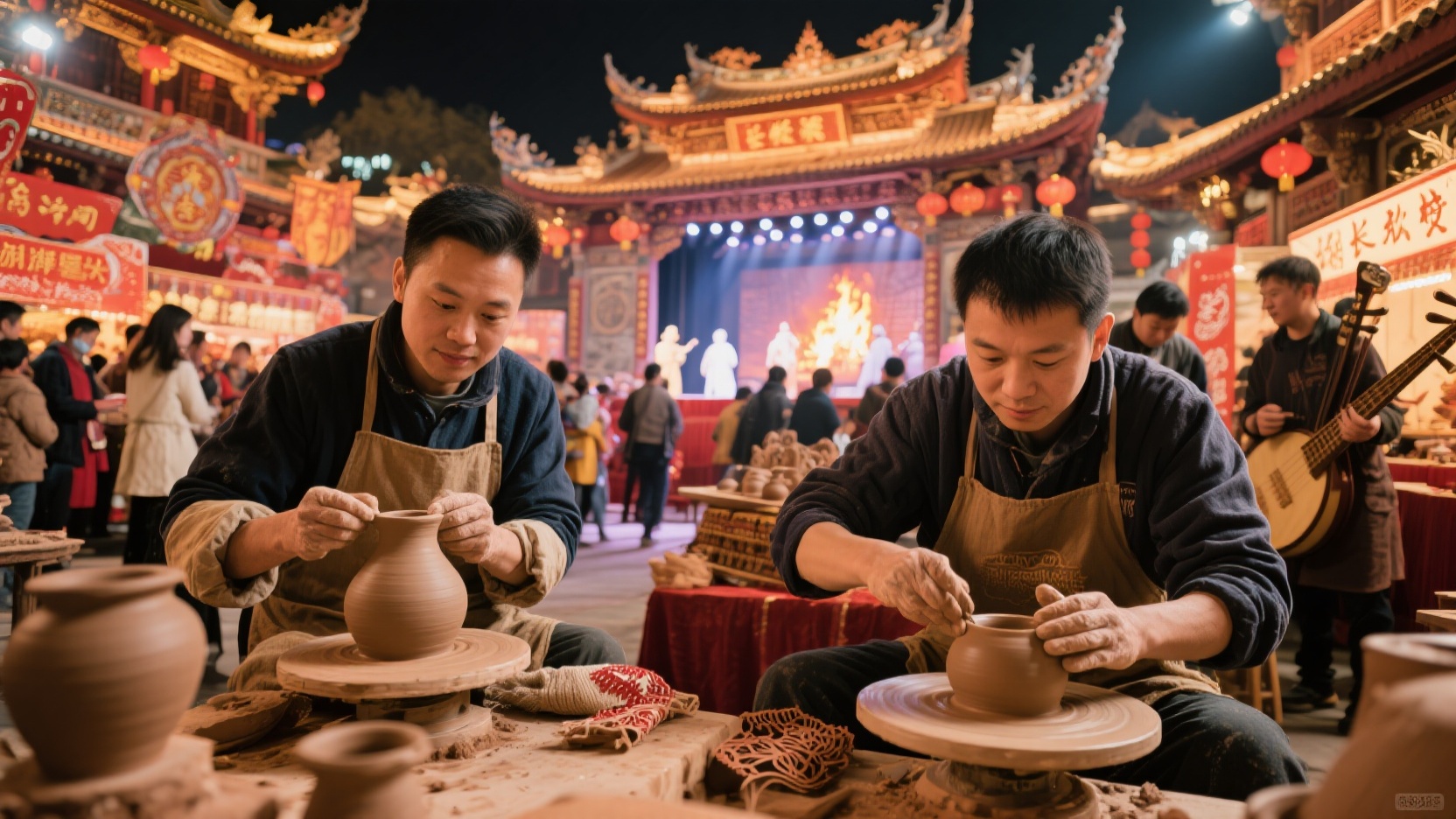
The cultural and artistic experience of Changsha doesn't have to be confined to museum displays. Its festivals, folk customs, and intangible cultural heritage still thrive in specific times and places: the Huogongdian Temple Fair during the first month of the lunar calendar, the pottery-throwing workshops of Tongguan Kiln, the paper-cutting and summer cloth crafts in the old houses of Wangcheng, and the Changsha storytelling performances in nighttime teahouses. The following four points are perfect for incorporating into your itinerary according to the season, allowing you to sit back and experience half a day like a local.
Huogongdian Temple Fair: A Hunan-style New Year's Festival in the First Month of the Lunar New Year
The fairs take place from the first to the fifteenth day of the first lunar month, with the most complete celebrations around the Lantern Festival; smaller versions also exist on weekdays and weekends. The scene is at the Huogongdian (Fire Palace) on Pozi Street, with the stage facing the square, surrounded by long benches and food stalls. The experience begins in the morning: first, walk around the crowd to watch the ritual of worshipping the Fire God, then find a seat in front of the stage. On stage, excerpts from Hunan opera and Huagu opera are performed in turn, often featuring the familiar melody of "Liu Hai Chopping Wood." Locals in the audience don't rush to take photos, but instead enjoy a bowl of sugar-coated glutinous rice cakes or sister dumplings, eating and cheering. Culturally, Huogongdian was originally named Qianyuan Palace. In the past, Changsha merchants used temple fairs to set up markets, combining snacks, acrobatics, and opera, gradually forming the "Huogongdian has it all" local tradition. Therefore, watching a performance here is not just about watching a show, but about witnessing how a city integrates faith, commerce, and entertainment on the same ground.
Tongguan Kiln Pottery: One-time throwing of clay next to the export porcelain kiln of the Tang Dynasty
The Tongguan Kiln experience can be enjoyed year-round, with spring and autumn being the most suitable seasons. The workshops are open on weekends. Located between the old factory buildings and the Longyao ruins in the riverside area of Tongguan Street, Wangcheng District, the experience is more than just simple clay sculpting: first, the clay is selected and kneaded to remove air bubbles; then, the craftsman holds the clay firmly from behind, controlling the speed with a foot pedal, and the fingers push outwards from the inside of the clay to create the desired curve of the cup or bowl. After shaping, decorations can be carved, inscribed, or painted with brown and green glazes, following the signature underglaze painting logic of Changsha Kiln. Firing takes time, and the pieces are usually shipped from the workshop after the experience. Tongguan Kiln was already a major center for export porcelain during the Tang Dynasty, pioneering underglaze painting, as evidenced by the large number of Changsha Kiln porcelains salvaged from the "Black Stone" shipwreck; the inscribed pottery with the poem "You were born before I was born" unearthed at the site further transforms everyday objects into emotional carriers. Compared to viewing broken porcelain in an exhibition hall, personally shaping and correcting the clay allows for a deeper understanding of the kiln worker's touch and the cost of failure.
Wangcheng Paper-cutting and Summer Cloth: The Handcrafted Skills in the Old House
These two handicrafts are most active before the Spring Festival and the Dragon Boat Festival, and can also be experienced in daily life. The location is usually the intangible cultural heritage workshop or old house courtyard in Wangcheng village, with a long table covered with red paper and hemp thread. The paper-cutting experience starts with folding paper, drawing patterns and cutting. First, learn to cut basic round flowers or three-dimensional "spring" characters, and then try more complex patterns such as "Liu Hai playing with the golden toad". Wangcheng paper-cutting has fine lines and full composition. In the past, it was mostly used to make window decorations, embroidery patterns and paper for sacrificial purposes. The summer cloth experience is more laborious: from spinning hemp and sizing to weaving on the loom, the most crucial steps of warp pulling and shuttle throwing are simplified. Summer cloth in the Liuyang River basin was once the main source of summer clothing and mosquito nets, and it shares the same hemp spinning language as Hunan embroidery. The common point of the two experiences is "slow": a piece of paper may be ruined three times, and a piece of hemp thread needs to be spliced repeatedly, but the sense of order in the hands is more like local life itself than the finished product.
Changsha storytelling and Hunan opera evening performances: Entrusting your ears to the old Changsha vocal style
The performances typically take place on Friday and Saturday evenings, or at specific nights during the Huogongdian Temple Fair or Intangible Cultural Heritage Performance Week. The venues are typically old teahouses or small traditional opera theaters, featuring square tables, covered teacups, and low stages. It's recommended to arrive early and listen to a short Changsha storytelling performance. A single person, a musical instrument, and a gavel will sing "Dong Guo Saves the Wolf" or "Wu Song Fights the Tiger" in Changsha Mandarin, with crisp pronunciation and a fast-paced narrative. Next, listen to a Xiang Opera excerpt, characterized by a singer's voice and the accompaniment of gongs and drums, with a direct and straightforward style. Changsha storytelling originated from Yugu Daoqing, and after entering the city, it evolved into storytelling performances in theaters. Due to the high barrier of dialect, there are few inheritors. Xiang Opera, on the other hand, retains the remnants of the Ming Dynasty Yiyang style, with a vocal system different from Kunqu and Peking Opera. It's fine to sit for half the performance and then leave; the key is not to treat it as background noise, but to clearly hear the rhyming, everyday stories told in the local dialect.
The four experiences don't have to be completed all at once. If you only have one day, prioritize festivals: visit the Huogongdian Temple Fair in the first month of the lunar calendar, try pottery making at the Tongguan Kiln in spring and autumn, do paper cutting and summer cloth making before the Dragon Boat Festival or Spring Festival, and save the evening for Changsha storytelling. Each of these takes two or three hours longer than a quick tour, but it allows you to experience the raw texture of Changsha culture.