
Xining Night Tour Map | Blogger's Personal Experience: A 6-Hour Route from the Huangshui River Lights to the Hehuang Folk Art Teahouse
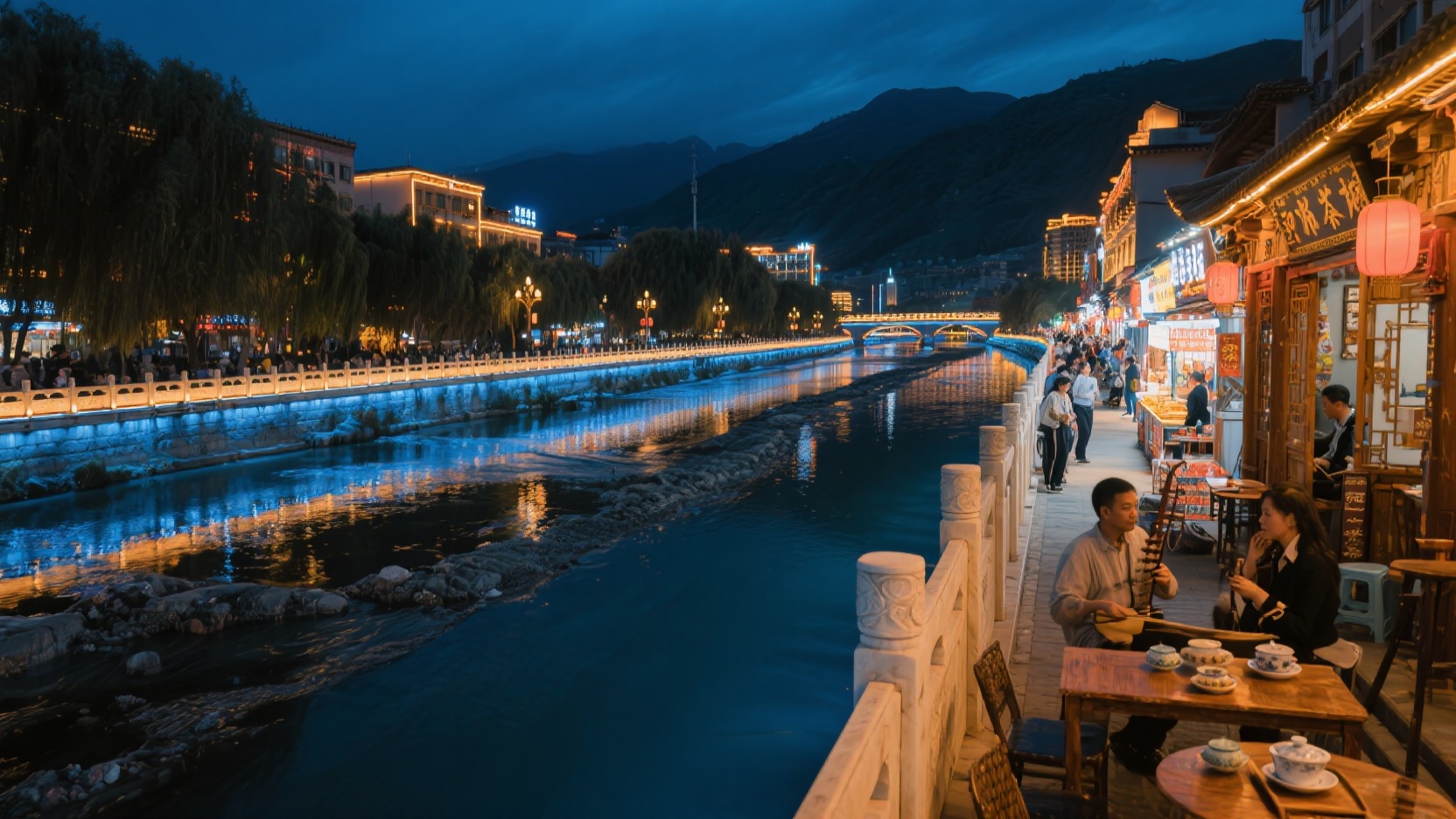
This was my third trip to Xining, and I finally mastered this night tour route that starts after 6 PM. The previous two times, I either got lost in the tourist shops on Mojia Street or couldn't find my way back to the main road late at night. This time, I started from the Huangshui River light strip, cycling and walking all the way to the Daxing Street night market, and finally listened to folk songs at the Hehuang Folk Art Tea House. The whole trip took five and a half hours, and I finished just before 11:30 PM.
18:00-19:20 Huangshui River Light Belt: Don't rush into the night market yet.
The starting point is on the north side of the central square. Arrive at the Huangshui River walking trail at 6 PM; the sun has just set, and the river surface is illuminated by cool-colored lights. Walk east for about eight minutes, and you'll pass the Beimenpo city wall ruins. The old city wall is outlined by warm lights, and its clear reflection is visible in the river. There are far fewer tourists than during the day, making it a good time to take some clean nighttime photos.
Continue east to Wuyi Bridge; this walk takes about 40 minutes, including time for taking photos. Around 7:00 PM, scan a shared bike at Wuyi Bridge and ride along Qiyi Road for about 10 minutes to Daxing Street Night Market. A reminder: the Huangshui River Trail is only suitable for walking; do not ride bikes on it. It's safer to scan your bike at the designated lane under the bridge.
19:30-20:40 Daxing Street Night Market: A more local late-night eatery than Mojia Street.
Daxing Street Night Market isn't as well-organized as Shuijing Lane, nor is it a shopping mall-style night market like Xinqian. It's squeezed between residential buildings, and most of the stalls are run by long-time vendors. They sell roasted lamb, hand-pulled noodles, liangpi (cold skin noodles), sweet fermented rice, and old-fashioned yogurt. I usually start with a bowl of black liangpi, then get three skewers of roasted lamb, and a box of old-fashioned yogurt. It's a very comfortable meal for just a few dozen yuan per person.
Don't sit down at the first shop as soon as you enter. Walk to the middle section and look for the shop with a short but continuous queue of locals; that's the one you're unlikely to go wrong with. At 8:40 PM, walk for about eight minutes from the south entrance of the night market, turn into an alleyway with shops at the bottom of an old residential building on Nanguan Street, and you'll find the Hehuang Folk Art Tea House.
21:00-23:00 Hehuang Folk Art Tea House: A nightlife style in Xining that's even more unique than a pub.
The teahouse is lit only by a warm yellow lantern at the entrance. Inside, there are octagonal tables, covered teacups, and a small stage. Starting at nine o'clock, Qinghai Pingxian, Yuexian, and Hua'er folk songs are performed in turn. The performers are mostly local veteran artists, and the audience is mostly long-time residents from the neighborhood. A cup of brewed tea or covered tea costs only a few dozen yuan per person, and you can sit until the show ends.
I recommend sitting diagonally to the side of the stage. This way, you can see the plucking movements clearly while avoiding the strong frontal light. First-timers might not understand the lyrics, but the melody is very catchy. During intermission, regulars might hum along; if you're not familiar with the singers, don't join in—quiet applause is the best way to show respect.
The event ended at 11:00 PM. I went outside, scanned a shared bike, and rode back to the central square. It took about ten minutes, passing the Kunlun Bridge along the way. The traffic and the reflection of the Nanchuan River were just finishing. I got back to the main road before 11:30 PM. I didn't need to take a taxi at all.
Blogger's summary: Season selection, night shooting locations, and safety tips
The biggest advantage of this route is that it's convenient and avoids backtracking. June to September is the best time to visit; after October, the wind along the river at night is strong, and it gets cold after the teahouses close. Monday to Thursday are less crowded and offer a better experience; on Fridays and Saturdays, you might need to arrive early to secure a seat at the teahouses, but the night market is much more lively.
Night Shooting Position 1: Opposite the Beimenpo City Wall Ruins, capture the warm light of the city wall and its reflection on the river; Position 2: Pedestrian walkway under Wuyi Bridge, use the bridge structure as a frame to shoot light trails; Position 3: Middle section of Daxing Street Night Market, use a telephoto lens to compress the firelight and steam from an oven; Position 4: Side view of the teahouse stage, shoot the actors' profiles and the steam from the covered teacups; Position 5: Under Kunlun Bridge on the return trip, shoot the reflection of the Nanchuan River and the light trails of traffic.
Four safety tips: 1. The temperature difference between day and night in Xining is significant. Even in June and September, bring a light down jacket or fleece for the evenings. 2. Night market passages are narrow. Put your phone and wallet in an inner pocket and wear your backpack in front. 3. Do not cycle on the Huangshui River trail. Go to Wuyi Bridge to scan for shared bikes. 4. Avoid drinking alcohol in the evenings on the plateau. Drinking brewed tea in a teahouse is the safest option. After the event, walk to the main road in groups and then call a taxi or ride a bike.