
Wandering through the alleys of Lhasa's Old City | A 3-hour Citywalk experience to avoid the crowds and enjoy an artistic atmosphere (including 2 side routes)
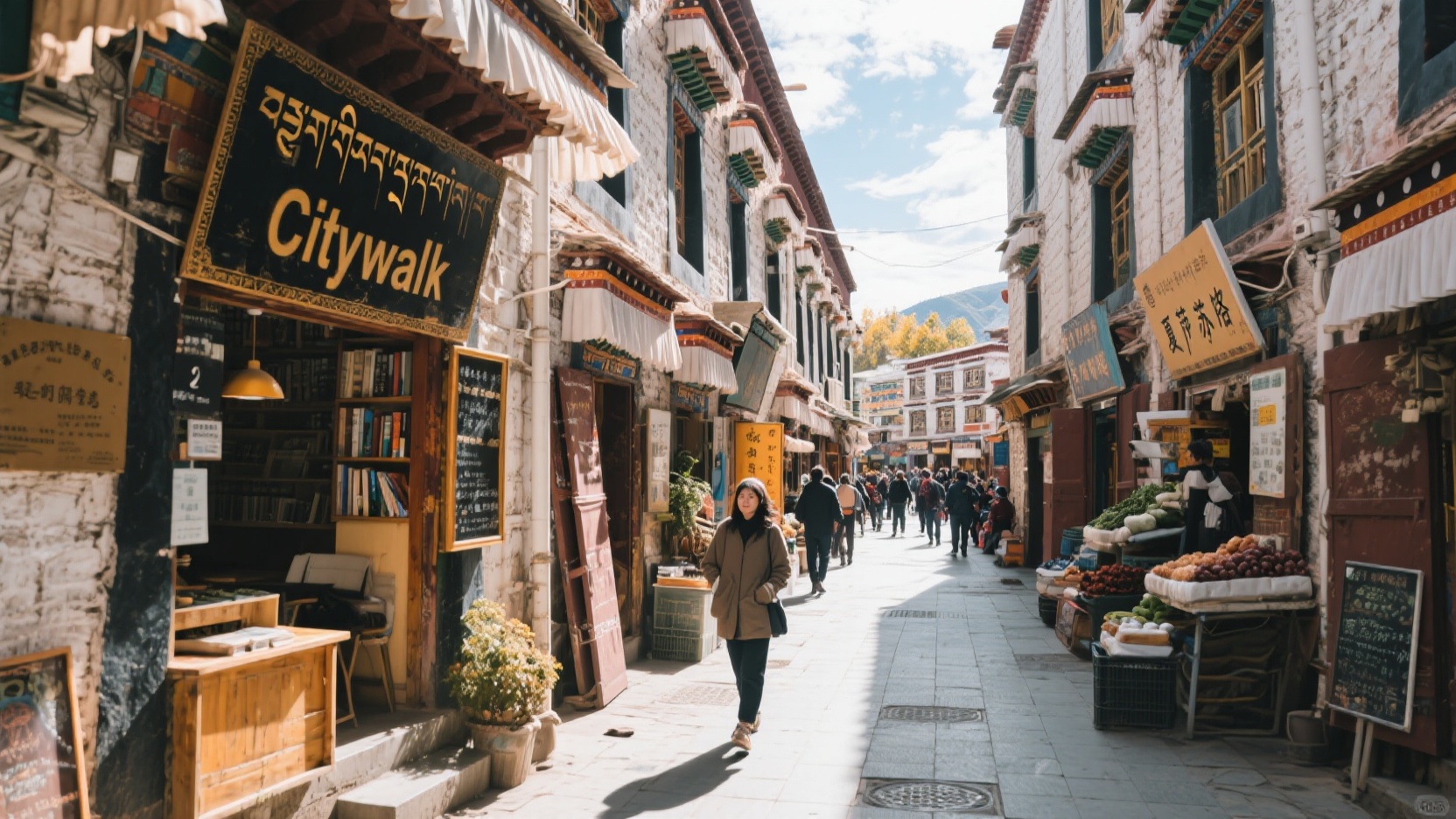
On my eighth stop in Lhasa, I finally stopped treating the main pilgrimage route of Barkhor Street as my only route. Instead, I turned off Dongzisu Road into an old alley without tourist signs. At four o'clock in the afternoon, the high-altitude sun sliced the white walls into sharp lines of light and shadow. I walked along an old city loop of about 3.8 kilometers until dark, turning into side streets twice along the way. This wasn't about checking off tourist attractions; it was more like a low-altitude version of "alleyway archaeology." The following route, personally tested, is suitable for those who appreciate the urban fabric, the atmosphere of old streets, and the rhythm of solitude.
I. Main Road Overview: The 3.8-kilometer Old Town Loop, take your time.
The main road starts at the intersection of Linkuo South Road and Dongzisu Road, passes through several residential alleys outside Barkhor Street, enters the corner of Chongsaikang Vegetable Market, then turns into Danjielin Alley and Lugu Alley, ending at a pocket park next to Jiangsu Road. The main road is about 3.8 kilometers long, and it takes about two and a half hours to walk.
The two branch lines are located on the northern section of Jokhang Temple Road and Xiasasu Road, respectively, each about one kilometer round trip. It is recommended to start after 3 pm, when the sunlight is lower and the old walls, prayer flags, and pedestrian shadows are more photogenic. Don't be intimidated by the name "Lhasa." Although the old city is at a high altitude, this route has almost no uphill sections, and a leisurely walk is more comfortable than a rush.
II. Dongzisu Road - Wengdui Xingka: A Prelude of Light and Shadow in White Walls and Wooden Windows (Approximately 20 minutes walk)
The blogger's camera position: Standing next to a utility pole on the east side of the intersection of Dongzisu Road and Linkuo South Road, using a medium-telephoto lens to photograph an elderly person slowly walking past a prayer wheel in the backlight at the alley entrance, with a continuous white wall and black trapezoidal window frames in the background. The oblique light in the early morning or evening will divide the wall into two color temperatures, upper and lower.
It's worth stopping for five minutes to look around because this alley preserves the most authentic glimpse into life in Lhasa's old city: people carrying water out to pour it at their doorsteps, cats sleeping beside incense burners, and the brass rings on wooden doors polished to a shine from being touched so much. It lacks the strong sense of ceremony of the main Barkhor Street, but it's closer to the daily life of old Lhasa.
3. Chongsaikang Market Street Corner: Understand Lhasa's Food in Five Minutes (Approximately 15-minute walk)
The blogger's camera position: shooting down the gentle slope steps from the north entrance of Chongsaikang. The colorful sunshades, the small mountains of yak butter, and the red yak meat stalls create a dense layering of colors. Note that you should use a wide-angle lens on your phone and avoid using the flash.
It's worth stopping here for five minutes, not to buy groceries, but to see how a city's food is transported, processed, weighed, and taken away. Butter is packed into old-fashioned wooden crates, and cheese curds are neatly stacked in transparent bags. Vendors and regular customers converse quickly in Tibetan. This is the most authentic supply chain scene behind the Barkhor Street commercial district. It's recommended to observe quietly and refrain from taking photos of people's faces.
IV. Branch Line A | North Section of Xiaozhao Temple Road: A Sample of Old Lhasa Life (Approximately 20 minutes round trip)
Turning north from the entrance of Chongsaikang Alley, you enter the northern section of Xiaozhaosi Road. This side street is narrower, with hardware stores, Tibetan clothing and fabric shops, and butter lamp shops mixed together, and the proportion of tourists drops rapidly. The blogger's camera position: in front of a gray-white doorway in the middle of Xiaozhaosi Road, the golden roof of the temple and the prayer flags spanning the alley are captured in the frame, with a resident in the foreground taking out their keys to open the door.
Stop here for five minutes, and you'll see Lhasa before it's been packaged for tourism: someone walks into a courtyard carrying freshly bought groceries, and a craftsman squats on the steps repairing an old wooden bowl. The Jokhang Temple itself isn't large, but the surrounding alleys are incredibly vibrant with life, best experienced by listening—the sounds of copper bells, sewing machines, and distant chanting blend together.
5. Danjielin Lane - Cemenlin Temple: A yellow-walled temple hidden in a residential area (about 15 minutes walk)
After returning to the main road, walk towards Danjielin Lane. The entrance to the lane is inconspicuous, but once inside, you'll find an entire yellow temple wall. The blogger's camera position: a low-angle shot from under the yellow wall on the east side of Cemenlin Temple, capturing the red-robed monk, the black window frame, and a few weeds on the wall in the same frame. The sidelight at four in the afternoon will make the yellow more saturated.
It's worth stopping for five minutes because there are almost no fixed routes for visitors. Monks and residents share the same narrow alley, and elderly people often sunbathe and spin prayer beads at the base of the walls. There are no clear boundaries between the temple buildings and the houses; you can hear chanting, cooking, and bicycle bells all at the same time while standing at the base of the walls. This sense of fusion is precious in Lhasa's old city.
VI. Side Route B | Chassasu Road: A Hidden Combination of Vinyl Records, Vintage Clothing, and Cafes (Approx. 25 minutes round trip)
Turning off Dangerin Lane onto Chasasu Road from the west, this side street feels like a "youth culture mezzanine" in the old town. The blogger's camera angles: find a small café that's only open in the afternoon, sit by the window and use the reflection in the glass to photograph the street scene; or stand in front of a vinyl record store and capture the handwritten recommendation on the glass door alongside a passing elderly person turning a prayer wheel.
This is a good place to stop for five minutes to half an hour. Most of the shops have small storefronts, some even with faded signs, but pushing open the door might reveal a different side of Lhasa: old vinyl records, handmade yak wool coats, independent publications, and old Nepalese rock music. The owners are mostly young locals or people from other places who have lived here for a long time. They're not in a hurry to sell; they'll only chat if you ask them a question. Prices range from affordable coffee to mid-range vintage clothing, catering to all budgets.
VII. Closing the Lugu Lane Pocket Park: Sit under the willow trees and give yourself time again (about 15 minutes walk).
From Xiasasu Road, I turned back to Danjielin Lane and continued south to Lugu Lane, finally stopping at a community pocket park next to Jiangsu Road. The blogger's camera position: sitting on a bench under a willow tree, shooting from a low angle, using the willow branches as the foreground and the exterior walls of residential buildings or the distant white pagoda as the background. The soft evening light made it easy to capture silhouettes of people.
This place is worth lingering for more than five minutes. Children chase after the exercise equipment after school, elderly people sit on the stone platform chatting, and occasionally someone pushes a bicycle by. The information density of the entire route decreases here; the temples, markets, and vinyl record shops of the old town recede into the background, and you suddenly realize: so-called in-depth travel is nothing more than slowing down a stretch of road and making five minutes feel longer.
Blogger's Summary and Practical Tips List
This route is not suitable for people in a hurry, but rather for those who want to "stay" in Lhasa's old city. The main road is about 3.8 kilometers long, plus two branch roads totaling about 5 kilometers. There are plenty of teahouses and public benches along the way, so it doesn't require much physical exertion.
Practical tips: First, it's better to start shooting after 3 PM, but don't go too late, as many small shops close before 8 PM; Second, keep your distance when shooting in markets and residential areas, and don't use flash close to people's faces; Third, the opening hours of side shops are unpredictable, so don't be too hard on your mind; Fourth, wear non-slip shoes, as the cobblestone streets in the old town can be slippery in the evening; Fifth, remember to drink plenty of water when hiking at high altitudes, and tea houses are great rest stops along the way, where you can sit for a long time for a small amount of money.