
Guilin Old Town Slow Walk Hidden Route | Blogger's 3.8km Citywalk Checklist (Autumn/Winter Solo Trip - Avoiding Pitfalls, Includes 2 Side Routes) (4 times)
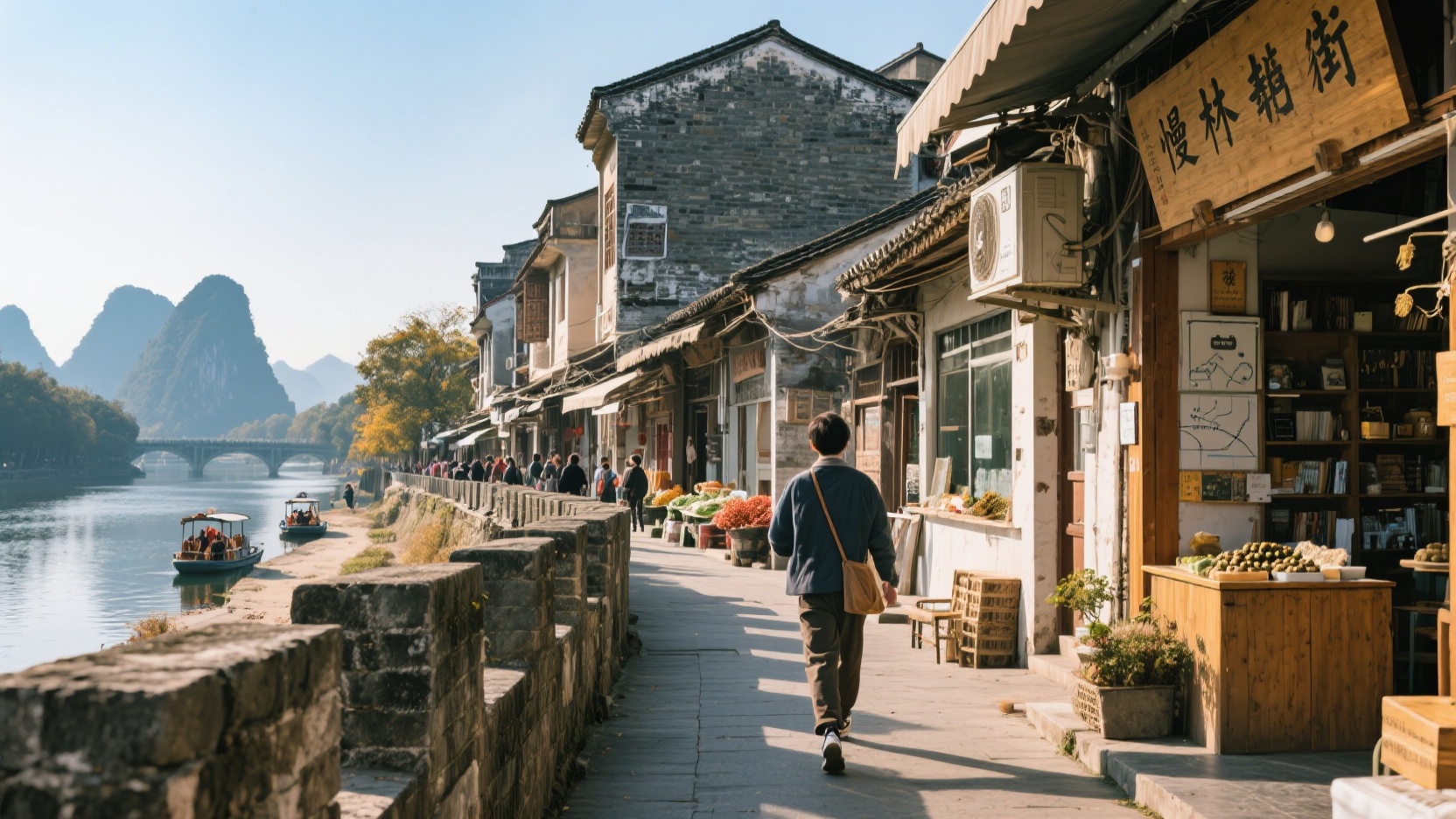
This was my fourth time hiking this route, and my phone's pedometer showed 3.8 kilometers. The first three times I encountered three major problems: being led astray by the navigation into a sea of tour buses on Zhengyang Road, getting lost in the Lequn Road market, and experiencing complete backlighting when visiting the Republican-era buildings in the evening. This time, I changed my approach, starting at 9 AM from the Ancient South Gate, bringing a wide-angle lens and a bottle of water, and finally managed to figure out the main route and the two side routes.
First stop: From the ancient South Gate to Sanduo Road | 600 meters along Ronghu Lake, don't just take pictures of the lake.
Starting from the stone steps on the east side of the Ancient South Gate, walk about 600 meters (8 minutes) along the north bank of Ronghu Lake. Don't rush to photograph the pavilion in the middle of the lake; instead, position your camera inside the gate opening and shoot outwards, using the old stone slabs as a frame to include the elderly people doing their morning exercises and the plane trees within the frame. Stop for 5 minutes because the Ancient South Gate is one of the few remaining Song Dynasty city wall ruins in Guilin, and the stone slabs of the gate opening appear thicker in the oblique light of 9 am compared to normal light.
When you reach the west entrance of Sanduo Road, don't rush to cross the street. The gray-yellow old building is a clue to the Guangxi Provincial Art Museum. The camera is positioned in front of the convenience store across the street, with the air conditioner unit blocked by roadside trees, leaving only the vertical windows on the second and third floors and the electrical wires visible. Stop for 5 minutes to see the old photos of the Anti-Japanese War Guilin Cultural City. Although the first floor is an ordinary store, the terrazzo walls are still there.
Second stop: Taiping Road vegetable market corner and first branch line | 10 minutes where you can smell the aroma of cooking pots
Turning from Sanduo Road onto Taiping Road, it's about 500 meters (7 minutes). You'll first smell the aroma of fried taro cakes. The main route stops at the intersection of Taiping Road and Lequn Road; this isn't a tourist market, but a local corner where people buy groceries. Position the camera in the southeast corner, using bamboo baskets as the foreground and electric bikes and clotheslines under the arcades as the background. Stop for 5 minutes because at 10 am, the sunlight streaming in from the arcade roof creates highly saturated blocks of color on the red plastic basins, very Guilin-esque.
The first branch line leads north from the intersection into Taiping Road Lane 1, a round trip of about 600 meters, taking 8 minutes one way. Inside the lane are a vinyl record shop and two vintage clothing stores, both with very small storefronts that only open in the afternoon. In the morning, focus only on the arcade facades and old wooden doors; the best spot is at the third utility pole at the lane entrance, capturing the depth of the continuous arches. The reason for stopping for 5 minutes is that this area features a continuous arcade facade rarely seen in Guilin's old town, where the veins of the ivy become translucent when backlit.
Third stop: Yiwu Road's old houses from the Republican era | Don't miss the names on the walls
Returning to the intersection, turn onto Yiwu Road from Lequn Road. It's about 700 meters and takes about 10 minutes. I recommend taking the west-side pedestrian walkway. The best spot is outside the gray courtyard wall in the middle of Yiwu Road. Use a telephoto lens to compress the distance between the old house's entrance and Diecai Mountain. Stop for 5 minutes because many remnants of Republican-era mansions and church buildings are preserved along the route. Most of them are unmarked and can only be identified by terrazzo steps, old-fashioned shutters, and the "Jiang Yiwu" stone tablet in the corner. I passed by them on my first try.
The side road is at the northern end of Yiwu Road. Turn right onto Fengbei Road and walk about 500 meters (7 minutes) towards Diecai Mountain to reach Mulonghu Pocket Park. The best spot is on the stone railing on the east side of the park, capturing the antique-style bridge and the distant mountains. The 5-minute stop isn't for the scenic spots, but because this place, just a few hundred meters from the main street, is so quiet you can hear the lake lapping against the shore, washing away the hustle and bustle of the market.
Fourth stop: The city wall and independent bookstores along Zhonghua Road | The 900-meter stretch that most resembles old Guilin
Turning back onto Yiwu Road from the branch road, head southeast onto Zhonghua Road, about 900 meters, 13 minutes. This section runs along the north and west walls of the Jingjiang Prince's City, densely covered with camphor trees, where people were playing chess at the base of the wall. I positioned my camera near a crooked camphor tree in the middle section, superimposing the reddish-brown city wall with the tree's shadow, waiting for a cyclist to pass by. I stopped for 5 minutes because the actual boundaries of the Ming Dynasty city wall are closer to their original state than the east and west alleys; the moss and tree roots are still there.
There's an old independent bookstore at the south entrance of Zhonghua Road. The storefront is small, with displays of local Guangxi books in the window. The best spot is on the opposite sidewalk, using the reflection in the glass to overlay the street scene onto the stacks of books. Spend five minutes browsing Guilin local chronicles and old photos from the War of Resistance against Japan; it will connect the streets and alleys in front of you. The store is quiet; you can browse sample books even if you don't buy anything, but please don't take pictures of the staff.
Fifth stop: From Donghua Road to Binjiang Road (the final 700 meters) | The final 700 meters in the river breeze
From the south entrance of Zhonghua Road, cross to Donghua Road, then walk east to Binjiang Road, about 700 meters, a 10-minute walk. There are community cafes and secondhand bookstores on both sides of Donghua Road, which open after 2 PM. The main route ends at the pedestrian path on Binjiang Road near Jiefang Bridge. It's not recommended to go up to Xiaoyao Tower, as it's crowded and the loudspeakers are loud.
The camera position was by the stone railing of the riverside promenade, with the arch of the Liberation Bridge as a backdrop, capturing bamboo rafts and fishermen. A five-minute stop was taken to observe the daily life on the Li River, rather than the cruise ship dock; as the sky turned grayish-purple at 6:30 pm and the bridge lights came on, the main urban feel truly subsided.
Blogger's Summary and Practical Tips
The main route is about 3.8 kilometers long, plus two branch routes totaling about 5 kilometers. A leisurely walk with photos along the way takes about 2.5 to 3 hours. In autumn and winter, it's recommended to start from the Ancient South Gate between 9 and 10 am to avoid the midday tricycle rush and weekend market crowds. Tips: First, there's no entrance fee for the main route, but a separate ticket is required for the Mulong Lake paid area; second, choose thin-soled, waterproof shoes, as there may be standing water in the market; third, use a 35mm camera or a camera with a zoom lens (about 2x on a mobile phone), as wide-angle lenses are easier to capture electric vehicles in photos; fourth, if traveling alone, choose the morning, as some branch routes are unlit in the evening; fifth, stopping for 5 minutes at each stop to sit on the roadside stone benches is more worthwhile than rushing to find a good photo spot.